Welcome to my weekly Author Spotlight. I’ve asked a bunch of my author friends to answer a set of interview questions, and to share their latest work.
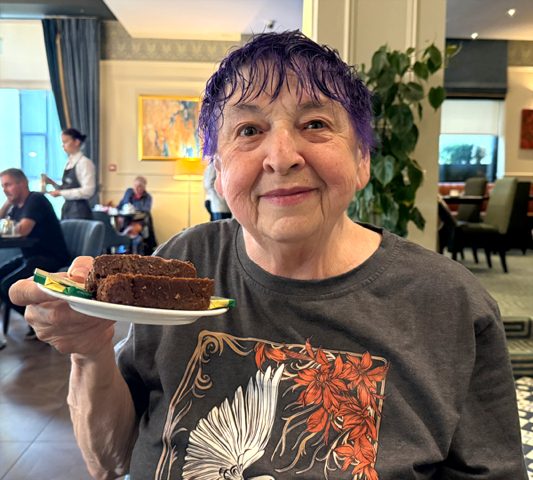
Today: Janice Jarrell is the author of emotionally rich gay romance novels about love, found family, resilience, and the lives that unfold after happily-ever-after. She published her first novel, Love’s Magic, in 2018 and has been following her characters into new stories ever since.
Before becoming a published author, Janice spent thirty years working in education and many years writing slash fan fiction. Now 82, she writes the stories she loves, creates videos and artwork to bring them to life, and continues to discover new ways to tell them.
She lives in Washington State with her best friend and editor, Cathy, and firmly believes you are never too old to find a new passion.
Facebook: https://www.facebook.com/groups/JanJarrellsReaders/
Instagram: https://www.instagram.com/gayromanceauthor/
Website: https://authorjanicejarrell.carrd.co/
Newsletter: https://janice-jarrell.kit.com/05a3e4b1a5
YouTube: https://www.youtube.com/@AuthorJaniceJarrell
Thanks so much, Janice, for joining me!
J. Scott Coatsworth: When did you know you wanted to write, and when did you discover that you were good at it?
Janice Jarrell: I think I’ve always been a storyteller, although it took me a long time to realize that meant I was a writer. I started writing seriously with fan fiction about twenty-five years ago, and that was probably when I first discovered how much I loved creating characters and giving them lives beyond the story already on the page.
As for when I discovered I was good at it—that came more gradually. Readers responded to my stories and, especially, to my characters. They cared about them. They laughed with them, hurt with them, and wanted to know what happened to them next. That meant more to me than simply being told I could write well. I realized I could make someone I had invented feel real to another person.
Eventually I found my way to writing my own gay romance novels, and that was when everything really clicked. I’d found the stories I wanted to tell: stories about men falling in love, building lives together, facing difficult things, and choosing each other again and again. I’m still telling those stories today.
JSC: What was your first published work? Tell me a little about it.
JJ: My first published novel was Love’s Magic, released in 2018. It’s the first book in my Revolutionary Heart series, and it introduced two characters who would go on to change my writing life: Colin Campbell and Joshua Abrams.
At its heart, Love’s Magic is about two men who seem very different on the surface but discover a connection neither of them expected. Colin is a successful attorney who has spent years keeping much of himself carefully protected, while Joshua is warmer and more open, but carrying wounds of his own. Their relationship challenges both of them and ultimately becomes something neither man knew he needed.
What I certainly didn’t know when I wrote it was how important Colin and Joshua would become to me, or to my readers. I thought I was writing their love story. Instead, I was beginning their life together.
Eight years later, I’m still writing about them. They’ve married, built a family, endured some extraordinarily difficult things, and grown and changed along the way. Other characters and couples have grown out of their world as well. Looking back, Love’s Magic wasn’t just my first published novel. It opened the door to a fictional world that became far larger, richer, and more enduring than I ever imagined it would.
JSC: Have you ever taken a trip to research a story? Tell me about it.
JJ: Yes! In 2025, I traveled to Ireland while I was working on Dark Justice, and that trip became an important part of the book.
I had actually written much of the Ireland portion of the story before I went, including scenes set at Ross Castle in Killarney. I’d researched it, studied photographs, and had a very clear picture of it in my mind. Then I stood there.
Being at Ross Castle made me go back and change parts of what I’d already written. Photographs can show you what a place looks like, but they can’t quite give you the feeling of standing there, the scale of it, the water and mountains surrounding it, the texture of the stone, the changing light, or simply the atmosphere of the place. Suddenly I could see Colin there in a way I hadn’t been able to before.
Ross Castle became part of a deeply emotional sequence in Dark Justice. Colin travels to Ireland alone at a point when he is struggling to find his way back to himself after a devastating trauma. Ireland, and Ross Castle in particular, becomes an important part of that journey.
I even brought home a small stone from Ross Castle, and a stone from the castle became an important symbol in the story as well.
That trip taught me something about research. You can learn an enormous amount about a place without ever setting foot there, and you can write it convincingly. But sometimes actually standing in the place you’ve already imagined changes what you thought you knew about it, and, if you’re lucky, changes the story with it.
JSC: Why did you choose to write in your particular field or genre? If you write more than one, how do you balance them?
JJ: I was fascinated by relationships between gay men long before I ever thought about writing gay romance. As I grew older and became more aware of the discrimination, rejection, and sometimes horrific violence LGBTQ+ people faced simply for loving who they loved, that fascination became something deeper.
The AIDS crisis affected me profoundly. I watched a generation of gay men endure not only a devastating disease, but far too often cruelty and indifference from the very society that should have cared about them. After that, my interest in the LGBTQ+ community, and particularly in the lives and relationships of gay men, only grew stronger.
Long before I published my first novel, I spent twenty years writing slash fan fiction. And I was writing it at a time when slash was certainly not as widely known or accepted as it is today. There was no commercial consideration involved. I wrote those stories because those were the relationships I wanted to explore and the love stories I wanted to tell.
So when I eventually began creating my own characters and writing professionally, gay romance wasn’t really a genre I chose. It was where years of writing had already led me.
I wanted to write about gay men not simply surviving hardship, but living: falling passionately in love, building families, arguing over ridiculous things, supporting one another, making mistakes, growing older together, and finding joy.
There is prejudice and hardship in some of my books, because those things exist. But I never wanted suffering to define my characters. Their love does that.
I think that’s ultimately why I’ve stayed with these stories for so many years. There is something powerful to me about giving people who were once told their love was shameful the same sweeping, emotional, unapologetic love stories that heterosexual couples have been given for generations. Those were the stories I wanted to tell long before I published my first book and they still are.
JSC: Are you a plotter or a pantser?
JJ: I think it depends somewhat on the book, but I’m definitely more plotter than pantser.
I do an enormous amount of research. Many of my books have significant legal elements, and those have to be right. If I’m writing about a criminal prosecution, a court proceeding, an investigation, or, as I am now, a political campaign, I can’t simply make up the mechanics because they’re convenient for the story. I need to know how things actually work before I can decide how my characters will move through them.
That takes time. My books aren’t written quickly, and I’ve never particularly wanted them to be. I research, plot, write, rethink, go back and research some more, and very often change what I’ve already written because I’ve learned something new.
But here’s where the pantser in me sneaks in: I plot the story, but I give my characters room to misbehave.
I may know where a scene needs to go, but I don’t always know exactly how Colin, Joshua, or one of my other characters is going to get me there. Sometimes a conversation takes a turn I hadn’t planned. Sometimes a character simply wouldn’t do what my outline says he’s supposed to do. When that happens, I listen. I’ve known these characters too long to force them into behavior that isn’t true to who they are just because it would make my plot more convenient.
So I suppose I’m a research-heavy plotter with a healthy respect for discovery. I build the road carefully, check the map, research every bridge and then occasionally one of my characters grabs the steering wheel.
JSC: What was one of the most surprising things you’ve learned in writing your books?
JJ: Honestly, almost all of it has surprised me.
I’m 82 years old, and perhaps the biggest surprise has been discovering an entirely new creative passion relatively late in my life. I published my first novel when I was 74. By then I’d already had a thirty-year career in education and retired. I wasn’t looking for another career. I found something much more fun.
And it hasn’t just been the writing.
Writing books led me into this whole creative world I never expected. I’ve learned to create and edit videos, work with images and audio, design promotional material, and use technology I probably wouldn’t have gone anywhere near otherwise. Every time I learn how to do something, I seem to discover three more things I want to learn.
I love that. I love making something that didn’t exist before, whether it’s a novel, a scene, an image, or a thirty-second video that captures exactly the emotion I wanted. The creative process itself has become one of the great joys of my life.
I’m also still amazed that, eight years after Love’s Magic, readers want to keep following Colin and Joshua through their lives. I never expected that either. Those two characters have taken me places I couldn’t possibly have imagined when I first wrote them.
Maybe that’s what has surprised me most. At 82, I’m still learning. I’m still experimenting. I’m still finding new ways to create, and I’m still getting excited when I figure out how to do something I’ve never done before.
It keeps me young. And it is one hell of a lot of fun.
JSC: What does success mean to you?
JJ: Success means something very different to me at 82 than I suspect it might have meant when I was younger.
I don’t measure it in sales. I spent thirty years working in education, retired with a good income, and I’m fortunate that I don’t need my books to pay my bills. That gives me an extraordinary kind of freedom as a writer: I can write what I love rather than trying to figure out what will sell.
I don’t measure success in reviews, either. One of the gifts of getting older is that, somewhere along the way, you can finally stop giving other people the authority to decide what you should love, what you should create, or whether you’re good enough to be doing it. I’ve had 82 years to learn that lesson, and I intend to take full advantage of it.
I write because I love to write. I write the characters I love, the relationships that fascinate me, and the stories I want to tell. I can spend an entire day wrestling with a scene, finally get it right, sit back and think, Yes. That’s them. That’s exactly what I wanted to say. To me, that’s success.
Of course I want people to read my books. I’m delighted when someone loves one of my characters as much as I do. But numbers aren’t what keep me sitting down at the keyboard and starting another story.
At this point in my life, success is having the freedom, the curiosity, and the sheer joy to keep creating.
And I’m not done yet.
JSC: Who has been your favorite character to write and why?
JJ: That one is embarrassingly easy. Colin Campbell-Abrams. Without question.
Colin first appeared in Love’s Magic, my first published novel, and I’ve been writing him ever since. When I created him, I had no idea that eight years later I would still be following his life—or that he would become the character I know better than any other I’ve written.
He can be difficult, stubborn, arrogant, funny, fiercely intelligent, maddeningly private, and extraordinarily loving. He has a tremendous capacity for taking care of everyone around him and an equally tremendous difficulty allowing anyone to take care of him. That contradiction has given me an enormous amount to explore over the years.
But what I love most about writing Colin is that he has never stopped changing.
I’ve written him falling in love with Joshua, building a marriage and a family, succeeding professionally, making mistakes, experiencing terrible loss and trauma, and finding his way back after being very nearly broken by it. Each experience changes him, but none of them turns him into somebody else. Underneath it all, he’s still Colin.
And after all these years, he can still surprise me. Sometimes I’ll be writing a scene convinced I know exactly what he’s going to say or do, and suddenly I’ll realize, No. Colin wouldn’t do that. At that point I generally surrender and let him have his way.
I sometimes joke that Colin stopped being entirely mine a long time ago. He has become so fully himself in my imagination that writing him feels less like deciding what he does and more like discovering what he does next.
Fortunately for me, he apparently isn’t finished yet.
JSC: Star Trek or Star Wars? Why?
Star Trek. No hesitation whatsoever.
I’ve loved Star Trek since the original series, and I still watch it. There is something about its fundamental optimism that has always appealed to me. The idea that humanity can actually become better, that curiosity matters, that differences don’t have to divide us, and that our future might be something worth looking forward to.
I loved it enough that I gave that love to Joshua. He’s my fellow Trekkie. When I write him watching Star Trek, that’s one of those places where there is definitely a little bit of me inside one of my characters.
And yes, I still watch the original series regularly. Give me Kirk, Spock and McCoy on the Enterprise and I’m perfectly happy.
Sorry, Star Wars. You never really had a chance.
JSC: What are you working on now, and what’s coming out next? Tell us about it!
JJ: I’m currently writing Dark Horizon, the second novel in my Unbreakable Vow series, and once again I’m following Colin Campbell-Abrams and Joshua Abrams into a part of their lives I never expected to write.
In Dark Justice, Colin survived a devastating act of violence that changed him forever. Much of that book was about trauma, survival, and his struggle to find his way back to the people and the life he loves.
Dark Horizon asks what happens after you’ve found your way back.
Colin is an attorney and prosecutor who has spent much of his career dealing with the aftermath of terrible things. Now he’s beginning to ask whether he can do something before the damage is done. When he’s approached about running for the Virginia House of Delegates, an idea he initially found almost ridiculous begins to take hold.
And Colin being Colin, once he decides to do something, he doesn’t do it halfway.
So I’m currently immersed in Virginia politics, campaign finance, election law, fundraising, campaign staffing, voter outreach, and all the machinery involved in turning an ordinary citizen into a candidate and putting his name on the ballot. I’m doing a tremendous amount of research, and I’m having a wonderful time with it.
But Dark Horizon is still, at its heart, a Colin and Joshua story. A political campaign doesn’t happen only to the candidate. It happens to the marriage, the family, and the life surrounding him. Joshua has already walked beside Colin through some extraordinarily difficult things. This time the challenge isn’t helping Colin survive. It’s making sure that, in trying to change the world around him, Colin doesn’t lose sight of the life they’ve built together.
I know where I think this story is going.
Colin may have other ideas.

And now for Janice’s latest book: Dark Justice:
Joshua believes love can bring Colin home. And even from across an ocean, Colin hears it calling.
Colin Campbell–Abrams went to Ireland carrying a weight his pack could never hold. Grief he couldn’t name. Guilt he couldn’t shake. A marriage he loved too much to destroy with the pieces of himself that remained.
Ireland didn’t heal him; it offered him the grace that allowed him to heal himself.
In green hills and strangers’ kindness. In ancient stones that remembered centuries of pain. In thirty seconds of unexpected sunlight breaking through gray skies. In the slow, stubborn work of putting one foot in front of the other until the man he used to be began to walk by his side.
The road taught him something Joshua had been trying to tell him from the very beginning: You don’t have to be unbreakable to be worthy of love.
Some journeys you walk alone, not to leave, but to learn how to come home.
Amazon | Audible
Excerpt
He laid both hands on the cool altar.
“Sarah,” he whispered. “I’m learning to make peace with what happened. I’ll always carry it—but differently now. You saved us. You saved him. I’ll spend the rest of my life honoring that.”
His breath caught. “Han, my friend, I let you down. Part of me still wants to pay for that. But now I know you’d want more for me than penance. You’d want peace.”
“Josh…” His voice cracked. “Ghrá mo chroí, I’m coming home. Not whole. Not healed. But close—close enough. I’ll trust you to see. I’ll trust you to know. I’ll trust you to take me the rest of the way.”
He pressed his forehead to the stone and felt grace wash through him—fierce and humbling, like breath after drowning.
He kissed the Ross Castle stone and left it there. Joshua’s love, traded for the peace he’d found here. A piece of his heart for the grace he’d been given.
Near his hands, he noticed shallow grooves cut into the stone—small, rough crosses, some barely more than scratches, others worn soft by rain and time. Dozens of them. Hundreds. Layered over each other until they blurred into one long, stubborn act of remembrance.
He ran his thumb along one, feeling the grit bite at his skin. Ordinary people had stood where he was standing, hearts hammering, watching the trees for soldiers and informers. Still, they’d come. Still, they knelt. Still, they’d marked this rock so the land would remember what they dared to do here.
Colin picked up a small, flat stone from the ground and hesitated. It felt foolish, presumptuous, to add his own mark to theirs. Who was he compared to the souls who had risked death for a whispered Mass?
Then he thought of Joshua’s face in the firelight. Of Sarah on his porch with her coffee mug and crooked grin. Of Hannibal, trusting him more than he trusted himself.
His hand steadied.
He pressed the makeshift chisel to the edge of the rock, where there was just enough bare surface left, and dragged it down. The stone fought him, but he kept going—short, careful strokes, his wrist shaking with effort. It wasn’t much to look at when he finished. Just a small, uneven cross tucked in among all the others.
“That’s me,” he whispered, fingertips resting on the fresh-cut lines. “That’s us. We were here. We survived.”
For the first time, the weight in his chest felt shared—spread out across centuries of fear and faith and stubborn hope, all anchored in this one, scarred stone. Now he understood why Aileen had insisted he visit this sacred place, why she had insisted he make it the last stop on his lonely pilgrimage. He wasn’t alone anymore. He stood with thousands of others who had faced their fears as he was facing his.
Near the edge of the rock, half-hidden by ivy, something caught the light—a small stone, smoky quartz veining its curve.
He brushed away the soil. Cool. Solid. Ordinary. But it felt right. Honest. Familiar. Like it belonged beside a compass and a penny.
Not a replacement.
A continuation.
He slipped it into his pocket, then looked back at the Mass Rock.
A good-bye. A vow. A prayer.
Then he turned toward the path that would take him home.