
Welcome to my weekly Author Spotlight. I’ve asked a bunch of my author friends to answer a set of interview questions, and to share their latest work.
Today: Daniel Ausema’s short stories, more than 100 of them, have appeared in places like Strange Horizons, Diabolical Plots, and Fantasy Magazine. His poetry has appeared in many of the same places, with nominations for the Rhysling and Elgin Awards. His newest collection, The Fall of the City of Bells—a novella in verse—is scheduled for release later this month. His novels include the epic fantasy Arcist Chronicles, and he’s the creator of the steampunk-fantasy Spire City series. He does sleep, but not as much as he should. He lives in Colorado and can be found online at https://danielausema.com.
Thanks so much, Daniel, for joining me!
J. Scott Coatsworth: When did you know you wanted to write, and when did you discover that you were good at it?
Daniel Ausema: I point to a few moments. One was when I used to invent and then act out stories with my younger brother. I started writing down character lists, and someone else in the family started calling them “Daniel’s books,” and I thought, “Huh, I like the sound of that.” Later I was taking a college journalism class and had to mock interview a classmate and then tell the story to the class. My partner for the exercise didn’t have a very coherent story, but I did what I could with it. I had a story that was ripe for him to simply run with…and he botched it. My first reaction was to think that I came off looking uninteresting, but then I realized that my skill wasn’t in being the most interesting but in presenting the other as worth the story.
JSC: How would you describe your writing style/genre?
DA: My branding tagline, such as it is, is “Lyrical Worlds: Stories of Strange Wonder.” To me that captures the lyricism and the imaginative secondary worlds I love to create. And I like to think I capture a sense of wonder, but it’s typically a step to the weird side from what you might expect from the old sensawunda way of doing that.
So…fantasy, highly imaginative and with a touch of poetic strangeness weaving through.
JSC: How long have you been writing?
DA: Since I was 12, based on my answer above… But as far as publishing, my first things published (apart from journalistic pieces) were a non-speculative short story and poem that came out at almost the same time in 2001. The story was about counter revolutionary forces in Latin America, betraying the people. The poem was about a mountain in Spain near where I had studied in college.
JSC: How do you approach covers for your indie stories?
DA: For the original Spire City books, they initially had a publisher. When that publisher closed, I was able to buy the rights to the images they’d used. I’ve sometimes used Unsplash to find good photos and then created the covers in GIMP. For my latest covers—for the Moth Plateau series—I wanted something that was quite obviously not AI. I looked through collections of older public domain images and came across these amazing scientific drawings of moths from 1705 and knew they were perfect for what I wanted. Bright colors on an older-looking paper background, and a whole series of them so I could make covers for each book that still were clearly part of a series. Then it was a matter of choosing complementary fonts and colors for them and creating them in GIMP.
JSC: How did you choose the topic for Riding the Moth Plateau?
DA: My first impulse came from the idea of a hawk so small that its primary food was moths and dragonflies and similar insects. For that to make evolutionary sense, I needed a place with lots of moths. Probably a swampland, I supposed. That idea sat in the back of my head for years. Then I remembered the idea when we were dealing with moths here—see, every spring/early summer here at the edge of the mountains, we get waves of miller moths that get into every gap and crevice of the house. And it occurred to me that moths didn’t have to imply swamps, but might be the high plains like where I live. I’ve always liked the Wild West as a setting, so then the story began to come together.
JSC: What secondary character would you like to explore more? Tell me about them.
DA: This is the first in a 5-novella series, and each novella has a different POV character. Including some that I had no idea about at all, when I started. So, I’ve had a chance to explore some of the secondary characters already (the fifth and final one just came out last month, with a character that was the minor-est of minor characters in the second novella but just took over the grand finale). A couple of the minor characters in this novella end up with prominent roles in each of the following titles. This first novella is a death mystery (murder-? you’ll have to read it to find out), and while our main character learns things about the dead man he’s sent to retrieve, I never dig too deep into his past. That could be interesting.
JSC: Who has been your favorite character to write and why?
DA: Probably Melle, the narrator of that final novella, because her voice just took over the story. She’s Mattie of True Grit (the book) if Mattie were transported to the strange world of my imagination. But really each of them as I wrote their story became my favorite. Rahel, the main character of the second one, was the first character I imagined for the series, and I loved creating her story. Sakehin, in the third novella, is so completely unlike me and unlike the characters I usually write about that it was fun to simply explore someone different.
JSC: They say to Write What You Know. Setting aside for a moment the fact that this is terrible advice…what do you Know?
DA: Hah, yeah, write what compels you, not what you know. But… I know working with kids. I’ve had various roles in education and education-adjacent spaces. Not to mention being a stay-at-home dad for years. I know various languages and love to learn more—but what I love to learn most is trying to understand the people and cultures that speak that language. And I know what it’s like to live on the high plains next to the mountains, as well as what it’s like to grow up among the lakes and farmlands of Michigan.
JSC: Were you a voracious reader as a child?
DA: Absolutely. I went through a Hardy Boys and a Black Stallion phase, but once I discovered fantasy, there was no going back. I remember coming across this odd, seldom mentioned book—Shadow of the Gloom World by Roger Eldridge—that had been misshelved among the little kid picture books. It was a post-apocalyptic book and far too advanced for me…yet I read it, and its imagery haunted me. Jane Yolen’s Pit Dragon trilogy was another that was shelved where I discovered it fairly young, and I both loved it and was proud of having read such big books. Robin McKinley’s The Hero and the Crown was another I read pretty young that I felt really stretched my reading ability at the time but was a favorite for years (and holds up to a more recent rereading!).
JSC: What are you working on now, and what’s coming out next? Tell us about it!
DA: With the full Moth Plateau series out, I’m between bigger projects. I’m working on getting print versions of the novellas available, and possible other formats. I’m also working on a text-based game about being a mad scientist in the same world as the Spire City and Moth Plateau stories. I’m hoping to have that read for beta testing within the next month or two, but I keep discovering extra steps I need to take before I can do that… It’s been in-progress for a couple of years, and it gives you a chance to have your own lab and design crazy inventions in the city of beetle-drawn carriages and chained spire singers.
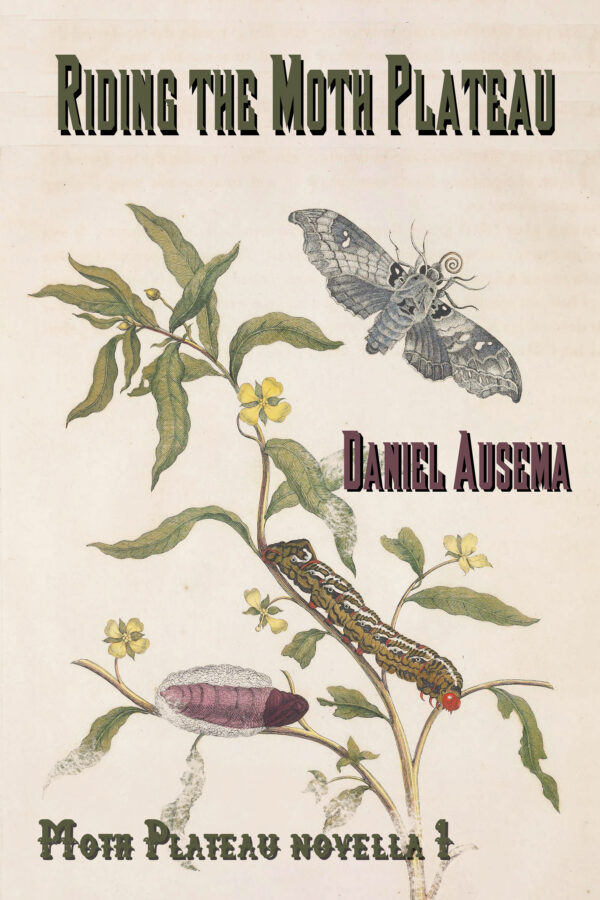
And now for Daniel’s latest book: Riding the Moth Plateau:
Rugged prairie wanderer and cattle agent, Drusk wants to be left alone to do his job. Head down, his pet hawks circling to clear the air of moths, he can take care of himself and not be bothered by others. When another agent dies on the upper plateau, reportedly of natural causes, he is sent to retrieve the body. But the upper plateau is a land of recluses and secrets, and Drusk questions more with each interaction whether he—or anyone—is safe in that land.
This new series, from the creator of the Arcist Chronicles and the Spire City series, takes readers into a strange and wild West of moths and mysteries.
Come along for a wild ride!
Series Overview: The Moth Plateau is a land of cattle drives and cowpokes, of bicycle-riding messengers and recluses hiding from their pasts, and (most of all) of moths. Swarms of moths turn the dead into mummies and the open prairies into a claustrophobic stillness.
Amazon | Universal Buy Link
Excerpt
You can always tell the new visitors to the Moth Plateau once they step outside the city. Inside Lepta, they can fake it. They strut around and look me in the eye like they belong every bit as much as I do. But once they leave the cluster of buildings that hug the edge of the plateau like a frightened toddler…no. Even before they take one step off the walkways, they’re staring at the swarms of insects, like they didn’t believe the stories they’d heard. Their arms lift to swat the moths away, their faces blanch, and they begin to sweat.
Well, I can’t see that they’re sweating from where I’m sitting beside the walkway. The moths swirl around me, parting and closing again to obscure the sight. But the fear is obvious. The sheen on their foreheads.
This group is carrying a body. A priest guides them, gesturing where to walk. He nods at me as they pass by. He isn’t a first-timer. Not a local, either—there aren’t a lot of us locals here, even with how big Lepta has grown—but he knows his way onto the paths. He shepherds them along one of the easier routes toward where I’m resting. The strange alloy of the pathway repels the moths enough for the group of visitors to keep walking. They’re still waving their hands in front of their eyes to see.
The air and the moths here on the plateau will preserve the body, mummify it. A lot of people come up here for that—bring their dead loved one, travel up the winding way to Lepta, leave the body out beyond the city for a few days while they drink away their sorrow inside. And then take the much lighter corpse back down to put in some crypt somewhere.
Or something. I don’t know. Do they prop it up in their houses? Visit it every morning before going to work? Set it up as decoration on their roofs? You got me. I’ve never been down from here, so Lepta and the massif are all I know. Wide spaces made claustrophobic by moths.
Once the group of visitors is out of sight, hidden by the swarm, I stand up, brush moths off my duster, and head in toward town. The three tiny hawks flitting around me keep the moths away until I reach the protection of the alloy walkway. They perch on my hat once we’re into town.
I am not a tall man, to stand out in a crowd. The birds draw attention, if they’re noticed. But they are not the only reason people—especially visitors like those carrying the body out onto the plateau—take note of me as I pass. I look, to them, exactly like they expect someone from the Moth Plateau to look. Rugged, wearing dusty clothes and a brimmed hat, skin browned by the weather, face a dozen days without shaving. I am the confirmation of all the stories they’ve heard and invented.
It isn’t entirely true, but that doesn’t matter. I am the set dressing, the ornamentation for their visit—seen, noted, and just as quickly forgotten. Like the peculiar rock formations they passed on the way up to the city or a lone cactus across the plain, covered in perching moths. We are the reassurance that they’ve come to the right place, the broad-stroke details they always imagined before they came.
It’s fine with me. I can be a symbol, as long as it’s just that. No strangers trying to sniff into my real, non-symbolic life. No pressure to be the person they imagine.