
Welcome to my weekly Author Spotlight. I’ve asked a bunch of my author friends to answer a set of interview questions, and to share their latest work.
Today: Peter’s first novel, The Woodcarver’s Model was released by Pride Publishing in April of 2022 and was a four time nominee in the Goodreads M/M Romance Readers’ Choice Awards.
Following the success of the first book, Pride Publishing released The Declan Hunt Mysteries series which includes Mann Hunt (nominated for a Goodreads M/M Romance Readers’ Choice Award and recently translated into German, Italian and Spanish), Hoodoo House, (also a Goodreads M/M Romance Readers’ Choice Award nominee and now available in Italian and Spanish), and The Burnt which came out in August of 2025 in English, Italian and Spanish with Entwined Publishing. The Burnt was recently nominated for a Goodreads M/M Romance Readers’ Choice Award in the Mystery/Whodunnit category. The fourth and final novel in the series – The Attercop – was released in August of 2026.
2024 also saw the release of the critically acclaimed teen novella Not Not Normal, published by Lorimer Press. This book was also nominated for a Goodreads M/M Romance Readers’ Choice Award.
Peter’s previous work was focused on writing for the stage, with award-winning productions of The Giant’s Garden, Newfoundland Mary, Bemused, and The Detective Disappears being produced across the country.
All of his novels are proudly set in Canada and are filled with humour and heart.
He spent many years working in palaeontology in remote locations including the Canadian Rockies, the Northwest Territories and Nunavut.
Peter lives in Toronto, Canada with his partner of twenty-five years, Scott White. At heart, he is an incredible romantic.
Thanks so much, Peter, for joining me!
J. Scott Coatsworth: How long have you been writing?
Peter E. Fenton: I’ve been writing now for thirty years starting with short stories and poetry then moving into plays and musicals before settling into long-form prose in 2021 (starting with The Woodcarver’s Model which came out in 2022).
JSC: Are you a full-time or part-time writer? How does that affect your writing?
PEF: I think of myself as a full-time writer because that’s all I do now. I transitioned into writing after retiring from my job of fourty-two years. For the most part, I’m a morning writer with a splash of evening writing when my partner escapes my insanity and heads off to work. That’s not to say I don’t work through the rest of the day. Notes are taken, scenes sketched out, and strange characters created, sometimes on the run. I often find myself huddling in one of the lookouts on the 500 metre long Prince Edward Viaduct that crosses the Don Valley in Toronto, tapping away endlessly on my phone’s note app. The best ideas always come to me when I go for a stroll.
JSC: How would you describe your writing style/genre?
PEF: The Declan Hunt Mysteries are multiple POV queer detective stories with an interwoven, evolving relationship between the two main characters. I chose multiple POVs because, in a mystery novel, I love to see to see things through the eyes of both the hunter and the prey.
JSC: Do you ever base your characters on real people? If so, what are the pitfalls you’ve run into by doing so?
PEF: I have named many of my characters after friends and family. On a few occasions I have had contests where the winner had a character named after them. In both cases I had their permission to do so. I usually chose do-no-harm characters (definitely for the contest winners) and I let everyone know that the character will bear no resemblance to them in physical appearance or behaviour.
A friend once found a particularly despicable character that bore the same first name as him and was a bit taken aback (although his partner found it quite amusing). I have become very cautious now about making that mistake.
The only time I have specifically based a character on a specific person, with all his flaws, was my youth novella Not Not Normal. In this book the protagonist, Jordan, with all of his flaws and challenges, was based on me…although I don’t recall giving myself permission to do so.
JSC: What was the hardest part of writing your most recent book, The Attercop?
PEF: Making sure that I wrapped up all of the story lines for the lead characters, all while trying not to contradict what was laid out in the previous novels. The books were written slowly over three years, so it was a lot of time between the first and last book. I still left a window of opportunity for more books to be written in this series, but the primary arc of the story was resolved.
JSC: We know what you like to write, but what do you like to read in your free time, and why?
PEF: I read a lot of different genres. I enjoy mysteries (the Rebus series by Ian Rankin is a favourite). Of course I read a lot of books by authors in the M/M genre both to support their work and also to learn from their writing. But if I was tucked away on an island vacation, what I enjoy most are books for youth and young adult readers…books filled with imagination, memorable characters and often, a sense of hope.
JSC: As a child, what did you want to be when you grew up?
PEF: My great dream was to become an archaeologist. As a kid, I lived for that. I guess I was always interested in solving puzzles. I ended up with a specialist degree in anthropology (my physical anthropology professor said that I was happiest when I had ancient human remains in my hands). Ultimately I landed a job in invertebrate palaeontology. Same puzzles, but a much older subject matter.
JSC: Tell me one thing hardly anyone knows about you?
PEF: I have a half-billion year old fossil species named after me: the extinct radiodont arthropod Mosura fentoni.
JSC: If you could choose three authors to invite for a dinner party, who would they be and why?
PEF: Ian Rankin, Lauren Wolk, and Margaret Atwood. Ian Rankin, because he’s an incredible mystery writer; Lauren Wolk because she writes such compelling youth novels (which I adore); and Margaret Atwood because she’s one of the greatest living writers of our time and seems to be able to predict the future with terrifying accuracy.
JSC: What are you working on now, and what’s coming out next? Tell us about it!
PEF: Once The Attercop is out, the focus for the next year will be getting more of my books into translations and audio books. I will be self-publishing a book called 30 poems from my younger years as a personal project, and there is a story set in northern Canada that will be edited and be included in an anthology in 2027. Those projects are already written. As for what is keeping me occupied in the writing room, I am in the early stages of writing on a new detective series with new characters and a different tone which is set in my home town of Toronto in Canada.
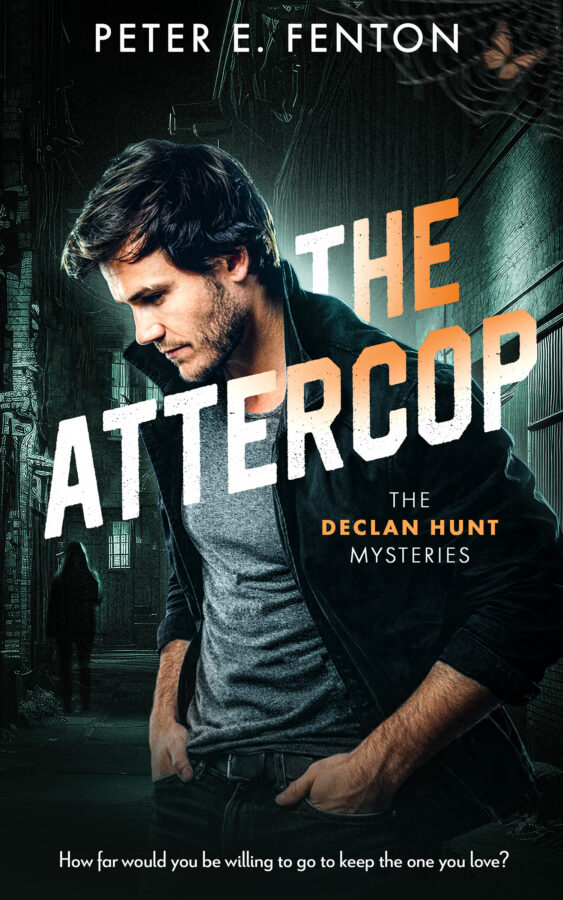
And now for Peter’s latest book: Attercop:
How far would you be willing to go to keep the one you love?
Charlie Watts has found the perfect partner in Declan Hunt, and he hopes that they can spend the rest of their lives together. But when your boss is sexy and talented, sometimes you’re not the only one who wants to tie him down.
The Attercop, a clever adversary who is good with disguises, starts to spin a web of lies and deceit to get Declan for his very own. And as the two detectives look into a break-in where nothing is taken, and a random beating at a gay bar, their perfect partnership begins to unravel.
Will Charlie be able to stop the worst from happening, or will The Attercop get his wish and take Declan away from Charlie forever?
Amazon | Barnes & Noble
Excerpt
The late-July sunset painted the Calgary horizon with radiating bands of yellow, orange, amber and purple. He watched as the colours began to shift, and the darkness devoured the light. He found momentary inner peace observing the death of the day from his home in the sky.
He thought back to the afternoon when he had attended the condominium’s open house last year. The fourteenth-floor penthouse suite had been priced far above any of the other units in the development. He had gently reminded the unseasoned sales rep that superstitious buyers were savvy enough to notice that the numbers of the floors jumped from twelve to fourteen, meaning the suite he wanted was actually on the thirteenth floor. He’d smiled, then continued, that given the current market of slowing condo sales, wary buyers weren’t going to jump at the chance of picking up the overpriced unit. The sales rep could let the suite linger on the market, which would only call into question the initial asking price, or accept his modestly reduced offer. He was persuasive when he wanted to be, but just to hedge his bets he had talked to other perspective buyers at the open house and expressed his concerns about rumours that the builder had cut corners by using substandard rebar in the construction. He’d gotten his price and now the place was his, a refuge from life’s stresses.
He stood naked in front of the floor-to-ceiling windows, took a sip of his vodka, and stared out at his view—which, he acknowledged, was courtesy of his father who had essentially paid for it by having the decency of dying and leaving him a healthy inheritance.
The money had come as a great surprise because his father had heartily disapproved of him. Not so much because he was gay—although his father had loudly carped that a queer son wouldn’t produce another generation to carry on the family name. No, the expansive parent–child chasm had grown out of his father’s determination that his son was weak and useless, just like his mother, who had run off with another man. He’d never met the other guy, but he had, after all, only been five when it had happened.
His father had further declared that his son “had no gumption” and that if he didn’t prove he could make something out of himself by the time he was thirty, he would be cut out of his father’s will. In the end it didn’t matter. Fate had intervened and the old man had died just a few days before his son’s thirtieth birthday.
The year surrounding that event had been filled with unexpected surprises, such as the reappearance of his mother. She’d said that she’d been watching him from afar and wanted to help him establish himself. She had used her connections to land him a decent job in a small, financially stable firm. He was all set for success. It looked as if he was going to prove his father wrong after all. But no matter how hard he tried, things never seemed to go his way, especially in his search for love, because nobody really liked him. Every time he thought he’d found ‘Mr Right’, it always turned into ‘Mr Right-Now-But-Never-Again’.
At first, he couldn’t understand why. He was good-looking and intelligent. He was certain he was good in bed. His major flaw, from what he could see, was that he fell in love too easily, and that was something he couldn’t help. He was a giver and, to those he fell for, he gave everything. He became infatuated with them. And what did he get in return? Another view of the curb he’d been kicked to—again and again.
Well, he’d had it with that. He was done with being ‘Mr Nice Guy’. He took another swig of his drink and lay on the carpet by the window. A small spider made its way along the floor and crawled up his naked body, past his carefully groomed pubic hair, slowly working its way toward his navel. He put his hand on his stomach to block its path, but it simply crawled up onto his fingers. Nothing was going to stand in its way.
He held the spider up to his face and watched its tiny legs working in precise synchronicity as it traversed the back of his hand. It was persistent. It had gumption.
Many people would have thrown the spider to the floor or squashed it where it stood. Spiders were repulsive to most—things to be feared, to be reviled. But he liked spiders. They were patient and meticulous and never gave up. Even when people tore down their webs, they started again. He needed to become more like a spider. He needed to decide what he wanted and go after it. And if anyone stood in his way, he would show them what a spider could do. Like the ones in his favourite book The Hobbit, he would ensnare his enemies, keep what he wanted, and make the others feel pain and suffering. ’Attercop’ was what the character Bilbo had called the spiders. A term that meant ‘poison head’ in old English. It was intended to be an insult, but he liked the description.
He gently lifted his hand to his face. It was time for he and the spider to become as one. He set it on the end of his tongue and swallowed. He knew what his purpose was. It was time to become The Attercop, spinning his web. And soon, he would pounce. He would snare the thing that he wanted most and if anyone got in his way, he’d suck them dry and discard their empty husks. And there was one person in particular he yearned to snare. Declan Hunt would be his.