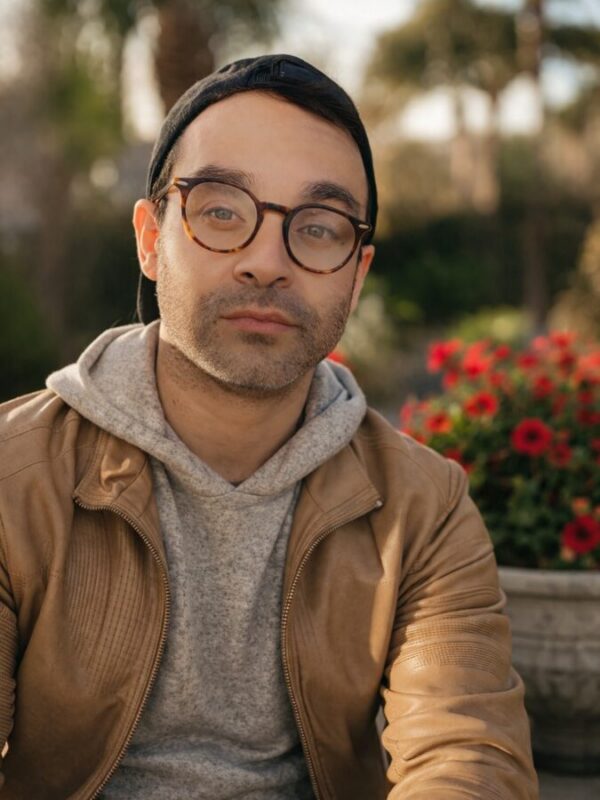
Welcome to my weekly Author Spotlight. I’ve asked a bunch of my author friends to answer a set of interview questions, and to share their latest work.
Today: Will Haddad writes about the moment love stops being safe. Set against deserts, mountains, fault lines, and other places where survival gets complicated, his novels follow queer characters forced to confront everything they thought they could outrun. He is the author of the Tectonic series.
Website: https://willhaddad.com
Instagram: https://www.instagram.com/officialwilllove/
YouTube: https://www.youtube.com/@Willloveauthor
Thanks so much, Will, for joining me!
J. Scott Coatsworth: When did you know you wanted to write, and when did you discover that you were good at it?
Will Haddad: I first started dabbling in writing in 1996, when I was fifteen and Scream came out. I was fascinated by how fresh and unexpected it felt, and it made me want to try writing a screenplay of my own. During my sophomore year, my film teacher connected me with screenwriter David Goyer, and I was able to send him some of my work for critique. It was about as good as you would expect from a fifteen-year-old, but the experience stayed with me, and so did the desire to write. As for when I discovered I was good at it, I think that is still to be determined. We’ll see how people respond to the Tectonic series.
JSC: How would you describe your writing style/genre?
WH: I write character-driven LGBTQ+ romantic suspense with the scale and urgency of a disaster thriller. I’m drawn to intimate relationships placed under extreme pressure. The danger matters, but I’m most interested in what fear, grief, loyalty, and survival reveal about people when they no longer have time to hide from one another.
JSC: Are there underrepresented groups or ideas featured in Tectonic: Foreshock? If so, discuss them.
WH: The Tectonic series places queer men at the center of a survival story without making their sexuality the source of the danger. Carter and Christian are sons, brothers, partners, and members of a larger family trying to survive a catastrophe. Their relationship is central, but they are allowed to be as flawed, heroic, frightened, and complicated as anyone else in the story.
JSC: What inspired you to write this particular story? What were the challenges in bringing it to life?
WH: The larger story began with a simple emotional premise: two men with unfinished history encounter each other again at the worst possible moment. Foreshock gave me the chance to show why that history still has such power over them. The challenge was compressing years of love into a short novella without making it feel like a summary. A few scenes, photographs, and remembered moments had to carry the weight of an entire shared life.
JSC: Tell us something we don’t know about your heroes. What makes them tick?
WH: Carter believes love is something you choose, declare, and build a future around. Christian loves just as deeply, but responsibility has taught him to see sacrifice as an act of love. He fears that choosing Carter could cost Carter the life he deserves. Their conflict comes from two incompatible ideas of what it means to protect someone, rather than from an absence of love.
JSC: Who has been your favorite character to write and why?
WH: Alton has probably been my favorite character to write because he could easily have existed only as an obstacle between Carter and Christian. Instead, he is kind, funny, emotionally intelligent, and genuinely liked by everyone around him—including Christian. He has done nothing to deserve being caught inside their unfinished history. Writing him meant refusing to treat the current boyfriend as disposable simply because readers may want the former couple back together. Alton has his own hopes, insecurities, and capacity for love, which makes the relationships surrounding him far more complicated and honest.
JSC: What was the hardest part of writing this book?
WH: The proposal scene was the hardest. I needed readers to feel the full force of Carter’s humiliation and heartbreak without turning Christian into a villain. Carter does not yet know everything Christian is carrying, so the reader has to remain inside that uncertainty with him. I also wanted the novella to feel emotionally complete while leaving the deeper questions unresolved for Tectonic.
JSC: Has a piece of writing ever “haunted” you? Has your own writing haunted you? What does that mean to you?
WH: The Bridges Are Ash haunts me in a way none of my other writing does because so many of its scenes come from things I lived. Sometimes a line or a small detail returns me to that time with such clarity that I can see the room, hear the voices, and remember exactly how everything felt. When I finally come back to the present, I have usually cried. Writing those moments gave them shape, but it did not make them easier to revisit. They still feel less like scenes I created than memories I placed on the page.
JSC: Do you read your book reviews? How do you deal with bad or good ones?
WH: I read them, and I’m a baby about them. I’m the same way with my cooking and decorating—I always want to impress everyone, which is obviously impossible. A good review can make my entire day. When someone doesn’t connect with the book, I take it harder than I probably should. I’m still learning how to listen for anything useful without letting one person’s reaction outweigh everyone else’s.
JSC: What are you working on now, and what’s coming out next? Tell us about it!
WH: I’m preparing for the release of Tectonic, the full-length novel that follows Foreshock, on August 31, 2026. Carter and Christian unexpectedly encounter each other on a trail outside Flagstaff just as an earthquake cuts off the mountain and Sunset Crater begins to erupt. Carter becomes trapped with Christian, his current boyfriend Alton, and a group of injured hikers. Every mile toward safety forces Carter and Christian to confront the history they have spent years avoiding. It is a story about survival, grief, family, and whether love can endure the damage people cause while trying to protect each other.
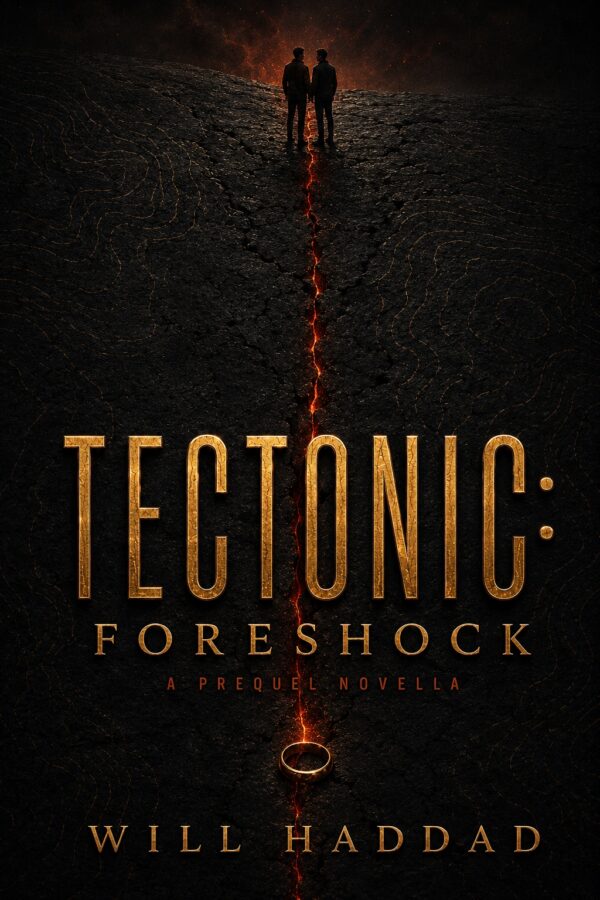
And now for Will’s new book: Tectonic: Foreshock:
Carter White has spent years imagining the life he and Christian Reyes will build together. On the day Carter graduates from college, he believes he is finally ready to make that future official.
Christian’s answer changes everything.
Reeling from the end of his first love, Carter must pack away the life he expected and leave Flagstaff for law school in Boston. Every photograph, familiar road, and unfinished goodbye forces him to confront what Christian meant to him—and whether leaving Arizona can ever be the same as moving on.
Tectonic: Foreshock is a tender prequel about first love, heartbreak, and the moment one life fractures before another begins.
Amazon
Excerpt
The first hint of sunrise hadn’t reached the San Francisco Peaks when Carter pulled into the Mount Elden trailhead.
The parking lot was nearly empty, just a dusty Tacoma with a bike rack and an old Subaru tucked beneath the pines. The air carried the Flagstaff chill that always surprised people who thought Arizona meant nothing but desert. Carter stepped out, zipped his fleece to his chin, and drew in a long breath scented with damp earth and ponderosa pine.
This was his favorite time to hike.
The world still belonged to the people willing to wake up before it.
His phone buzzed.
Christian: Two minutes.
Carter looked toward the empty entrance to the parking lot.
You said that five minutes ago.
Three dots appeared almost immediately.
Traffic.
Carter laughed under his breath.
There is literally one road.
Exactly.
He slipped his phone back into his pocket.
Headlights swept across the trees.
A battered silver Bronco rolled into the lot and parked beside him.
Christian climbed out wearing faded hiking boots, dark jeans, and a charcoal hoodie over a black T-shirt. His beanie hid most of his dark hair, though a few strands had escaped across his forehead.
He carried two coffee cups.
“I come bearing peace offerings.”
Carter folded his arms. “You’re late.”
“I brought coffee.”
“That wasn’t the charge.”
Christian held out one of the cups.
Carter took it.
“You remembered.”
“You get the same thing every time.”
“That doesn’t mean you have to remember.”
Christian’s mouth tilted. “Vanilla cold brew. Two pumps. No foam.”
Carter took a sip. “You’re forgiven.”
“I figured.”
Their fingers brushed around the cup.
Christian looked tired. Faint shadows sat beneath his eyes.
“You slept?”
“I closed my eyes.”
“For how long?”
Christian adjusted the strap of his backpack. “Enough.”
“You have a test tomorrow.”
“I’ll study tonight.”
“You said that yesterday.”
“And I meant it yesterday.”
Carter shook his head.
Christian reached over and brushed something from his sleeve.
“What?”
“Pine needle.”
“There wasn’t a pine needle.”
Christian flicked his fingers toward the parking lot.
Carter stepped closer. “Liar.”
Christian’s hand settled at his waist beneath the open fleece.
Carter set his coffee on the hood of the car and slipped both hands into the front pocket of Christian’s hoodie, gathering the warmth there.
“Cold already?” Christian asked.
“It’s twenty-eight degrees.”
“It’s thirty-four.”
“I like my number better.”
Their foreheads touched.
The parking lot stayed quiet around them. Wind moved lazily through the pines, and somewhere farther down the mountain, a raven called once before disappearing into the trees.
Christian kissed him.
It was brief and familiar, the kind of kiss that asked for nothing beyond the moment.
When they separated, Carter straightened Christian’s beanie.
“That’s going to fall off in five minutes.”
“It builds character.”
“It ruins your hair.”
Christian pulled the beanie off and ran a hand through it.
“Better?”
Carter smoothed one stubborn piece away from his forehead.
“There.”
Christian smiled. “You always fix it.”