
Welcome to my weekly Author Spotlight. I’ve asked a bunch of my author friends to answer a set of interview questions, and to share their latest work.
Today: Clayton Graham is an award winning Australian author of several science fiction novels and short story collections. He has won many book awards including Author’s Show ‘50 great writers you should be reading’, Readers’ Favorite International Award finalist, and Book Excellence Awards finalist.
A background in aerospace engineering encourages his thoughts to surge skyward and well beyond our universe. He delights in creating strange new worlds and the intriguing peoples that inhabit them, and loves to take readers on a journey to meet other universal travellers.
Clayton loves animals, including well-behaved pets, and all the natural world. He would likely love well-behaved alien animals, too!
If you like, you can check his novels out, download a free story, and read his many blogs on our mysterious universe at his web site: https://claytongraham.com.au
You can also connect on social media:
https://www.facebook.com/claytongrahamauthor
https://www.instagram.com/claytongrahamscifi
https://bsky.app/profile/claytongrahamscifi.bsky.social
J. Scott Coatsworth: When did you know you wanted to write, and when did you discover that you were good at it?
Clayton Graham: I have written short stories from around the age of twenty, but only started to seriously publish after I approached retirement. I hope I am good at it, but that question should really be answered by readers. However, I do think I have excellent plots and characters, especially for those who question our role in the universe and where humankind may or may not be heading.
How we would react to, and interact with, otherworldly beings, has always fascinated me. It probably fascinates the extraterrestrials, too! Everything flows from that. As a timely afterthought: any kind of upcoming government disclosure would be a great literary catalyst!
JSC: If you could sit down with one other writer, living or dead, who would you choose, and what would you ask them?
CG: My interest in science fiction came naturally from an early age. HG Wells and Isaac Asimov were authors I read avidly. They are totally different, including an obvious generation gap, but are both capable of ‘stretching the mind’ albeit in different directions. I would certainly ask them where there ideas came from, if they believed in the supernatural [the natural as yet unexplained], if they believed in a universal creator, and what their favorite foods and drinks were.
I am sure their answers would be poles apart, but that’s the beauty of being human, is it not?
JSC: Are you a plotter or a pantser?
CG: A bit of both. I definitely need a well structured opening to my novels, but then it is likely that the characters in the pages will take control and take the action forward. Quite often they will deal with ‘what ifs’ just like I do, and quite often make the wrong decision [just like I do], but that’s life.
I dearly love my treasured characters, whether good or bad, and trust them to lead the way through the oncoming pages.
JSC: What are your least favorite parts of publishing?
CG: Without wishing to join a bandwagon that must be suffering from wheel buckle, there can be no doubt that Marketing your books is the most difficult part of publishing, especially for Indie authors.
Sure, there are a lot of sources out there, but there are very few that are genre specific. That is why Liminal Fiction is such a blessing.
I have also noticed this year, thanks to the influx of AI, that there are an ever-increasing multitude of scammers to be avoided at all costs.
JSC: What book is currently on your bedside table?
CG: Sitting on my bedside table at the moment is ‘Never Flinch’ by Stephen King. It’s about a serial killer with rather a strange motive. The plot is compiled with a twin narrative that certainly keeps you guessing.
King and Dean Koontz are probably my two favorite authors as I am seldom disappointed with their books.
About This Book:
JSC: How did you choose the topic for this book?
CG: First and foremost, the stories are blessed with the engaging characters from the Milijun Trilogy, a previously released First Contact Sci-Fi series. I wanted to see what happened in their futures, and if they would survive everything that the universe throws at them.
Also, the events are set in the Milijun Universe and are created using that vast place and its cosmic array as a catalyst.
I wanted to test the protagonists. There’s a chase for revenge that stretches from rust-red dunes to our blue marble planet, a search for hope under stars that are likely not real, and a thrilling standoff on a planet ravaged by war.
The novellas are entirely independent in plot, and can be described as standalone. They are three separate tales with family links, connections to the otherworldly [from the human perspective], and conclusions that most readers will revel in.
JSC: What secondary character would you like to explore more? Tell me about them.
CG: Jason Sinclair, the First Seen of the Milijun Trilogy, was fourteen years of age when he was taken by the Rbuzen to serve as a progenitor for alien-human collaboration and joint universal exploration. Although he features predominantly in the Milijun Trilogy, his role in Those Alien Skies is secondary.
Through the years, Jason developed into the leader of a clandestine Martian base. He also takes part in universal expeditions aboard the incredible Rbuzen interdimensional motherships. The prospect of future adventures is tantalizing to say the least!
JSC: Choose a passage from your writing. Tell me about the backstory of this moment. How you came up with it, how it changed from start to end.
CG: Laura stood there for a full minute, her flashlight catching dust motes in the air. What she really wanted was some evidence of Nomi’s long-ago presence; some unwritten signature that she may have unwittingly left behind. Nomi was, after all, the keeper of the secrets of Milijun. Had no doubt used them to push for alien collaboration on Mars. And she had succeeded, for the Martian base was named after her.
Laura recalled her remembrance plaque on Mars:
In commemoration of the founding of Millison
Colonel Norma Millison, known as Nomi
Gracious founder and leader
May she find peace among the stars
Came to us: 2160 Left us: 2256
This short passage is from the beginning of ‘Aliens Whispers: Conflict and Communion’, the third book in the Milijun Trilogy, where Laura Sinclair, the mother of First Seen, Jason Sinclair, has returned to Earth in search of what happened to her long-lost partner.
The planet she revisits is vastly different from the one she left. Never in her wildest nightmares would she have envisaged the trials and tribulations ahead. She must ground her thoughts, and focus on who she is, and what she has become.
JSC: What are some day jobs that you have held? If any of them impacted your writing, share an example.
CG: My career was predominantly in Aerospace in the area of Design and Research. It involved substantial global travel and experiencing different cultures.
Although there is no direct relation between my work and my writing, working in my chosen field did require an inquiring mind and the development of problem solving techniques. Maybe the building of literary universes grew from that!
JSC: What are you working on now, and what’s coming out next? Tell us about it!
CG: My current Work in Progress is as yet untitled, although it’s almost almost half complete. The principal protagonist is a mild-mannered schoolteacher who gets shanghaied by a ruthless military to help solve certain inexplicable alien contact events.
It is a story set in the near future, a story influenced by the expectations of UAP disclosure, and plagued by the possibilities of what alien interactions may actually mean for humankind.
Governmental intrigue and betrayal are never far away, and just what can be publicly revealed is always open to question. This is the raw brutality of disclosure! Whatever could go wrong!!
Thanks so much, AUTHORNAME, for joining me!
INTERVIEW
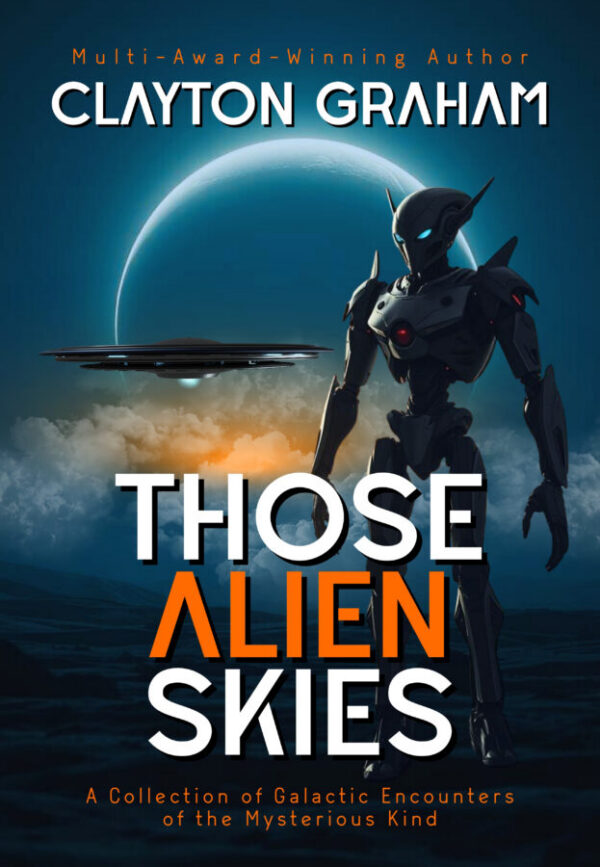
And now for AUTHORNAME new book: Those Alien Skies:
- LITERARY TITAN BOOK AWARD GLOBAL BOOK AWARD SILVER
- BOOKSHELF TOP TEN FINALIST READERS’ FAVORITE 3 FIVE STARS
- INCIPERE SECOND PLACE AWARD
★★★★★ “This is a masterclass in visionary science fiction. Highly recommended.” – The International Review of Books
★★★★★ “Those Alien Skies shows how Graham deserves a position among science fiction’s most thoughtful voices because he offers readers thrilling adventure and profound philosophical reflection alike.” – The Book Review Directory
★★★★★ “This is sci-fi that lingers. Raw and thoughtful and achingly alive. Read it. You won’t come back the same.” – Author Píaras Cíonnaoíth
Thrilling stories of cut and thrust, search and destroy, and love and sacrifice between worlds and across galaxies.
Get ready for an atmospheric wild ride through alternate universes and beyond. Embark upon three captivating journeys littered with treacherous paths, intergalactic intrigue, and heart-stopping suspense.
Perfect for both long-time science fiction fans and newcomers who enjoy bold ideas and thought-provoking adventures, Those Alien Skies is smart and suspenseful, offering a welcome challenge to the limits of imagination and expectations. It is a timely reminder that the universe still hold secrets waiting to be found.
You won’t want to miss out on Those Alien Skies. With its enchanting characters, mind-bending plots, and gripping suspense, this three novella collection is sure to leave you yearning for more.
Amazon | Universal Buy Link
Excerpt
Stella Browning is standing on an unfamiliar beach at arm’s length from the wreck of a huge alien submarine. She laments the death of her robotic companion, Orx.
***
Stella held the laser in her hand, deciding on a modified inscription:
“Orx, a partner forever remembered.
And all others who lie within this beach.
AD 2291.”
That was the Earth year she had left Hina. Maybe it had changed, maybe it hadn’t. Perhaps it didn’t matter. It was the best she could do, and the least she could do. She inscribed the words carefully, tongue clenched between her teeth, a picture of concentration. She did not put her name. She did not fully belong here yet.
Stella turned her head to glance at her words, to check them out, to read them once more—and received the shock of her life. Below her own words, others were forming as if by magic.
Stunned, she watched in fascination and awe, tasting the words one by one.
“I love you not only for what you are, but for what I am when I am with you.” —Elizabeth Barrett Browning, AD 1806–1861, Earth
Her eyes, brimming with tears, ranged the sky. She was familiar with the words in the statue room on Mars, words dedicated to Nomi, Laura Sinclair, and the First Seen, Jason Sinclair. They were Rbuzen-etched words. And so were these. In the heavens above, there was no sign of a sailship, but there must have been one hiding somewhere. How did the Rbuzen know of Earth poetry? How could they possibly know? And to find her namesake from over four hundred years ago!
Tears now completely flooded her eyes. Underneath their majesty and aloofness, their knowledge of the cosmos, these aliens had hearts that would put any human to shame.
***
The above excerpt from Those Alien Skies describes a moment, just after a devastating battle, when Stella Browning, damaged by conflict, finds the beginnings of peace on an alien planet she barely knows. It is a brief time of reflection as, thankful to be alive, she ponders what her future will be, or, indeed, if she even has one.