
Welcome to my weekly Author Spotlight. I’ve asked a bunch of my author friends to answer a set of interview questions, and to share their latest work.
Today: David S. Pederson has written multiple mysteries, all featuring LGBTQ+ characters. He’s a two-time finalist for the Lambda Literary Award for Gay Mysteries. His second book, Death Goes Overboard, was selected by the GLBT Round Table of the American Library Association for the 2018 Over the Rainbow book list.
In 2025, he was asked to write a short mystery to be included in an anthology, “Crime Ink: Iconic — Where Queer Icons Meet Killer Stories”, a collection of crime stories inspired by queer icons.
He focuses on historical fiction because he wants to show that LGBTQ+ people have always been here, just sometimes in the shadows, and often doing extraordinary things, like solving murders.
Website: www.davidspederson.com
Facebook: https://www.facebook.com/DavidSPedersonWriter
Thanks so much, David, for joining me!
J. Scott Coatsworth: If you could sit down with one other writer, living or dead, who would you choose, and what would you ask them?
David S. Pederson: Good question. I would have to say Agatha Christie, because she was a huge inspiration to me, and still is. I’d love to ask her things most people don’t know about her, like what was her favorite food, how did she enjoy spending her time when she wasn’t writing, and what’s the real story behind her famed disappearance?
JSC: Are there underrepresented groups or ideas featured in your book? If so, discuss them.
DSP: All of my books feature LGBTQ characters, and I chose to set most of them in the past because I feel it’s important to show the history of what LGBTQ+ people have gone through. Did you know it wasn’t until 1987 that homosexuality was finally completely removed from the Diagnostic and Statistical Manual of Mental Disorders? And it was still considered illegal in many parts of the U.S. until 2003. Illinois was the first state to decriminalize it, but that wasn’t until 1962. Prior to that, and still to this day in some countries, people could be arrested, jailed, and even put to death just for loving someone of the same gender. Lobotomies and castration were common, too. Just think about what Alan Turing, a hero of World War II and a code breaker, suffered. This is history I don’t want people to forget, or if they don’t know, I want them to learn.
JSC: What’s the funniest or creepiest thing you’ve come across while researching for one of your stories?
DSP: Most of my stories are historical fiction, so I do a great deal of research on the past, involving the 1930s, 40s, and 50s, depending. For one of my books, “Death Foretold”, I had a character eating a candy bar, which led me to the question of what kind of candy bars were eaten in the 1940s? That particular mystery was set in Milwaukee, WI, and I discovered that there was a candy bar called Chicken Dinner that was hugely popular until 1962, when production ended. Despite its rather bizarre name, it consisted of chocolate with crisp, crunchy peanuts.
JSC: If you had to write an entire story without either action or without dialogue, which would you choose and how would it go?
DSP: I’m all about dialogue, so for me it would be a story without action. In fact, I begin most of my books by writing groups of dialogue, and then piecing it together like a puzzle. I find dialogue can tell an entire story, as if you were sitting in a café, listening to two strangers carry on a conversation, perhaps heated, intimate, and personal.
JSC: What is a weird, hyper-specific detail you know about one of your characters that is completely irrelevant to the story?
DSP: Actually, it’s a weird detail about pretty much all of my protagonists. They all like their underwear, and I tend to mention it in some off-hand way in most every book.
JSC: As a child, what did you want to be when you grew up?
DSP: An actor, first and foremost, and a singer, but I soon discovered I only had a modicum of talent for both and lacked the fortitude to improve. And for a while, I wanted to be a veterinarian because I love all animals and am a vegetarian, but I faint at the sight of blood, lol, so I shelved that idea.
JSC: What was the first book that made you cry?
DSP: Charlotte’s Web. I remember sobbing uncontrollably over that as a child. I was inconsolable, much to my mother’s chagrin. I think that was one thing that led me down the path of being a vegetarian, animal rights activist, and animal lover.
JSC: What other artistic pursuits (if any) do you indulge in apart from writing?
DSP: Well, I dabble in painting, and I still love to act and sing, and do so during readings and book events. For every book launch I’ve had, I’ve written a song parody that I perform that ties into the book.
JSC: Tell me about an event that absolutely changed your life. Did it change your writing too? How?
DSP: I was the victim of a Gay-bashing when I was thirty years old. Four males, I hesitate to call them men, jumped me as I was leaving a bar and walking to my car. I was put in the hospital, and ended up with a plastic plate in my head. The recovery was long and slow, and to entertain myself, I started writing again, something I had shelved years earlier as my life had gotten busy with other pursuits. That led to writing my first mystery, “Death Comes Darkly”, which was subsequently published by Bold Strokes Books.
JSC: What are you working on now, and what’s coming out next? Tell us about it!
DSP: I’m working on a new mystery entitled “Fall Into Murder”. It’s a Halloween mystery, my first, and it takes place in La Crosse, WI in 1939. The two protagonists, a young couple, are Gay and closeted out of the necessity of the time. They move to a two-bedroom apartment in a small, six-unit building, posing as roommates, and are subsequently drawn into a murder.
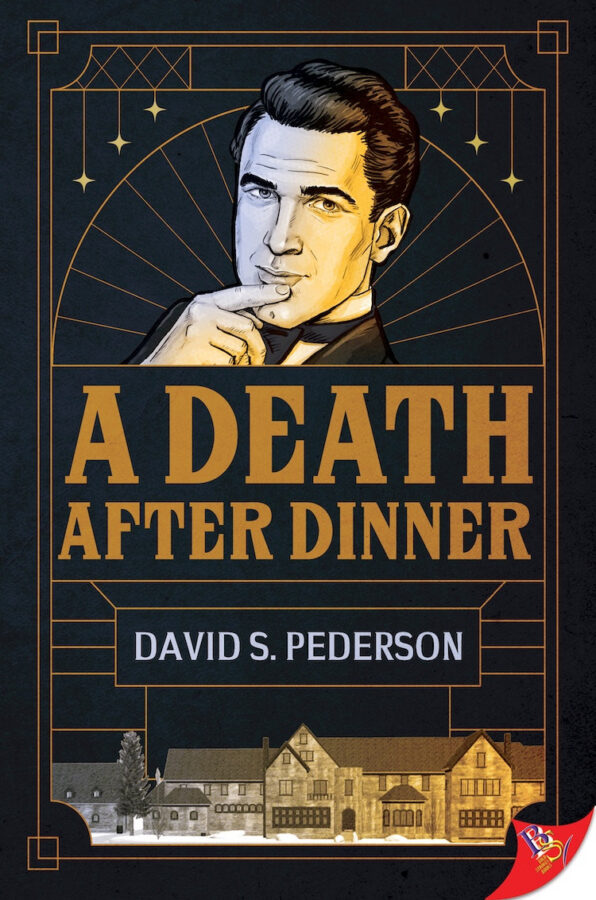
And now for David’s latest book: A Death After Dinner:
England, 1951. Black tie, French champagne, and a pinch of poison.
Sir Roderick and Lady Endicott have planned a pleasant weekend for their family and friends at their sprawling country estate. Scandal is the last thing on the menu, but tempers simmer as difficult and disliked decorator Oscar Maxwell joins the party. By the time he suddenly drops dead after dinner, no one is exactly sorry.
As the local inspector determines poisoning, suspicion falls on a charming and secretive man close to Lady Endicott’s brother, Professor Liam Cuthbert. Liam must wade through a tangle of secrets, rivalries, and outright loathing to get to the truth. Someone at the table is a killer, and if Liam doesn’t find them soon, an innocent man could be sent to the gallows.
Publisher | Amazon | Barnes & Noble | Bookshop.org | Walmart
Excerpt
Chapter One
Saturday morning, December 8, 1951
The dining room at Chatterfield Park, an old country estate in England, owned By Sir Roderick Endicott and his wife, Lady Olivia Endicott
The body of Oscar Maxwell lay on a cold slab in the Birmingham city morgue, while just twenty minutes away at Chatterfield Park, breakfast was served as usual, and everyone took the same places they’d had the night before at dinner. Except, of course, for Oscar Maxwell. Nivens, the butler, served plates of sausages, eggs, biscuits, kippers, buttered beans, and fried bread, along with tea and coffee, while those present pondered what, exactly, had happened to Mr. Maxwell. Some silently rejoiced that he was gone, while others weren’t exactly silent about it.
“Well, this looks delicious, I must say,” Sir Roderick said in an attempt to be cheery, despite the previous evening.
“Yes, it most certainly does,” Lady Olivia Endicott said with a forced smile.
“I’m afraid I’m not in the least hungry,” Margo Saxby said.
“Oh, dear, my darling daughter,” Olivia said. “I feel terrible we invited you and Wade here this weekend, considering all that’s happened. You look exhausted.”
The young woman stifled a yawn and gazed at Olivia. “It’s all right, Mother, but it’s true, I didn’t sleep at all well last night.”
“Nor did I,” Margo’s husband, Wade Saxby, said, looking at her. “But mainly because you were tossing and turning, my love.”
Margo smiled wanly at him. “Sorry, darling.”
“It’s fine,” he said as he patted her hand. “I’m happy just being next to you, asleep or awake.”
“Spoken like a true newlywed,” Sir Roderick said to his son-in-law.
Margot blushed. “It will be our first anniversary next month, Father,” she said.
“I remember. A January wedding, just after the winter ball.”
“It was a lovely affair,” Olivia said. “It’s hard to believe it’s been almost a year.”
“Harry and I have been married nine years. Nine long years,” Ruth Grundle said.
“Ten next March,” her husband Harry said.
“I’m well aware,” Ruth said, glancing at Olivia. “And I wish we hadn’t been invited here this weekend either, Lady Endicott.”
“I wouldn’t exactly say you were invited, Mrs. Grundle,” Lark Allard said. “Your husband is, was, Oscar’s assistant in his decorating firm, and as such, he was here assisting Oscar in making plans for the winter ball. You chose to tag along.”
“And we all know, Miss Allard,” Ruth said, “that you could have chosen to stay home, too. You knew Oscar was going to be here, yet you decided to come anyway.”
“Why shouldn’t I?” Lark said. “Roderick and Olivia are like an uncle and aunt to me and have taken care of me since I was a child.”
“Yes, after your mother died suddenly of a heart ailment no one knew she had. Rather peculiar,” Ruth said.
“How do you know about that?” Lark said. “Oh, of course, Oscar. He never could keep a secret.”
“He mentioned it, yes, along with a few other tidbits, including your volatile temper,” Ruth said.
“Oscar is—was—despicable and clearly not to be trusted.”
“And yet here you are, spending the weekend when you knew he would be here.”
“Just because Oscar broke off our relationship to be with you, Mrs. Grundle, doesn’t mean I should deprive myself of a relaxing visit here.”
“Hardly relaxing, as it turned out,” Professor Liam Cuthbert said. “I must say I wish now I hadn’t been invited this weekend, either. And I certainly wish I hadn’t brought Bruce along with me. No offense, Olivia, my dear sister. Or Roderick.”
“I understand, Liam,” Olivia said. “I was so looking forward to seeing you, but this whole mess has ruined everything. I admit, though, that having you here has been a comfort to me.” She looked at Bruce. “How are you holding up, Mr. Babcock?”
Bruce sighed. “All right, I suppose, Lady Endicott. I’m afraid I didn’t sleep well either, though. I was fretting, tossing, and turning all night.”
“You’ll feel better once the inspector rings up with some news, my friend,” Liam Cuthbert said.
“Maybe.”
“Come now, Bruce,” Liam said. “You’ve nothing to worry about. I’m sure they’ll determine Oscar died of a heart attack or something.”
“But they said Mr. Maxwell could have been poisoned.”
“Be that as it may, they said it could have been a heart issue, too. You’ve done nothing wrong.”
“I know, Liam, but I do hope the inspector knows that.”
Liam smiled warmly at the young man, wishing he could embrace him. “He will, he will, don’t worry.”
“The inspector seemed a bit of a dolt to me,” Lark Allard said.
“I thought he was very thorough,” Wade said.
“Too thorough. He kept asking me the same thing over and over, like he couldn’t remember what I’d said from one moment to the next.”
“That’s actually common police procedure, Lark,” Liam said.
“He was trying to trip you up, probably because he’s suspicious of you,” Ruth said, “and I can’t say I blame him. If it turns out Oscar was poisoned, I’m sure you’ll be his number one suspect.”
“I can’t say I’m surprised you’d say that, Mrs. Grundle,” Lark said.
“Pity I’m so predictable, but then, so are you.” Ruth groaned. “Ugh, Oscar dying like that was horrible. I didn’t sleep a wink, either.”
Harry scoffed. “Not true, you were snoring like a freight train, and that kept me awake.” He had an angular face, with a long, narrow nose; small, dark, round eyes; and large, protruding ears.
Ruth glared at him. “I beg your pardon. I do not snore, Harry. And how could I sleep, even with those tablets Lady Endicott gave me? I’m simply devastated about Oscar. I can’t believe he’s gone, and just like that,” she said, snapping her long, slim fingers.
“I’m sure you are devastated, dear wife,” Harry said. “After all, who’s going to buy you expensive gowns now?”
“You’re jealous, Harry. You always have been, and it’s not becoming,” Ruth said.
“What’s not becoming, my dear, is my wife indiscreetly sleeping with my employer.”
Ruth scowled. “You don’t know what you’re talking about, nor does Miss Allard. She’s jealous, too. Neither of you really knew him. Not really. Oscar was kind to me, that’s all. I know he was rude and insulting, but he only did that because deep down he was very insecure. He lashed out as a defense.”
“I worked for him for many years,” Harry said. “He only lashed out at those who couldn’t defend themselves—store clerks, employees, waiters, maids, children, and anyone else he didn’t consider an equal. He was cruel.”
Ruth shook her head and scowled. “He wasn’t, not really. I thought last night, after it happened, well, that youunderstood at least, Harry. But now, in the light of day, you’re back to being the same way you were, and it’s not pleasant.”
“Maybe if I’d been able to get some sleep last night, I’d be more understanding and pleasant,” he said, scowling back at her.
“I slept quite well,” Lark Allard said, sweeping away a strand of her thick, red hair that had come loose from her chignon. “And I’m not jealous, Mrs. Grundle, but I am hungry.”
“I’m hungry too, Lark,” Professor Liam Cuthbert said, clearing his throat. “So, why don’t we all eat? The eggs and other things are getting cold, and this is far better fare than I usually have in the mornings at my house.”
“I concur,” Sir Roderick said. “Enough bickering and small talk. We can’t change what happened here last night, and it won’t do to starve ourselves.” He picked up a fork and dug in, cleaning his plate in short order, as did Professor Liam Cuthbert, Miss Allard, and Harry Grundle. Everyone else mostly picked at their food.
When Sir Roderick had finished, he patted his stomach and nodded toward Nivens, who was standing at attention by the door to the pantry.
“Another fine meal, and an excellent start to another cold, rather gray winter’s day. Go tell Mrs. Hatch to give my compliments to Mrs. Marks and the kitchen staff.”
“Yes, sir,” the butler said, stepping through the doorway and into the pantry to deliver the message.
“That was indeed most excellent, Sir Roderick,” Harry said, sitting back with a satisfied look.
“How can you eat like that at a time like this?” Ruth said.
“Why shouldn’t I eat? Oscar Maxwell being dead doesn’t bother me in the least.”
“I second that,” Lark said. “I know he was your cousin, Uncle Roderick, but he was a dreadful man.”
“I can understand your feelings, Lark, considering,” Sir Roderick said.
“Indeed. As can I,” Harry said. “And I’m sure everyone can understand mine.”
“You’re heartless, Harry,” Ruth said. “And so are you, Miss Allard.”
Harry shook his head. “I think it is you, my love, who is heartless, the way you treat me. I gave this a great deal of thought last night, while you were keeping me awake with your snoring. And you should eat up this weekend. With Oscar gone, I’m probably out of a job, and he’s certainly not going to be taking you out for fancy meals behind my back anymore.”
“As I said earlier, you’ve no idea what went on between Oscar and me,” Ruth said.
“I’ve a pretty good idea, and so does everyone else, unfortunately. As I said, neither of you was discreet,” Harry said.
“You certainly weren’t,” Lark said. “You say Oscar was just being kind to you, but you and Oscar threw your relationship in everyone’s faces yesterday.”
“You’re just upset that he ended things with you, Miss Allard, and favored me,” Ruth said. “You said so yourself.”
“I never said I was upset, and I don’t blame you for taking up with him, Mrs. Grundle. I’m well aware Oscar was alluring and charming, almost hypnotic in his appeal. And certainly, he had his softer moments, usually when it was just him and one other person, and especially if he wanted something from them. I fell under his spell for a time, too, obviously. But believe me, it’s better for everyone that he’s dead.”
“Did you tell the inspector that?” Ruth said.
“He didn’t ask.”
“Um, what will happen to Oscar’s decorating and design business, Mr. Grundle?” Olivia said.
Harry glanced at Lady Endicott. “He mentioned once or twice he was going to leave it to me if something should happen to him, but I don’t know if he ever put that in writing. He had no living family except for Sir Roderick here, and I was his only employee. Perhaps you and Sir Roderick will inherit it.”
“Yes, well, that all remains to be seen, of course,” Sir Roderick said. “If that does prove to be the case, certainly we’d keep you on or perhaps sell it to you. I’ve no interest in running a decorating and design firm in London, or anywhere else, for that matter.”
“I wouldn’t mind,” Olivia said. “I think I’ve a good eye for that sort of thing.”
“You do have good taste, Lady Endicott,” Harry said.
“Be that as it may, what do you mean, Olivia?” Sir Roderick said. “You’re an Endicott. Lady Endicott, my wife. We do not run any other businesses except the estate.”
Olivia stared down the long table at her husband. “Frankly, Roderick, I don’t see why I shouldn’t or couldn’t. You run the estate along with Mr. Bottoms.”
“Eoin Bottoms has been the estate manager here for years, and he does an excellent job.”
“I agree, and you help him. For me, every day here at Chatterfield Park is pretty much the same as the previous one. I receive visits from the other ladies, pay visits to them, oversee Mrs. Hatch, approve the daily menus, write letters, read letters, and organize dinner parties and gatherings. I also read books, knit, take my daily constitutional around the property, and paint, though I admit I’m not very good at the latter. It all gets to be rather dull, especially now that Margo is married and out of the house. The only exciting thing I’ve done lately is learn to shoot.”
“And that was over my protests. Shooting is not ladylike. Perhaps you could try needlepoint or flower arranging or writing poetry or something.”
“Something dull, you mean.”
“Something feminine is what I mean,” Sir Roderick said. “It’s out of the question for you to work outside the house in a business.”
“It’s not out of the question, Roderick,” Olivia said.
“I agree,” Lark said. “Aunt Olivia is smart and capable. She could accomplish most anything she set her mind to. Most women could if men didn’t hold them back.”
“I don’t recall asking for your opinion, Lark.”
“You didn’t, but I gave it to you anyway.”
“As you always seem to do.”
“Because it’s the right thing to do. You don’t like women being independent. You didn’t approve when I moved out of Chatterfield Park a couple of years ago and went to London to pursue my music, but I did it anyway because it was the right thing to do, too.”
Sir Roderick raised a bushy brow. “Was it? The city was a mess with all the rebuilding from the war and clearing out the bombed-out buildings. Noise, dirt, and crowds, everywhere. Even now, six years after V-E Day, things are a mess.”
“I didn’t mind, and I still don’t mind. The grit and the spirit of London are exciting. The people are determined and resilient.”
“The people, indeed. From what I hear, you’ve been flitting about with all sorts of men in London, none of whom I would describe as gentlemen or suitable suitors. And that incident with your roommate, Irene what’s her name, that ended with the police being called. She seemed undesirable to me from the start, and she certainly proved it. And then for you to take up with Oscar Maxwell shortly after that. I mean really, Lark,” Sir Roderick said. “And what on earth did you need a roommate for, anyway? You’ve just a one-bedroom flat, and your monthly allowance more than covers your expenses.”
“You and Aunt Olivia have been good to me since you took me in as an orphan when I was ten, but I’m not the same as your daughter.” Lark glanced briefly at Margo—“No offense, Margo”—and then back at Sir Roderick. “I can take care of myself, for better or worse. And whom I flit about with, as you call it, or choose to have as a roommate, is hardly your concern.”
“It is when it reflects badly on this house, young lady.”
“On you, you mean. But I’m not an Endicott, I’m an Allard, so you needn’t worry. And your wife taking on a decorating business, or any business, wouldn’t reflect badly on you, either. Quite the opposite, actually. It would show you’re open-minded and progressive, which you claim to be. What is it you’ve been touting all year? ‘After all, this is 1951.’ ”
“Don’t mock me.”
“Well, right now it’s a moot point, anyway, as we don’t know if Oscar had a will or any kind of directives concerning the business,” Olivia said. “I will agree that if we acquired Maxwell Designs, we would certainly keep Mr. Grundle on.” She looked over at Harry. “In my opinion, you have a better eye for decorating than Oscar did.”
“Thank you, Lady Endicott,” Harry said. “I’m glad someone appreciates my input.”
“Honestly, Harry,” Ruth said, “Oscar had style and flair. Your design ideas are pedestrian at best.”
“Personally, I think Mr. Maxwell’s designs were far too bold and erratic,” Lark said.
“There you go again, Miss Allard, putting in your two shillings’ worth when it wasn’t asked for,” Ruth said. “As I said before, you’re bitter over him dumping you.”
“I am not bitter. And you’re clearly still in Oscar’s grasp, but it shall pass now that he’s dead. Amazing, really, how he could summon someone from across the room without so much as a word or a gesture, and how he could get a woman to do anything by just staring at her. Oscar could undress a woman without even a touch and make her not feel ashamed about it in the least.” Lark turned to Mr. Grundle. “You can’t really blame your wife, you know. I know of no other man who possesses the powers Oscar had.”
“I’m aware Oscar was a womanizer and that he had a way about him with the ladies,” Harry said. “As his assistant in the shop, I saw more than my fair share of women come and go over the years. He was a snake.”
“Naturally, you would say that,” Ruth said. “But if you didn’t like him, why didn’t you just quit?”
“The job itself was adequate, I suppose. I could put up with Oscar.”
“And complain about him to me every night.”
“I could put up with him until he set his sights on you, Ruth. I knew it was a temporary fling, but it still stung. It was degrading.”
“Yet you didn’t do anything about it.”
“Because I wasn’t absolutely certain until recently, though I had my suspicions.”
Ruth shook her head. “No, you didn’t do anything about it because you’re not qualified to be anything else but his assistant. You’re unskilled and uneducated, so you turned a blind eye. Oscar did you a favor keeping you on.”
“Wouldn’t I laugh if I ended up owning the shop? If he really did leave it to me, as he said he would? What would you do then, Ruth?” Harry said.
“I’d laugh, too, or I’d cry because you’d run it into the ground. You’re thirty-five years old. You barely make enough to pay the rent on our flat, much less take me to dinner or buy me nice clothes. Oscar was two years younger than you, and he owned a successful design firm. He kept you on because of me, you know.”
“That’s enough out of you, dear wife. Oscar’s dead now, don’t forget.”
“I’ll never forget it. Never. And I’ll never forget how chuffed you are about it.”
“I’m hardly the only one,” Harry said. “Certainly, Miss Allard isn’t crying in her tea.”
“Of course she’s not. We all know why, too,” Ruth said. “Including the inspector, no doubt. I wonder if he knows about your mother, Miss Allard.”
“Leave my late mother out of this, Mrs. Grundle. I doubt anyone at this table is particularly broken up about his death except you. And I seriously wonder about you,” Lark said.
“What’s that supposed to mean?” Ruth said.
“It’s obvious to me what she means,” Harry said. “You seem to be one of the few who slept soundly last night, despite your protests to the contrary. And you knew Oscar was showing signs of growing tired of you. You meant nothing to him, you know. To him, you were a mere distraction, another plaything he was getting bored with and would soon discard, but you’re still my wife, and I’m still your husband. That’s why I did nothing. I was biding my time until he tossed you aside.”
Ruth swept a strand of her inky black hair away from her face and laughed. “Oscar was bored with me? Again, you don’t know what you’re talking about.”
“I believe I do. And let’s not forget, Ruth, how he humiliated you at the dinner table last night. You were livid.”
“May I say,” Liam said, clearing his throat once more, “that perhaps this conversation is better suited to your bedroom or somewhere else more private?”
“Why?” Harry said. “It’s not like I’m the only one who hated Oscar.”
“Be that as it may,” Sir Roderick said, “Liam is right. If you two wish to continue to quarrel, perhaps you should do so upstairs, Mr. Grundle.”
At that moment, Nivens entered once more from the butler’s pantry. “Pardon me, Sir Roderick, but there’s a telephone call for you.”
“Ah, that will be Inspector Littleton, no doubt. Thank you, Nivens, I shall take it in my study.” He got up, dropped his white linen napkin on his empty plate, and left as hurriedly as his gout-riddled foot would allow.
“Now what do the rest of us do?” Wade Saxby said.
“Since we’re all finished eating, why don’t we retire to the grand salon or the drawing room or something?” Liam said.
“Yes, once Roderick returns. For now, I think we should wait here,” Olivia said.
“Hopefully, he won’t be too long,” Margo said. “The sight of this food on my plate is nauseating me.”
“I’m so sorry, my daughter. You definitely look peaked. Nivens, why don’t you go ahead and clear?” Olivia said. “I believe everyone is finished.”
“Yes, madam.”
“Darling, why don’t you go lie down?” Wade said. “Your mother’s right, you’re pale, and you really do look tired. I can let you know what the inspector said.”
Margo smiled softly. “Thank you, my love, but I’m fine, and I’m also curious.” She turned her attention to Professor Cuthbert. “Uncle Liam, I do hope you’ll entertain us later with one of your poems or stories.”
“I’m glad you find them entertaining, Margo. And I might be persuaded, depending.”
“Perhaps I could play one of the pieces I’ve been working on for all of you later,” Lark said.
“Certainly, Lark. I always love your music, and we could all use a few distractions at the moment,” Margo said.
Nivens finished clearing, and the eight people around the table now sat in silence, attempts at small talk falling flat, until at last, Sir Roderick came back. “Ah, good, you’re all still here,” he said. “Sorry, but that took a bit longer than I anticipated.” He sat down on his chair with a huff. “Damned gout. It’s a long walk from here to my study. We should have a telephone installed in the dining room, Olivia.”
“We’ll add that to the list. And drink your water, dear. Dr. Pennypat said that would help your gout.”
“Yes, yes, I know. Bah, water. It will rust your innards.”
“As you so often say.”
“That American decorator we met on a crossing years ago used to say that,” Sir Roderick said.
“I remember. Walter Wingate, from Arizona. He was rather unscrupulous and uncouth, yet you two seemed to hit it off.”
“I found him amusing, that’s all.”
“I’m sure he was hilarious, but don’t keep us in suspense, Roderick. What did the inspector have to say?” Liam said.
“Hmm? Oh, sorry. I’m just trying to think of what to say to you all. The inspector asked me not to mention anything until he gets here, but obviously, you all know he was on the telephone,” Sir Roderick said, stroking his mustache thoughtfully.
“So, he is coming back today?” Liam asked.
“Blimey, I’ve said too much, haven’t I?” Sir Roderick said, taking a drink of water. “Well, yes, I’m afraid so.”
“Good Lord, Roderick. Out with the rest of it, then,” Liam said. “Since he’s coming back here, we know it’s not good news. What exactly did he tell you?”
“Well, I suppose I’ve already let the cat out of the bag.”
“Ugh, I hate that expression,” Liam said. “Cats should never be in bags.”
“It’s merely a figure of speech,” Sir Roderick said.
“I know, but I don’t care for it.”
“Be that as it may, the inspector told me the autopsy showed that it was death by poison.”
“Can’t say I’m surprised,” Lark said. “Only a matter of time until someone bumped him off.”
“Somehow I just knew it wasn’t heart disease,” Ruth said. “Oscar was the picture of health. Much like your mother was, I hear, Miss Allard, before she suddenly died.”
“Surely you’re joking about the poison, sir,” Wade Saxby said as Margo gasped and covered her mouth. She looked like she might be violently ill.
“I’m afraid I’m not joking, Wade. Arsenic traces were found in Oscar’s body and in the glass that he’d been drinking from in the billiards room.”
“Oh, no,” Bruce said, looking ill himself.
“What about the brandy decanter?” Harry said. “The inspector took that in for testing, also.”
“That was clean, nothing but regular brandy.”
“And the cigarettes?” Liam said.
“He said there was nothing unusual about them,” Sir Roderick said. “The used butt and the unsmoked ones had not been tampered with.”
“Why did he test Oscar’s cigarettes?” Harry said. “Is it because I’m the one who filled his case and fetched them for him like a good dog? Because the inspector suspected me of poisoning them?”
“If Mr. Maxwell was intentionally poisoned, and apparently he was, everyone’s a suspect, like it or not, Mr. Grundle,” Liam said. “No need to get your knickers in a twist.”
“Oh, it doesn’t bother me. I actually find it amusing,” Harry said with a smirk on his little mouse face.
“That’s because you’re off the hook, Mr. Grundle,” Bruce Babcock said. “The cigarettes were fine.”
Olivia looked troubled. “So, the inspector thinks Oscar was murdered?”
“He didn’t say in so many words, my dear, but that was certainly the impression I got. An accidental poisoning seems highly unlikely.”
“Of course he was murdered. Why are you all so shocked?” Lark said. “It was bound to happen. He made a lot of enemies over the years—jealous husbands, angry women, dissatisfied customers, clerks, waiters, you name it.”
Ruth narrowed her dark eyes. “Angry women, Miss Allard? That fits you to a T.”
“Stop insinuating that I had something to do with Oscar or with my mother’s death, Mrs. Grundle. Those who cast stones. Besides, I mentioned jealous husbands, too.”
Ruth pivoted toward Harry. “That’s true, and it makes sense. Did you have a hand in this, Harry? Somehow, I know you did.”
Harry grinned wickedly. “Didn’t you hear Mr. Babcock, my love? The cigarettes were normal. I’m off the hook.”
“I don’t believe anyone’s off the hook yet, Mr. Grundle,” Liam said, “including myself.”
“You’re right about that,” Sir Roderick said, looking at his watch. “The inspector will be here in roughly twenty minutes, and he wants to question all of us who were present last night, including you, Nivens.”
Chapter Two
Saturday morning, December 8, 1951
The drawing room at Chatterfield Park
Inspector Littleton arrived at Chatterfield Park at twenty past ten, along with Constable Harkum, a handsome young policeman. Paulson showed them into the drawing room per Sir Roderick’s instructions. As for Sir Roderick, he and the others, including Nivens, had retired to the library to wait until they were summoned, one by one, like naughty children to the headmaster’s office.
Sir Roderick was first, followed by Lady Endicott, then Wade Saxby, and Margo Saxby, who had indeed vomited up what little breakfast she had eaten and was feeling much better. She was followed by Lark Allard, Harry Grundle, and then Ruth. Professor Liam Cuthbert was questioned after Ruth, and next, Nivens. Constable Harkum came for Bruce Babcock about a quarter after one. He ushered him politely down the corridor to the well-appointed drawing room and opened the door. Inspector Littleton was seated at the writing desk, which had been pulled out away from the wall. A side chair had been placed in front of it.
“Mr. Bruce Babcock, Inspector,” Constable Harkum said, closing the door behind the two of them and standing off to the side.
Bruce looked about nervously. “You wanted to see me next, sir?”
“I did indeed. Sorry to keep you waiting.”
“It’s fine, I don’t mind being the last.”
“Yes, though I may have further questions for some of the others, depending.”
“Depending on what, Inspector?”
“On what you have to say, among other things. Have a seat there,” Inspector Littleton said, pointing with his pencil to the small chair opposite him at the desk.
“All right,” Bruce said, walking over with some trepidation. He hiked up his trousers and sat down on the little chair, crossing his legs and gripping the edges of the seat cushion.
“Comfortable?”
“Hmm? Oh, yes, I suppose so, sir. Thank you.”
“Would you like some water or something?”
“No, thank you,” Bruce said, swallowing several times. In truth, he could have used some water, as his lips felt dry and his throat parched, but he wanted to get this over with as quickly as possible.
“Suit yourself. Now then, as you know, Mr. Oscar Maxwell died in the billiards room last night here at Chatterfield Park, and it appears death was the result of poisoning, at least according to the autopsy. I intend to find out what exactly happened.”
“I didn’t do anything, sir, I swear,” Bruce Babcock said.
“Yes, well, that’s what I want to determine. I’m not in the habit of taking anyone’s word for things, of course.”
“Should I call a solicitor?”
“If you wish to have a solicitor, you can certainly engage one, but I’m only making inquiries of everyone present last night. No one has been charged yet. Do you understand?”
Bruce wiped the sweat from his brow with the handkerchief Professor Liam Cuthbert had given him just days prior. He looked pale and worried. “Yes, sir, I understand. What kind of inquiries are you making, exactly?”
“General inquiries, standard procedure. I know I spoke with you and a few of the others very briefly last night and got a short statement, but now I’d like to get some more detailed information. Would you please state your full name again, along with your age and occupation?”
“Oh, certainly. I can do that. My name is Bruce Bryan Babcock. That’s Bryan with a ‘y,’ sir. I don’t believe I mentioned that last evening. I’m twenty-seven, and I’m a writer.”
“And what is your relationship to the deceased?” the inspector said, scribbling in his notebook, which lay open upon the desktop.
“My relation to Mr. Maxwell? I guess I didn’t have one, sir.”
“Don’t be daft. What I mean is, how did you know the man?”
“That’s just it, Inspector. I didn’t know him. I only met him last evening, right before dinner.”
“What do you mean?”
“I mean, sir, that I actually only met everyone in the house yesterday. That is, except for Professor Cuthbert. He brought me here as his valet.”
“His valet? You don’t particularly look like a valet. And you mentioned earlier that you’re a writer.”
“Yes, well, you see, I think that my being his valet was the professor’s way of having a giraffe on his brother-in-law, Sir Roderick. A bit of the pulling of the leg.”
The inspector raised a bushy eyebrow. “Seems an odd joke to me, but after questioning Professor Cuthbert last night and this afternoon, it does seem to fit his character.”
“Yes, sir. He’s a bit of a character all right, but a good chap. Solid.”
“Thank you for your testimonial, Mr. Babcock, though I like to draw my own conclusions. Now then, what were you doing at the time the deceased passed away?”
“As I told you last night, sir, I was playing billiards with Sir Roderick, Mr. Saxby, and Professor Cuthbert, or rather, we’d just finished a game.”
“Yes, you were in the room when it happened.”
“That’s right. Mr. Maxwell sat in a chair and watched us play, as did Mr. Grundle. And then, well, he died. Mr. Maxwell, I mean.”
“Correct. I’m not accusing you, Mr. Babcock, but I must say you could be considered a strong suspect.”
Bruce swallowed several more times. “You mean because I’m the one who served him the drink you think was poisoned?”
“Er, yes, I was told that was you last evening. Traces of arsenic were indeed found in Mr. Maxwell’s glass, which had only your and his fingerprints on it. You poured that drink and handed him the glass, isn’t that correct?”
“Yes, yes, sir, that’s correct.”
“Hmm. I’m not jumping to conclusions at this point, but there are some things that don’t seem to add up, and other things that appear peculiar. Therefore, I’d like to gather some more information from you and the others. You’ve no objection, I assume?”
“I guess not, Inspector.”
“Fine. Now then, do you have any identification?”
“Identification?”
“That’s right. Your identity card.”
“Oh. Actually no, I’m afraid I don’t, sir.”
“What about a driver’s license, fishing license, or ration card? I need something that can prove you are who you say you are.”
Bruce swallowed nervously. “No, sir, I don’t have any of those.”
The inspector raised his bushy brow again and rubbed his gray eyes. “That’s curious. Per the National Registration Act of 1939, all Britons are required to carry their identity cards at all times.”
“Yes, sir, I know. It’s just that I don’t drive, you see, or fish much at all, and up until recently, I’d been staying with my parents. I left my identity and ration cards at their house. My departure from them was sudden.”
“Curiouser. And you say you had never met anyone in this household, including the deceased, prior to yesterday?”
“Except for Professor Cuthbert, sir, as I mentioned earlier.”
“Right. And when did you meet him for the first time?”
“This Tuesday last.”
The inspector set his pencil down and raised both brows now, causing his searching gray eyes to grow large. “Only four days ago?”
Bruce swallowed again but maintained eye contact. “That’s correct, sir.”
“Hmph, so after only four days, he decided to bring you along with him for the weekend to meet his sister, Lady Endicott, and his brother-in-law, Sir Roderick, and have you pretend to be his valet?”
“I know it sounds silly…”
“It sounds preposterous. How did you come to meet the professor?”
“Well, I answered a newspaper advertisement he placed regarding a room for rent. I’ve been staying at the Munyon Arms Public House in London, but as I believe I mentioned, I’m a writer, and I needed a quieter place. The Munyon Arms was noisy until the wee hours nearly every night.”
The inspector jotted the name of the establishment into his notebook. “Munyon Arms Public House, got it. Yes, you’ve told me you’re a writer a few times now, as well as a pretend valet. What have you written?”
“Well, nothing yet, sir. I should say, I suppose, that I want to be a writer. That’s why I came to London, mostly.”
“Hmm. And where did you come from? Where were you before this Munyon place?”
“Southampton, sir. I’d been clerking in my father’s hardware store there. I only arrived in London ten days ago or so.”
“And you made a hasty departure from your family, yes, so you said. What is your father’s name and the name of his store, Mr. Babcock?”
“His name is Robert, sir, Robert Babcock. The store is the Imperial Hardware on Grover Street.”
“All right.” The inspector made another note and then looked at the policeman standing by the door. “Harkum, send in Professor Liam Cuthbert again.”
“Yes, sir.”
The inspector looked back at Bruce. “I’ll want to know more about why you departed Southampton in such a hurry that you left your identity and ration cards there, but for now, I want to know more about how you ended up here this weekend.”
“I can explain that, sir,” Bruce said, “with Professor Cuthbert’s help.”
“As I thought, which is why I’ve sent for him.”
There was a knock on the door, and then Constable Harkum brought Cuthbert in. “Professor Liam Cuthbert, Inspector,” he said.
“Fine, thank you, Harkum. Come in, Professor. Pull up that other chair there and have a seat.”
“Yes, sir.” Cuthbert walked over to them, slid out the chair next to Bruce’s, hiked up his trousers, and sat. They exchanged glances. “You all right, then, Bruce?”
Bruce nodded. “Yes, I think so.”
“Good,” the professor said, looking at Inspector Littleton. “What’s all this about? We’ve all been pacing the library while you call us in here to the drawing room one by one, some of us repeatedly.”
“Yes, well, sorry to keep you all waiting, but I find it pays to question people individually.”
“But you’ve already questioned me, Inspector, both last night and today. In fact, you have questioned everyone in the house already this afternoon.”
“Can’t be helped, sir. When one person says something of interest, that leads me back to someone else, and after speaking with several individuals, I most definitely wanted to speak to Mr. Babcock, and after speaking with him, I wished to speak with you once more. Mr. Babcock, if that is his real name, is a person of interest.”
“What do you mean if that’s his real name?”
“He wasn’t able to provide any identification.”
“Well, I can vouch for him. His name is Bruce Babcock. And why is he a person of interest? He’s done nothing wrong.”
Inspector Littleton shook his head. “I was told last evening that he’s the one who poured and served the drinks in the billiards room, and he admitted it a few moments ago.”
“What of it?” Liam said. “He only poured the brandies because Nivens was busy elsewhere, and Mr. Grundle was out of the room. Sir Roderick asked him to.”
“Yes, I’m aware, but sometimes one seizes an opportunity, you know.”
“No, I don’t know. Bruce didn’t seize anything.”
“That’s right, I didn’t,” Bruce said. “I swear.”
“Yes, well, hopefully I’ll know more once I finish my inquiries.”
“On what authority exactly are you here, if you don’t mind my asking?” Liam said.
“Chatterfield Park is in the jurisdiction of Birmingham, which is where I’m stationed. It’s a twenty-five-minute drive or so from here.”
“I’ve driven it in less. Have you been an inspector long?” Liam said, studying the man across the desk. He was in his late fifties, heavyset and clean-shaven, with thin lips and a Roman nose that looked like it could smell blood from twenty paces.
“Why, I’ve been on the force thirty-two years, sir.”
“I thought as much from the looks of you, and I mean that as a sincere compliment. You’re a keen fellow, so surely you must realize this could all be completely innocent. The arsenic could have been administered accidentally somehow,” Liam said.
“Naturally, that’s a possibility, Professor Cuthbert, but as I said, we’re exploring other options, too. And I’m a curious fellow.”
“Curiosity comes with the job, I imagine,” Professor Cuthbert said. “Just as I’m curious as to when we can all eat lunch. It’s well after one, you know. The maids brought in cucumber sandwiches to the library a while ago, but they weren’t very filling. At this rate, it will be tea time before we’re finished.”
“This shouldn’t take too much longer,” Inspector Littleton said, tapping his pencil on the desk.
“Good, not that I’m very hungry, but I know some of the others are. So, in an effort to move things along, tell me, what are you most curious about this afternoon, Inspector? Besides who killed Oscar Maxwell.”
“Well, for one thing, I’ll have you know that I haven’t even had a cucumber sandwich, and I am hungry, but for another thing, I’m curious as to how Mr. Babcock came to be here this weekend in the first place. He tells me that he only met you this past Tuesday when he answered a newspaper advertisement you’d placed for a room to let.”
“That’s correct.”
“And you agreed to rent him said room?”
“I did.”
“After checking his references?”
“No, sir, I didn’t feel the need.”
“Really? You didn’t even bother to check with”—the inspector consulted his notebook briefly—“the manager of the Munyon Arms, where he claims he’d been recently staying?”
“No, sir.”
“Hmm. Did you ask for identification?”
“I did not. I find myself a good judge of character, and I felt Mr. Babcock’s was excellent.”
“Fascinating but daft, I must say.”
“Oh? Do you think so? In what way?”
“Well, to take in a stranger to your home based solely on your, shall we say, intuition?”
“It hasn’t let me down yet.”
“Then you’ve been lucky. People have been robbed, assaulted, and even murdered by trusting their intuitions like that, you know.”
“Bruce isn’t a robber or a murderer.”
“I most certainly am not,” Bruce said.
“According to him and your intuition.”
“That’s right,” Liam said. “It’s good enough for me.”
“Fine. So, you rented him a room. How did you come to invite him here with you for the weekend?”
“Well, I thought it would be a good experience for him as a writer.”
The inspector snorted. “And as your valet, I understand.”
Liam fidgeted in his seat. “Oh, that. I was only having a giraffe on my brother-in-law. He rather looks down on me, you see, so I thought it would be fun to show up for the weekend with a valet.”
The inspector turned to Bruce. “And you were amenable to this little joke?”
“Er, yes, well, I didn’t exactly know it was a joke at first.”
“I told him I would pay him for his time while he was here at Chatterfield Park,” the professor said.
“So, you hired Mr. Babcock to play a part? That’s the only reason he was here?”
Liam glanced at Bruce and then back at the inspector. “To be honest, no, not entirely. The fact is, I took a strong liking to Mr. Babcock, and I thought having him along would make the weekend more pleasant for me.”
“Then why didn’t you just tell Sir Roderick and your sister you were bringing a new friend rather than play a silly joke?”
“Because, Inspector, the truth would not have gone over very well with my brother-in-law, and the servants would have been bound to gossip, which would have hurt my sister. Single, unmarried gentlemen of my age are looked at questionably when they show up for a long weekend with a handsome, younger, single male friend. You understand what I’m saying?”
The inspector nodded gently. “Ah, yes. Of course. I should have known. Are you saying you’re a homosexual, Professor Cuthbert? Because if you are, homosexuality and sodomy are illegal.”
“I’m well aware of that, Inspector, believe me. I have friends who have been prosecuted for loving someone of the same gender, as have many other men.”
“You’re quite correct. Unfortunately, some of those men over the years have even been sentenced to death and executed.”
“I’m aware of that, also. So, therefore, I’m not saying that I am a homosexual, only that some people may choose to believe that of me, and so I thought it wise to deflect such unwarranted suspicion.”
“A wise decision, no doubt.” Inspector Littleton sighed and checked the time on his pocket watch. “Nearly two o’clock.” He looked toward where the police officer was standing, listening attentively. “Harkum, see if you can get that butler fellow to brew some strong coffee and have him bring me a sandwich, will you? But not a bloody cucumber. Roast beef with mustard, if they’ve got it.”
“Certainly, sir,” Harkum said. “He’s still in the library with the others. I’ll see to it straight away.”
“Good. Have him serve it in here.” He glanced at Bruce and Liam. “What about you two? Fancy a sandwich?”
“No, thank you, sir,” Bruce said.
“I can wait a bit yet,” Liam said.
“All right.” He looked back at the policeman. “Have them make you a sandwich, too, Harkum, if you want one. I imagine you’re as hungry as I am.”
“Yes, Inspector, thank you, sir.”
“Now, then,” the inspector said once Harkum had gone and the door to the hall was closed, “I will say, off the record, gentlemen, that personally, I don’t agree with the Criminal Law Amendment Act of 1885 that made homosexual activity, even in private, illegal. I’m not a homosexual myself, but I’ve known a few, and in general, they’ve all been fine men and upstanding citizens. That’s not to say I agree with their behavior, you understand.”
“I understand, sir,” Bruce said.
“Are you a homosexual, Mr. Babcock?”
Bruce’s complexion turned rosy red. “Me, sir? Uh, no, no sir, not at all.”
“Very well. So, the two of you are just friends. Very recent friends. We can leave it at that. Now then, tell me about making the decision to have Mr. Babcock pretend to be your valet, Professor.”
“Well, I actually came up with the idea in part as a way to convince him to come with me. I knew he could use the money since he was unemployed. In addition, I truly did think it would be a lark to arrive with a valet in tow, and I wanted to see Roderick’s reaction. But the utter, complete truth is, I wanted to spend some time with him, as a friend, and I truly thought it would be an excellent experience for him as a writer.”
“But you didn’t know Mr. Babcock at all, sir. Wasn’t it risky enough to bring him into your home? I mean, honestly, old chap, to invite a total stranger, a vagabond, to your sister’s house seems careless.”
“I’m hardly a vagabond, Inspector.”
“No offense, lad. But one never knows these days. Fellows that look completely normal and gentlemanly can end up being ruthless killers.”
“Bruce is not any kind of killer. And of course I wouldn’t bring a stranger here, Inspector. I met Mr. Babcock on Tuesday, and didn’t invite him along for the weekend until Wednesday morning.”
The inspector rolled his eyes. “Oh, twenty-four hours makes all the difference, I’m sure. So, you felt you knew him well enough by that time.”
“Yes, sir. Well enough.”
“I have a feeling this is going to be a long afternoon,” the inspector said. “So, since I have the two of you here, why don’t you tell me exactly what all has transpired, starting with Tuesday last, when you answered the newspaper advertisement, Mr. Babcock? Don’t leave out any detail, no matter how trivial.”
“Everything?” Bruce said, looking at the professor and then back at the inspector.
“That’s right. Don’t worry, I’m the soul of discretion, and it’s just the three of us here now. Though anything you say may come out in a court of law later if I decide to arrest you, or if you’re called to testify, is that clear?”
“Yes, sir, I understand.”
“As do I,” Liam said.
“Fine. Now then, last Tuesday,” the inspector said, flipping over to a fresh page in his notebook.
“All right,” Bruce said, wetting his parched lips. “It all began in the morning. I had a tin of kippers and a bottle of beer for breakfast. When I’d finished eating, I borrowed the classified advertising section from Mr. Hooper’s newspaper, with his permission. Mr. Hooper runs the Munyon Arms, you see. A particular ad in the classifieds caught my eye…”