Welcome to my weekly Author Spotlight. I’ve asked a bunch of my author friends to answer a set of interview questions, and to share their latest work.
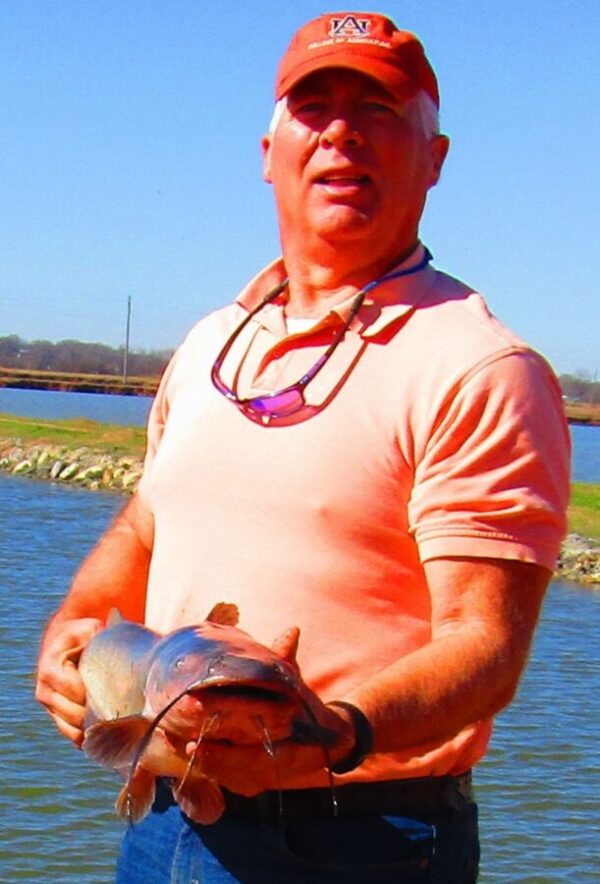
Today: Gregory N. Whitis was born in Gainesville, Florida, moved to Dubuque, Iowa and graduated from Iowa State University with a B.S in Zoology. He then attended graduate school at Auburn and earned a Master of Aquaculture. After working three years on Alabama’s largest catfish farm, he started his professional career with Auburn as a State Extension Specialist for Aquaculture, and recently retired after 33 years of service. He’s published two popular novels about catfish farming, Blue Green and Nighthope and EW Shell’s History of the Auburn University Fisheries Program. In March 2025, his third novel, Eight Minutes, hit the shelves to wide acclaim. He is also well published in the areas of inland shrimp production, the environmental impacts of aquaculture and innovative catfish production. He currently resides in Greensboro with his wife, Karen.
Thanks so much, Gregory, for joining me!
J. Scot Coatsworth: When did you know you wanted to write, and when did you discover that you were good at it?
Gregory N. Whitis: I met my writing mentor, Aileen K Henderson, a highly respected author, and she encouraged me to write a book. She was aware of my diverse background and said, “Greg, write what you know.” I happened to be reading Charles Frazier’s debut novel Cold Mountain and said to myself, damn I can do this. I’d taken creative writing in school and enjoyed the course. So, I cranked out my first novel Blue Green and it garnered great reviews.
JSC: Have you ever taken a trip to research a story?
GNW: Yes, Eight Minutes, my third novel, is an apocalyptic thriller about the Sun dimming prematurely, turning Earth into another Mars like planet. I traveled to the gates of the presidential bunker in southern Pennsylvania which is a funny story. My wife is still waiting for the feds to show up and interrogate her. I also sat in a decommissioned nuclear missile silo. If the reader wants to know how to launch a nuclear missile it’s in the book. And I walked the entire path between the White House and NASA headquarters on a make-believe tactical mission avoiding criminal gangs using my law enforcement/military experience. Readers have marveled how descriptive the book is because of my research.
JSC: What do you do when you get writer’s block?
GNW: That’s easy. I put on my running shoes and hit the road. Running is so fricking boring. This is where I get most of my epiphanies for writing. I guess the endorphins from exercise are unclogging the neural pathways for creativity.
JSC: How long do you write each day?
GNW: My typical writing day is waking up around 5:30, watching local and national news for an hour while drinking coffee. Then I’ll hide out in my home office, write or research until 11 am. So maybe four hours max and then my brain is pretty much toast. I’ll go for a run with the dog and think about the next chapter.
JSC: Do you read your book reviews? How do you deal with bad or good ones?
GNW: Oh yes, I read all the reviews. Almost all of them are good and motivating. I ask my readers all the time to post reviews. I don’t know what it is about human nature but getting reviews out of people who enjoy the book is like asking them if you could sleep with their spouse. I’d love to know the percentage of readers that leave reviews. Anyway, how do I handle bad reviews? First off, an occasional bad review indicates the review system isn’t cooked. If I see a hundred reviews on Amazon and they are 100% five-stars, that’s suspicious. I received a 1.5 star review for one of my books. I shrugged it off as someone probably waking up on the wrong side of his pallet in an alley somewhere. Probably a bad batch of Thunderbird the night before too. Ha!
JSC: Name the book you like most among all you’ve written and tell us why.
GNW: It’d be Eight Minutes for sure. This was my third novel and I had picked up a lot of tips about self-editing. Like I said before, the months of research were invigorating. My writing efficiency had also drastically improved. A fellow writer told me to let computer read the manuscript back to you. Another writer told me about Grammarly which is a powerful editing tool. So, in a nutshell, I know how to write a book now. I miss working on all of them since publication.
About this book: Eight Minutes
I witnessed a total solar eclipse in western Kentucky and marveled about nature’s response. The insects, frogs, toads and birds had ceased making a sound. It was like something had mashed a giant mute button. The shadow crept over the ground and the temps dropped fifteen degrees. The brighter stars appeared in a noon cloudless sky. I was mesmerized. As soon as I got back home, I researched the Sun. I found this scientific fact—if the Sun reduced its energy output by 1% the results would be catastrophic for Earth. One percent! And then I came up with the premise of the book. We have all been told the Sun will last another five billion years but what if they are wrong? What happens if the Sun dimmed? One neat thing about Eight Minutes — this is an apocalyptic thriller with a good ending. How many apocalyptic thrillers have good endings? You’ll like Eight Minutes because it won’t leave you depressed like Cormac McCarthy’s The Road. He has a great book if you can afford the Prozac.
JSC: What inspired you to write Eight Minutes? What were the challenges in bringing it to life?
GNW: The total solar eclipse I witnessed inspired the story. The main challenge was making the Sun’s dimming plausible. One of my advisors, a physics professor at the University of Alabama helped me with the dimming of the Sun idea. Then I had to formulate the tactical missions of retrieving an astrophysicist stranded at NASA headquarters with rampaging street gangs in downtown Washington DC and getting two astrophysicists to Minot Air Force Base in North Dakota. My technical advisor is a former Navy SEAL with combat experience in the Middle East. He told me about the sound a NATO round makes when it impacts human flesh. There are more riveting details in the book about combat. I also know a former Air Force pararescue guy. Folks, back when Russia was the Soviet Union we conducted covert missions there. And no, I’m not revealing my source. Want more? Read Eight Minutes. I had to enlist a lot of expertise in writing Eight Minutes.
JSC: What was the weirdest thing you had to Google for your story?
GNW: How to make a nuclear bomb. Folks, the info on this will blow your mind– no pun intended. I needed info on what it would take to send a specially designed nuclear missile to the Sun to start a cascading reaction in the Sun’s outer atmosphere. The book isn’t entirely fiction. I probably triggered a government supercomputer in a mountain somewhere with all my inquiries on building a nuclear missile. I’m still waiting for the federales to show up.
JSC: What is the subject matter that is incredibly difficult for you to write about?
GNW: Readers are asking if I’m going to write a sequel to Eight Minutes. How in the hell do you write about a post-apocalyptic world without research to base it on while keeping it plausible? This is the challenge. I’ll be running ultra marathons before I figure that out!
JSC: What are some day jobs that you have held? If any of them have impacted your writing, share an example.
GNW: As a faculty member of Auburn University, I traveled extensively throughout Central and South America and the Caribbean. These experiences were the foundational background for many of my characters. As a farm manager for Alabama’s largest catfish farm, I was able to “write what you know” for my first two novels, Blue Green and Nighthope. I wrote about a life-threatening ordeal that happened to me on a fish farm—I accidently submerged a pickup truck upside down in an eleven foot deep catfish pond and escaped out the side window. I was a nuisance alligator hunter/trapper for Alabama’s Department of Wildlife and Fisheries. I have plenty of humorous stories about those days in my writings. And to cap all this, I was a fully certified and let’s say “overtrained” deputy sheriff for ten years after graduating from the police academy at the age of forty-four. All three of my novels incorporate this law enforcement experience.
JSC: Tell me about an event that absolutely changed your life. Did it change your writing too? How?
I read Charles Frazier’s debut novel, Cold Mountain. My favorite book to this day. After reading, I decided to try my hand at writing. I never dreamed I’d become a writer after college. I hope to meet Charles Frazier and belly up to a bar with him. Drinks on me.
JSC: What fantasy realm would you choose to live in and why?
GNW: I came up with a time machine concept in Eight Minutes as a conversational topic among my characters as they were traveling. You get hooked up neurally to a supercomputer with unlimited access to all the data in the world, powered by the most advanced AI available. Nurses hook you up to IVs to keep you hydrated and nourished. You tell the staff how long you want to travel and when. They put you in a coma. The computer takes you there with electrodes inserted in your brain at your dream center. AI fills in all the particulars of the time, environment, available inventions, ect. My particular event would be as a crewmember of the Lewis and Clark Expedition, particularly when Captain Lewis crested the ridge on the Idaho Montana border expecting to see the Pacific Ocean and all he sees is the Bitterroot Mountains stretching out to the horizon for a hundred miles. He groans ,”What in the hell?” (and a few other choice words that only I get to hear.)
JSC: What’s your favorite line from any movie?
GNW: Billy Jack–“When the law breaks the law, then there is no law.” That was my mantra while a deputy sheriff.
JSC: Do you write in the margins of your books?
GNW: I highlight writing gems when I read. Then when I finish a book, all the gems go in my journal for future reference. I never never plagiarize a gem but reword it to capture its essence in my writing.
JSC: What are you working on now, and what’s coming out next? Tell us about it.
GNW: I am writing a non-fiction history book about Sacagawea, the Native American woman who accompanied Lewis and Clark to the Pacific Ocean and back. Through my research and field work, I may have found her remains. Up until now, she has had no known gravesite. I think I found her. The book’s title is The Bones of Sacagawea: A Quest for Her.
Thank you Scott, I hope this has been good for you.
JSC: Yes, great interview, and thrilled to have you. Good luck with the book!
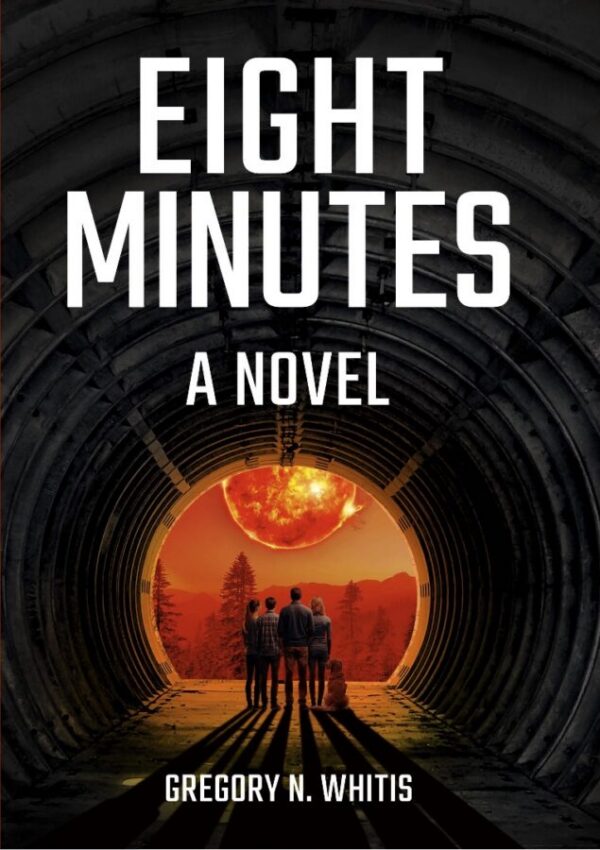
And now for Gregory’s latest book: 8 Minutes:
“The Sun will last another five billion years,” agreed all the world’s scientists—except two.
After a massive solar flare wipes out nearly everything more complex than jumper cables, the Sun dims, and Earth’s climate begins to rival that of Mars. The U.S. government, led by a distant presidential successor, takes shelter in a bunker, grappling with life-threatening global conditions as humanity is tossed back into the Stone Age.
While the Raven Rock Mountain Complex is isolated, the rest of the world slowly devolves into a cosmic snowball. Recognized as an extinction-level event, a team of four embarks on a mission to rekindle the Sun using the world’s most powerful nuclear missile. Alex Tate, his quirky sidekick Mick Moore, and two war-hardened federal agents, Hans Jupp and Dirk Karsten, brave a frozen wasteland, encountering friendly preppers and dangerous thugs. Quincy and Teedarius, marooned at a remote Arkansas catfish processing plant, provide comic relief during their engaging struggle for survival.
Eight Minutes is a gritty, fast-paced romp through a realistic apocalypse. You’ll never take the next sunrise for granted.
“A chilling apocalyptic action-adventure thriller with gutsy heroes, an impossible mission, unthinkable challenges, and edge-of-your-seat suspense!” – Lynessa Layne, USA TODAY Bestseller & Book of the Year Silver Falchion Award Winner
Book Trailer
Publisher | Amazon
Excerpt
CHAPTER ONE
ALEXANDRIA, VIRGINIA
The first rays of an August dawn filtered through the massive white oak in the gated neighborhood. Bo, the household’s golden retriever, nuzzled Alex Tate’s bent elbow. Tate squinted at the trickle of light coming through the closed Venetian blinds.
“Bo, lie down.”
Bo jumped, planting his heavy front paws on Tate’s chest.
Tate rubbed his eyes, staring at his dog. “What’s got into you?”
His wife, Tali, stirred. “What’s going on?”
“Bo needs to go out.”
“But it’s dark outside.”
She rolled over, groping for her Garmin Forerunner on the nightstand. “Not even five yet.”
Alex flipped the sheet off and stumbled into the hallway, Bo at his heels. He opened the front door, and Bo darted out. Alex folded his arms across his chest, noticing the chill in the air. Bo didn’t sniff out his usual spot for relief but instead urinated in several places along the yard’s perimeter.
What’s all that about?
As Bo returned to the door, Tate glanced at the digital display for his amateur weather station next to the doorframe. The screen indicated falling temperatures, rising barometric pressure, and a steady east breeze. That’s strange. A combination of increasing pressure and winds out of the east. Usually, east winds were a portent of impending storms and falling pressure. And it had turned unseasonably cool. He checked the battery indicator on the bottom edge of the screen. The lithiums were five by five.
Bo waddled past him and lay by the rear patio door, peering outside, seemingly waiting for the sunrise.
NASA HEADQUARTERS, SCIENCE MISSION DIRECTORATE, WASHINGTON DC.
Director and Nobel Prize Laureate Dr Amil Bassar stared at the new spectroheliograph photo from Zurich by his beloved Nobel collaborator, Boris Spitz. The profound anguish on his face mirrored the look of a man staring at a pistol barrel aimed between the eyes. The hammer was dropping in slow motion. He blinked, rubbed his eyes, and stared at the picture again. They were still there. Thicker and darker than usual. Sunspots thickly coalesced over the surface. The corona was shrinking. The Sun’s visible surface, the photosphere, was cooling off at a cataclysmic pace.
The paper Spitz co-authored with him forty years ago and presented at an annual international astrophysics conference was considered far-fetched by their peers. It was based on conjecture and poorly supported by corroborating science. The academic world of astrophysics was hyper-theoretical, off-limits to laymen. Their fellow cosmic scientists considered the paper almost heretical.
It was happening. The Sun released energy while converting hydrogen into helium. The Sun consumed four million tons of hydrogen every second for the past five billion years.
According to the Bassar-Spitz theory, the phase shift would start at the core if the hydrogen atom converted to a lower energy hydrogen-helium isotope due to the constant intense heat of fourteen million degrees in a hyper-speed thermonuclear chain reaction. The new hybrid isotope would burn at a much lower temperature, if at all. In effect, the Sun would burn out or become a red star or something in between. The mother of all eclipses in terms of going dark. And it’d be the last one.
Bassar realized what would happen next. Seven billion people would die in a matter of days. By the end of the week, they’d be frozen solid. Life for the survivors, an icy hell.
He looked out at his staff through his office picture window. They were staring at him. He was their trusted leader. They worshiped the ground he walked on. Just passing through his energetic shadow gave them the daily motivation to fight the traffic, dash through the criminal-infested ghetto two blocks over, and worry if their cars would be there after work. Their day’s highlight was bringing him a cup of coffee, sharing fresh Krispy Kremes, or just sitting at the same table for lunch. If your resume listed that you had worked under Amil Bassar, greener pastures were over the next hill.
His administrative assistant, Betty Gayle Stewart, dabbed at her eyes with a Kleenex. She had printed the email from his friend in Zurich. Bassar slowly got up from his chair, pushed it into the desk cavity, and walked solemnly to the threshold of his office.
“You all need to go home, hug your loved ones, and find peace with God. That’s all I want to say.”
“Doctor Bassar, how much time is left?” asked Stewart.
“Maybe a week or two.” He removed his reading glasses perched on the end of his ruddy nose and wiped his eyes with the back of his hand.
Anguished gasps filled the room. Their leader turned around and walked to the exterior picture window. He faced the morning Sun.
Yes, it did look different.
Within minutes, the office cleared out. Some of the staffers bawled in sheer anguish. A few screamed as they ran down the corridor. Bassar sat back down at his desk. He opened the drawer on the right side. He found the framed picture of his late wife, Toni. She’d died three months before of pancreatic cancer. He took the picture out, methodically folding out the stand. He placed it on top of the photos of the dying Sun. He opened the left-hand drawer and grabbed a chrome-plated Cobra derringer.
“Honey, I’m coming.”
He stuck the barrel in his mouth and pulled the trigger.