
Welcome to my weekly Author Spotlight. I’ve asked a bunch of my author friends to answer a set of interview questions, and to share their latest work.
Today: John Beresford is a British science fiction & fantasy author who has been writing his whole life, but let his family and career get in the way of publishing for the first fifty years.
Now retired, he writes full-time and has several works to his credit. Seven novels (a science fiction thriller about what happens when GM food goes wrong, and two fantasy trilogies set on the world of Berikatanya), two volumes of poetry, a book describing the “writing challenge” he undertook after publishing his first novel, and two albums of songs. He is presently working on a series of horror short stories.
The Berikatanyan Chronicles trilogy was conceived with the premise: “what if Earth’s first planetary colonization missions discovered the world they chose was already occupied?” followed by the equally compelling twist: “…and what if those indigents had magical powers?”
The first volume – Gatekeeper – follows five characters who join the colonization mission, each for their own very different and very personal reasons. They arrive on the new world to find that it’s not only the native population who can manipulate the traditional elements of Earth, Air, Fire, and Water. Some of the colonists develop powers too, though no-one understands why. Their ship has arrived in the midst of a centuries old conflict between the two centres of a medieval civilisation that has recently escalated. This war plays out during the course of the story, involving each of the five in different ways.
In the second volume – Water Wizard – the final colony ship arrives from Earth bringing with it more surprises for the band of Elementals. The conflict sparked by these events escalates into an even greater peril than our heroes faced in book #1, and long-lost Elements and their powers are rediscovered.
The trilogy concludes with Juggler, in which the final terrifying power is unleashed to save or damn the population of Berikatanya – both natives and colonists.
In the Second Chronicles our heroes escape to the north, where they find new communities and new challenges.
Website: https://johnberesford.com/
Facebook: https://www.facebook.com/garretguy
Amazon: https://www.amazon.com/stores/author/B008DE3F0M
Goodreads: https://www.goodreads.com/author/show/14053960.John_Beresford
Thanks so much, John, for joining me!
J. Scott Coatsworth: What was your first published work? Tell me a little about it.
John Beresford: An SF “technothriller” called War of Nutrition. Its premise: “What would happen if a food product based on genetically modified wheat, released early without adequate testing because the CEO is driven to solve world hunger, reacts with a common food additive to cause a prion-like degenerative disease similar to mad cow disease?”
It suffered many of the traditional problems of first works, the biggest of which proved to be that title. I thought it was a clever play on “War of Attrition” with a food slant. Turns out that readers don’t very often get beyond the word “Nutrition”, passing it over because they’re looking for a science fiction thriller, not a cookery book.
The story still holds up, 14 years after publication, but the whole thing would need repackaging (title, cover, better internal formatting) to stand any chance of improved sales, and in any case Amazon doesn’t like old things, so I’d rather invest my time in new work.
JSC: Do you read your book reviews? How do you deal with bad or good ones?
JCB: I do. The good ones give me a buzz that’s hard to beat. The thought of a complete stranger reading your work and enjoying it enough to write a review is a validation that never gets old. A recent reviewer wrote that he hadn’t enjoyed a book as much as mine since reading Magician. To be compared to Raymond E. Feist (whether or not I believe it’s justified) was incredibly exciting.
On the other hand there’s that 1-star review – “I can’t stand books that don’t even have a full chapter with a single character POV. Total waste of time.” – which just goes to show you can’t please all the people all the time. How do I deal with it? Shrug and move on. Everyone has an opinion and you have to take the rough with the smooth.
JSC: How long on average does it take you to write a book?
JCB: Well let’s see. I’ve published eight books since 2012, so the arithmetical average is a year and three-quarters. I was very pleased to read recently that “rapid release” strategies are becoming less effective, especially in my genres! But that simple average hides the extremes. I started writing my first book in 2001. Between rewrites, failed attempts at traditional publication (with their usual lengthy waits for agents to respond to queries), and more rewrites, it took eleven years for that book to see the light of day. Whereas I published the last two books of my second trilogy in the same year (2024), when I had the plot and characters firmly embedded in my head and could “write like God.” According to my notes those books took 70 and 94 days respectively.
JSC: How did you deal with rejection letters?
JCB: By bursting into floods of tears. No, seriously, it was another case of “shrug and move on.” I’d read enough about the process to expect a majority of my queries to become rejections. There were two particular categories of rejection I found marginally harder to deal with:
- Those that said “this isn’t what we’re looking for” or “we’re not accepting new clients right now” when I’d carefully researched their website to determine that they were, in fact, taking on new clients and my submission was exactly what they (said they) were looking for. AND I’d addressed it to the specific agent who was supposedly both taking on and looking.
- The “no” at the end of a 13-week wait for a response to my submission of a full manuscript (at their request). From a top New York agency. I later discovered that requesting fulls was almost their default response to queries that came anywhere close to interesting them, so while not exactly a “slush pile” in the truest sense, it was basically the same thing.
JSC: What book is currently on your bedside table?
JCB: Stephen King’s “Fairy Tale”. The man is an unrivalled genius at drawing his readers into a story. He flexes his style as easily and as often as most of us change our underwear, but always delivers a cracking yarn. And his more recent work shows that he’s conquered one of the most common criticisms of his work – that he can’t write endings. Well now he can.
JSC: How did you choose the topic for Gatekeeper?
JCB: It had been a log-line in my Ideas List for many years: “what if humanity’s first colony mission lands on a planet that’s already inhabited? And what if the indigenous people can do magic?”
I asked my daughters which of my ideas they’d like to read most, and this was their choice. A great choice, as it turned out, because while writing the last chapter I realized the world I’d built had scope for this book to become a trilogy. And after writing the first trilogy I found I still had enough ideas for a second. It’s kept me busy for ten years.
JSC: Who did your cover, and what was the design process like?
JCB: Gatekeeper had two covers. When I first published, it was only my second work. I hadn’t discovered the wealth of online resources for indie writers. Indeed back in 2015 much of it didn’t exist. But I did have a friend who was good with Photoshop and montage-style art. I did have an idea what the cover should look like. And I was reasonably capable at doing my own lettering using GIMP.
So for the first ten years of its life, Gatekeeper struggled with a cover created by two guys who, despite their various skills, knew nothing about cover design, genre fit, reader expectations, and all of that. Color schemes? No idea. Fantasy font choices? What does it even mean? You get the idea.
In the end, I had to do something about it, and 2025 was the year I grasped that nettle. I engaged with Getcovers.com. Their pricing scheme doesn’t break the bank and they offer unlimited revisions until the author is happy with their new cover. Which was a good thing because my initial brief was… sketchy to say the least. I ended up with a shocking expanse of naked man-chest better suited to a paranormal shifter romance than an epic science fiction/fantasy crossover. But true to their word they had another couple of goes at it until we homed in on something that matched my vision while at the same time ticking the reader-expectation box.
JSC: Do you believe in the old advice to “kill your darlings?” Are you a ruthless darling assassin? What happens to the darlings you murder? Do you have a darling graveyard? Do you grieve them?
JCB: Let’s establish some ground rules first. I see a lot of people commenting on this old trope as if the darlings in question are their characters. They’re not. At least, not always. In the original version of this advice “darlings” referred to any part of the work that an author was particularly proud of, or loved for any reason. Yes, it can be a character, but more often it refers to a scene, or a passage, or even a single sentence that is especially meaningful to the author. Maybe the prose sings. Maybe it’s a clever Easter egg that only a handful of people will get. Maybe it’s a fictional representation of something from the author’s past that holds a special significance to that author. But any and all of these examples have one thing in common that makes them a darling: they don’t fit the narrative. They don’t adhere to the principle that anything in the story should move the action forward, introduce meaningful and germane facts, fill in necessary backstory, or foreshadow things to come.
If it’s not contributing to the story, but is only something you’re really pleased with it, then kill that darling.
I used to find it hard to cut darlings, but it gets easier with practice. And my darlings never really die. I don’t kill them, I only evict them. They emigrate to temporary lodgings in my File of Clever Writing, ready to be installed in a future work (with any necessary editing) where they’ll get on better with the neighbors.
JSC: Choose a passage from your writing. Tell me about the backstory of this moment. How you came up with it, how it changed from start to end.
JCB: There is a scene in War of Nutrition that happened almost by accident. An early reader commented that it stood out as having a completely different, more “literary” feel from the rest of the work. Maybe that’s because I wrote it in isolation, as an afterthought, purely because I was short of my target word count, and was aiming at the time for traditional publication. I wrote the piece in a single sitting and apart from one or two minor edits for vocabulary choice and grammar correction, it didn’t change from first draft.
The protagonist, Ruth, along with her young son Patrick, is escaping from the authorities. Hoping to meet up with our hero, Jeff, in an anonymous roadside diner…
From the corner of her eye, Ruth caught the waitress checking her out again. The third time in ten minutes. When she first walked into the diner she had assumed the woman was middle-aged. At least mid-forties. A closer look revealed the drudgery of the woman’s job had worn lines around her mouth and eyes, aging her considerably. A little of the dust from the road, carried in on the feet of hundreds of passing nobodies, had settled over her eyes. A film of weary life that prevented her seeing any possibility of escape from the long lonely nightshifts in the diner. Her chipped and grease-spattered badge read simply ‘Jane’. She could not have been more than twenty-five, but nightshifts always counted as double time so perhaps it was not surprising she looked closer to fifty. When Jane served her second cup of coffee, Ruth thought she detected a trace, behind the dull film, of the spark she might once have had. Ruth imagined her on the first day at her new job, eagerly sharing her smile with the few who brought their trade and their dust into her cafe, wondering which of them would be the one to pluck up the courage to ask her out? Which would be the one to take her away from here altogether? Would any of them ever ask her out? Soon, she would have been asked to cover for someone who could not make the nightshift. They had to stay home and nurse their sick child. After the disappointment of her first few months on the day shift, the quietness and the stillness of the night shift called to Jane. Tempted her with its silence and its lack of bustle and its greatly reduced ingress of dust. When she asked to be moved to nights permanently, the other staff thought their Thanksgiving and Christmas had rolled into one long holiday, although they never expressed their gratitude to Jane for giving them the chance to spend more time with their husbands, or lovers, or both. Jane figured when she was alone through the long dark shift, she would have no competition. She would be the point at which all eyes focused as they brought their dust into her domain. Or maybe one of the nobodies from the day shift would miss her and seek her out after dark. Maybe they had trouble sleeping, or had a row with their wife. They knew they could count on Jane for hot coffee, a warm muffin and a friendly smile. Perhaps they were just passing through and had room to give a pretty girl a ride. One of them would turn out to be somebody. But in the end Jane had to admit the night-time nobodies were just like the daytime nobodies. They brought the dust in with them just the same (only cooler), and it was still the only part of them that stayed. Over time, it settled in the lines and creases of Jane’s face. In her hair and over her eyes until all that remained was a grey and faded husk of the sparkling girl who had first walked into the diner.
On her third coffee Ruth’s thoughts took another direction. One closer to home. The café possessed no Internet connection, which severely limited Jane’s options on the nightshift. No late night chat sessions to while away the small hours. No chance she could meet her own Jeff between rounds of toast and mugs of coffee.
The sadness of life for Jane, her collection of nobodies, and most of all her lack of a Jeff suddenly hit Ruth. It brought back to her with crystal clarity how much she missed him. How much she had unconsciously been worrying. A single tear rolled down her cheek, adding its saltiness to the bitter dregs of her cold coffee.
Patrick coughed in his sleep. His juice sat untouched on the table. He lay on the bench seat between the table and the wall, sleeping fitfully through Ruth’s thinking and drinking.
“Another?”
Jane had crossed the diner and stood poised over her with a pot of fresh black coffee, its almost-chocolaty aroma already convincing Ruth it was exactly what she needed to banish her funk.
“Yes. Please.”
“Stood you up has he? Or run out on you?”
Ruth studied Jane’s grey-on-grey eyes for a moment, trying to imagine how much more drab the diner could look when seen through them. She shivered.
“No. He’ll be here.”
JSC: What are you working on now, and what’s coming out next? Tell us about it!
JCB: About four years ago I had the idea of a series of horror stories with a linked theme. I worked on the list until I had thirteen (obviously!) workable story ideas, and began to plot and draft them as a kind of background project.
The fact that four years have elapsed shows that the “background” approach hasn’t really worked. I have two stories that are complete apart from a final editing pass, and one more whose first draft is about one-third finished, but it’s not much to show for all that time. So I’ve decided to give it my whole focus in 2026 and aim to publish at least one and possibly two books this year. The stories are writing up a little shorter than I’d first hoped. I think this is mainly due to not working out the plots to the same level of detail I usually operate with, so it’s been a bit of a hybrid plotter/pantser approach. Those first stories have turned out somewhere between short story and novella length, so I’ll be combining three or four tales into each volume.
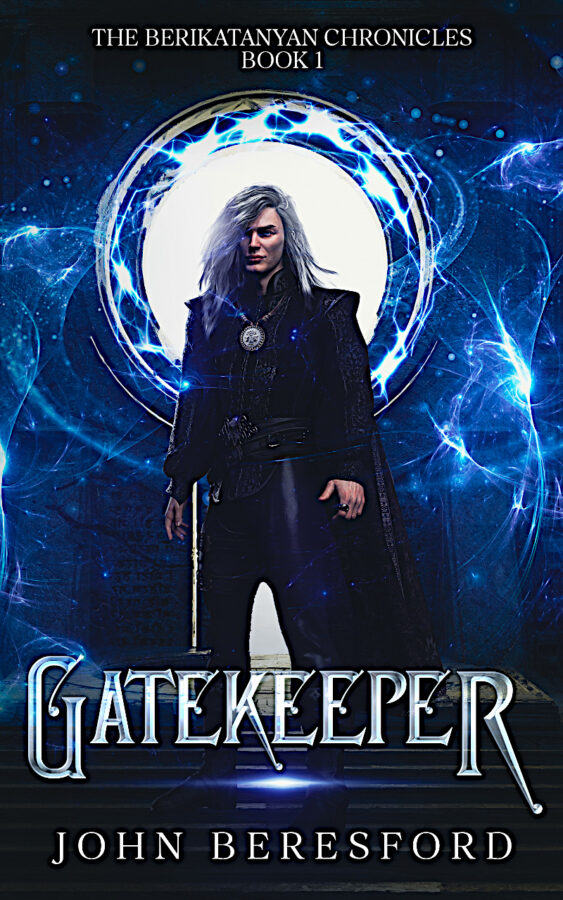
And now for John’s latest book: Gatekeeper:
He went to the stars to start over. His troubles have just begun.
Earth, 2072. Jann Argent has no memory of committing the murder that landed him in prison. So when he’s offered a chance at freedom, he accepts the price of exile to humanity’s first colony planet. But when the ship crash lands on the new world’s surface, he’s shocked to discover an indigenous population and a strange sense of familiarity.
Stunned when he and several other shipmates develop mystical powers, Jann discovers previous colonists have all joined one of two rival native houses. And with a tyrant’s power play set to devastate the realm, he’s about to become the lynchpin in a magical war that could destroy him.
Can Jann uncover his destiny in time to stop a terrifying plot?
Gatekeeper is the first book in the genre-bending Berikatanyan Chronicles science fiction fantasy mashup. If you like gritty heroes, elemental magic, and journeys to other worlds, then you’ll love John Beresford’s towering tale.
Amazon eBook | Amazon Paperback | Amazon Audiobook (US Only)
Excerpt
Back in his cell Jann snatched a besom from behind the door. He closed the door, checking the corridor outside through the grille out of habit. His bunkmate Jonno looked up in surprise from his dog-eared wank magazine.
“Short dinner. Food no good?”
“Food’s the same as always. It’s the company I didn’t like the taste of.”
Jonno slipped the magazine under his pillow and put his hands behind his head.
“Let me guess. Needham, Wheezer and their usual winnets, with all those tired old jibes about—”
“Tired jibes is all they’ve got. None of them have a single original thought.”
Jann rested the broom at head level between the two double bunks.
“Well you’re not exactly renowned for your memory,” Jonno grinned.
“Don’t you start.”
He began a series of fast chin-ups on the suspended broom handle. After the first twenty Jonno retrieved his reading material, flipping back to his page.
Three hundred chin-ups and forty-five minutes later Jann dropped from the broom, wiped his face on a sheet from the unoccupied lower bunk, and vaulted onto his own bed to catch a nap before his first shift as offender-side security detail. He knew the position would attract even more needle from certain quarters, but it was worth the hassle for the increased exercise time and snack allowances.
“Do you think it’ll ever come back?”
Jonno’s magazine slipped under his pillow once more.
“Give it a rest Jonno.”
“Genuine question, mate. I’m not taking the piss.”
Jann blew out a long breath.
“I dunno. I’ve been over and over it. There’s not even a flash. Not a hint of anything before I was standing in that room.”
“With a body.”
“Of course with a body! For fuck’s sake, what else am I doing here?”
“And no ID.”
“Is this supposed to help? Christ, you’ve heard it a hundred times. You know the story almost as well as I do, and it’s mystory!”
“Yeah, but right now it only has a middle. You can’t remember how it begins, and no-one knows how it ends.”