Welcome to my weekly Author Spotlight. I’ve asked a bunch of my author friends to answer a set of interview questions, and to share their latest work.
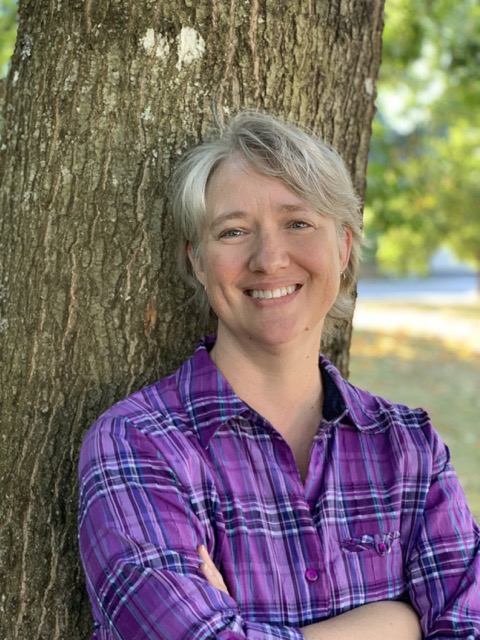
Today: Krista is a fantasy writer, jazz & rock musician, audiobook narrator, actor, podcaster, mother, Gran, a lover of pie, dark chocolate, and fine single malt scotch. She hails from Port Coquitlam, BC, where she writes and records in a closet, emerging occasionally to sing with the big band FAT Jazz, or her duo, the Itty Bitty Big Band. She is the author of the Gatekeeper fantasy series, and an urban fantasy comedy romance: Griffin & the Spurious Correlations. She has short stories published in Pulp Literature, Heart’s Kiss, electricspec, and 49th Parallels (an Aurora nominated anthology). Krista sometimes throws knives, and sometimes tap dances, but not usually at the same time.
Learn more at:
Website: https://kristawallace.com/
Facebook: https://www.facebook.com/totallyfantastictitle
Instagram: https://www.instagram.com/thekristawallace/
LinkedIn: https://www.linkedin.com/in/krista-wallace-3107a1a/
Thanks so much, Krista, for joining me!
J. Scott Coatsworth: What was your first published work? Tell me a little about it.
Krista Wallace: I love reading aloud (more on that later). At conventions I have kind of developed a cult following for reading a particular book I bought in about 2000. When I was at World Fantasy convention in San Diego in 2011, I gave a reading from this book, and consequently was invited to participate in a more formal event. Several writers had been invited to read from their own work, in 20-minute timeslots. I had a tough time deciding what to read, but ultimately decided that since the event was taking place outdoors in a garden, I didn’t want to read anything super serious. So I read from my short story, “The Pageant – a Battle Maiden’s Cunning Stunt.” This was my first time reading this story, and had no idea what to expect. The laughter was everything I could have hoped for. I got to the 20-minute mark and stopped. The audience said, “You can’t stop NOW!!!” So I kept going and read the whole thing. Betsy Dornbusch from Electric Spec was there, and asked me to submit the story, which she subsequently published.
JSC: Are you a plotter or a pantser?
KW: Actually, I write by magic. (I tried plotting. Nope nope nope nope nope.) Moreover, I don’t write consecutively. I get an idea for a scene, I write it, and later I figure out how it fits in the story. (There have been very few scenes that didn’t find their way into a book). I put them in the right order, and then I write the transitions and anything else that’s missing. Sometimes I have a vague idea of where the story is going, but mostly I just let it happen. If I run into a snag, I step away for a few days and let my subconscious brain do the work. It eventually goes ping! and reminds me about the tiny detail I inserted at one point, not knowing how useful it would be, and I sit back down and finish the section.
JSC: How do you deal with rejection letters?
KW: One time a friend and I put our rejection letters up as targets on a wall and threw knives at them. Other than that time, I just kind of ignore them. I see them as separating the wheat from the chaff. Some rejections are cool: If they say they loved the story, but can’t accept it because, for instance, “it isn’t Science Fiction enough” for that particular anthology, that’s totally ok with me.
JSC: What is the most heartfelt thing a reader has said to you?
KW: Remember how I said I love reading aloud? I first put my books out on my podcast, [totally fantastic title], where I read a chapter each week. I then published the books in audio before I started publishing them in print. One reader told me she listened to my podcast during the terrible time of her mother being on her deathbed. The reader said the sound of my voice reading my story to her transported her, gave her something else to think about and cling to. It really helped get her through this incredibly difficult time. That meant the world to me.
JSC: Name the book you like most among all you’ve written, and tell us why.
KW: Much as I love all the books in the Gatekeeper series, I would have to say my standalone, Griffin and the Spurious Correlations. It is just so wild and nutty and hilarious and intense… The “rules” of the magic involved in the story allowed me to truly do whatever I wanted, because basically anything could be rationalized. It turned out so crazy and fun! And the story took me completely by surprise. It was meant to just be a goofy urban fantasy with humour, but about 2/3 of the way through writing it, I realized, “Oh shit. I’m writing a romance.” Turned out, the romantic subplot wasn’t just a subplot. I was going through a really tough time in my life during the writing of this book, and I think I lost myself by diving in head first. The result was something unique and out-of-the ordinary, which makes me laugh out loud.
JSC: What were your goals and intentions in Gatekeeper’s Crucible, and how well do you feel you achieved them?
KW: The keyword I kept in my head while writing this book was “relentless.” This book is the buildup to the Big Finish, so there was no more time for experimenting, for playing with ideas and seeing what other sidelines and subplots I could come up with. This book needed to grab the reader by the short-and-curlies and not let go. [grin] I think I did pretty well.
JSC: What was the hardest part of writing this book?
KW: Coming up with the story arc. Heh. See, the one drawback of not having planned out the story is that I didn’t know how it was going to end. I had so much fun letting the characters do stuff, and adding in all sorts of little details here and there, that I had a ton of loose ends to tie up when it came time to wrap up the story. But. What I did not have was a story arc for the final book. Obviously, I couldn’t just list all the ways the loose ends tied up. Y’know, like they do at the end of some movies: Ted bought a goat farm and now makes award-winning cheese. Frida took up violin and now composes commercial jingles.
No, one really needs to tell a story with a solid foundation of an arc. It took me a long, long, long time to figure out the central conflict in this one.
JSC: What action would your name be if it were a verb?
KW: Funnily enough… it already is: Two separate sets of friends used the verb “to Wallace” independently of each other. To Wallace a thing (usually a cooking/baking dish, or a dish you’ve eaten from) means to clean a dish with a fork, spoon or spatula so as to make it look almost as if it hadn’t been used, with the intention of not wasting a drop or speck of food. This is not to be confused with “washing.”
Used in a sentence: “Could you please Wallace the mixing bowl before I put the cake in the oven?”
JSC: What’s in your fridge right now?
KW: A Toblerone given to me by my dad, who died in 2012.
JSC: Awww. What’s your favorite line from any movie?
KW: “I don’t wanna kill you and you don’t wanna be dead.” From Silverado
JSC: What are you working on now, and what’s coming out next? Tell us about it!
KW: I’m working on edits of Gatekeeper’s Revelation, which is honestly and truly the absolutely ultimate, final, last book in the series. (which is not to say there won’t be spin-offs, and short stories to follow). I am leaving it as a trilogy in five parts. So that is what’s coming out next. Beyond that, I have already started writing three other novels: an urban fantasy, a paranormal romance, and another fantasy that takes place in the Gatekeeper world, but involves a character we meet ever so briefly in book one, Gatekeeper’s Key, and the protagonist of my short story, He Had it Coming (the story readers get for free when they sign up for my newsletter).
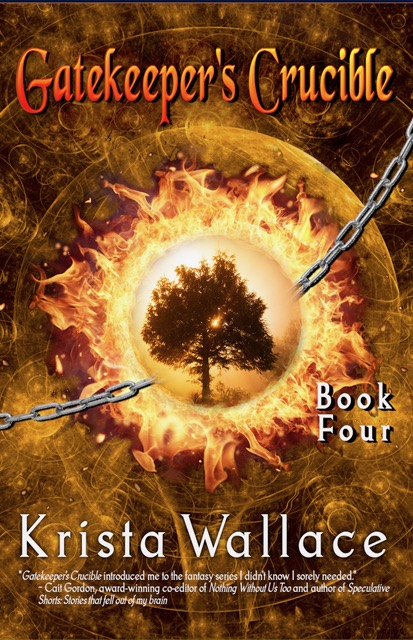
And now for Krista’s new book: Gatekeeper’s Crucible:
“If you’re so obsessed with the truth, you need to look a little closer to home.”
Kyer learns a shocking truth—her “Guardian” is none other than Golgathaur, lieutenant to Dregor himself.
Kyer must use her newfound magical talent, Gating, to enter Golgathaur’s realm and try to rescue the one person who holds the key to her identity: her mother. But Golgathaur reveals a disturbing fact that will change her life, and the lives of those she holds most dear. Even as Kyer is thunderstruck by the discovery of yet another magic she didn’t know she possessed, he demands an impossible choice.
She is forced to escape without her mother, and Golgathaur sets up a magical device, which blocks her return. Now, Kyer’s motivation is agonizingly interconnected with Golgathaur’s: each needs the other alive to get what they want.
Worst of all, Kyer learns the horrific reality behind the Cymrion and dark elves’ need to flee Rydris, and she now realizes she is in grave danger.
Kyer and the company must journey to carry out a heartbreaking deed in order to save her mother, to connect Kyer with the truth of her past, and to save Rydris from a terrible fate.
Even those who have already fled are in peril.
Author Site | Amazon | iBooks | Barnes & Noble | Kobo | Smashwords
Excerpt
Greok pushed with his haunches, pulled with his foreclaws, and slid through the tunnel. Its stone walls smoothly glided along his scales with a scraping sound. There was no light in his tunnel. He could see quite fine without it, particularly when he turned the second to last corner, at which point the light reached and illuminated the walls. It didn’t matter. There was nothing to see in his tunnel. The goal was the opening, where the tunnel widened and the slits of his eyes shuttered while the pupils adjusted to the brightness of the outside. He stuck his snout out the aperture.
The fresh air always gave him pause. The contrast with the dark closeness of his lair never failed to send a shudder of appreciation through his entire body, so that his very scales quivered. He took a moment to breathe, to fill his reptilian lungs with its moistness, its saltiness, to widen his eyes and broaden his gaze to take in the vastness of the ocean before him. He loved the juxtaposition of the nothingness in the dark of his lair with the nothingness in the light of the exterior. His keen eyesight picked out tiny—compared to himself—flying creatures, birds and insects. Swimming things under the surface of the water provided a unique challenge for his vision. Something about the reflection of the sun and clouds on the surface of the water confused his perception of the slithery creatures’ location. The miniscule fish were that much harder to pinpoint. But what was life without a challenge?
Greok drew his hind end forward, and his wings tightened in anticipation. With a gargantuan thrust, he forced his bulk first with his forelegs, then a mighty heave from his hind legs. He dove into the air, wings reaching out in a glorious stretch into freedom as satisfying as that first breath of fresh air. He soared.
All this is mine!
He basked as he flew. The cloud cover diffused the light and heat. He tilted and twisted, reaching out all his limbs, savouring the sublime stretch of his full mass after confinement. With a massive pump, he reached up and up, flapping his wings again and again, carrying him higher and higher, until he crashed into the cloud. He pivoted as he flew, pirouetting and drilling through the mist, and then, flash! Out into the wondrous sun.
The change in temperature was sudden, as if he’d collided with his mountain. There was something marvellous about slapping himself with the heat and blaze of the sky fire and staying in it as long as he could possibly endure. Especially when he abruptly switched direction, scrunched his bulk in the sky, and with a roar, beat his wings against the heat and plummeted. He streamed back down through the clouds, burst into the below-cloud world, the ocean beckoning. With a violent pull of his wings, and a thunderous roar he cannoned into the sea. The cold bit through his scales and churned into the skin underneath. The freezing agony ripped a scream of pleasure through his nostrils.
He surged through the water, a wake of violent waves behind him. He tossed and turned, creating a frenzy of foam. He opened his maw and accepted every living creature into it as he drove into the water. Seals, sea lions, fish, plants he scooped up and carried back out into the air and swallowed. Another dive and another gullet-full and at last, sated, he soared as far out over the sea as he dared, while leaving time to turn back and make landfall before he should tire. How vast the sea was! How he longed to fly farther! To explore and find what else was out there! The continent felt so torturously small. He had flown its length and breadth, had seen virtually every corner, from the arid desert to the snow covered north that stiffened his nostrils and froze his flames. Rydris was pleasant enough, but Greok knew, the way he knew his own entrapment, that there was more out there. He had seen other lands, reported them to the master, but the master wouldn’t let him go.
Always the tug.
Furthermore, Greok knew there were other dragons. He had seen them in the far distance, wheeling, swirling. Free.
Exhausted and content with his flight, he alighted on a bluff. He lifted one foot, then the other, like a bird on a perch, stretching his toes and finding a comfortable position. He stretched his wings and allowed a shudder to ripple through his body, ridding himself of all tension. Finally, he tucked his wings into himself and settled.
Life, he said to himself, is good.
He made ready to leap off, and revel in another climb and wheel, when the interruption came. The tug. Always when he had a moment to himself, to feel free, to put reality behind him for a brief time. It was as if the master perceived he was having an instant of happiness and said to himself, “No, no, we mustn’t have that!” He could ignore it for a time, but soon the tug became a pull. Centred in his body near his spine, just behind his stomach, a sensation like a hook piercing his muscles, or nerves, or whatever was in there. Not really painful, not at first, but insistent, and if allowed to go on too long without being responded to, it indeed became pain. Greok had experimented with it, years ago, to see if he could resist it, maybe escape it, if he could withstand it long enough. But it was impossible. The tiny spark of a tug evolved into indescribable pain, sharp, burning, that radiated outward from that centre to a throbbing ache which pulsed and seared. No, there was no withstanding it for long.
Greok stretched his neck, spread his wings, and pushed off with legs and haunches. Back toward the lair, to the master. The master had created the tug, and only he could stop it. Even the younger master couldn’t do that. It gave Greok no pleasure to obey the master’s whims, not unless they involved food. The younger master’s whims were often related to the master’s, so Greok followed his orders as well, since he couldn’t be sure who was the one giving them. But only the master had the means to stop the pain.
Greok flew back, slowed, folded his wings and crawled into the lair like the beast that the master never hesitated to remind him he was.
“Ah Greok, my lovely,” said the master. “I have so many delightful tasks for you today!”