Welcome to my weekly Author Spotlight. I’ve asked a bunch of my author friends to answer a set of interview questions, and to share their latest work.
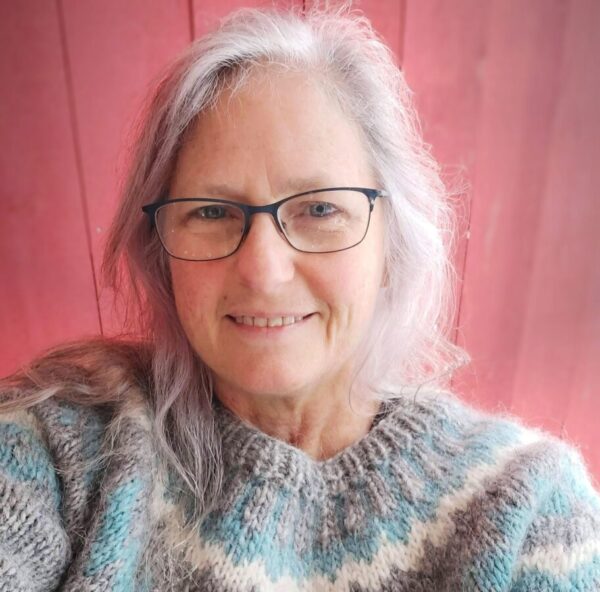
Today: LJ Cohen is a novelist, potter, fiber artist, homestead farmer, & relentless optimist. She writes science fiction & fantasy and was among the 1st wave of indie writers to qualify for SFWA membership. LITANY FOR A BROKEN WORLD, her 9th novel is available now. She lives on a farm in central MA and if you want to know how (and why you would even want) to knit a sweater for a cow, just ask her.
http://www.ljcohen.net
https://www.facebook.com/ljcohen
https://zirk.us/@LJ
Thanks so much, LJ, for joining me!
J. Scott Coatsworth: When did you know you wanted to write, and when did you discover that you were good at it?
LJ Cohen: I remember in early elementary school taking my vocabulary lists and instead of making individual sentences with each one, like we were supposed to, I would write little stories that included all of them. So I guess I’ve been writing since I was single digits old? It wasn’t until I was a little older when I realized that there were people who wrote all the books I loved to read and that writing was an actual job someone could do. I remember deciding that I wanted to be Madeleine L’Engle when I grew up.
In terms of finding out writing was something I was good at? Probably when I discovered I had the dubious superpower of writing an excellent essay to an entirely different question than the teacher had asked and getting an “A” anyway. That was certainly a different kind of creative writing than I do now! In terms of true creative writing, I knew I had at least an ability to write a cohesive story when I submitted a short piece of fiction with my college application and it was good enough that I was able to opt out of Freshman Composition.
JSC: How would you describe your writing style/genre?
LJC: My first real writing love was poetry, so I lean on poetic tools when I write fiction. Not so much in using flowery prose (which is what a lot of people think of when they hear poetic), but in being strategic and thoughtful with word choice, especially the sound and rhythm of the language. Having said that, I also see my writing style – both in poetry and in prose as very direct and accessible, along the lines of poets like Mary Oliver or Billy Collins.
In terms of genre, I’ll jump on the bandwagon of adding ‘punk’ to everything and say if I had to invent one that encompasses all of my writing, it would be earnest-punk. I have never been someone who likes cynicism, snark, or sarcasm, insincerity or apathy. Perhaps that puts me out of step with a lot of popular media, but I think there’s nothing sexier than a character with a solid moral compass.
JSC: How long on average does it take you to write a book?
LJC: Like the answer to so many aspects of writing: it depends. The fastest novel I ever drafted was completed in 4 months. A few months after that, it was revised and edited. But that was a book with a single point of view and a fairly tight storyline.
Until recently, I would have said my average was about a year and a half to move from initial idea to finished novel. And then I experienced a major burnout which coincided with trying to write LITANY FOR A BROKEN WORLD.
That was my slowest novel to date. It took over 4 years to draft and then another year or two to revise and edit before it found its way into the world. There were a lot of reasons that book was so difficult to write, but the main problem was that I kept trying to shoehorn the story into a tidy number of points of view. I wasn’t able to make progress on it until I accepted that this story needed to expand. I had gotten to 20,000 or 30,000 words and scrapped them all to start again at least three times before I found the through-lines that I needed. Once I stopped fighting myself and let the story breathe, I was able to get a draft that worked. Thankfully, the sequel is moving a lot more quickly.
JSC: Are there underrepresented groups or ideas featured in Litany? If so, discuss them.
LJC: My most recent book (LITANY FOR A BROKEN WORLD) is centered around a group of unhoused people in modern day Boston and the makeshift shelter they have created from an abandoned building. I’m not sure I’ve ever read another speculative fiction book where several of the protagonists are homeless. It was something I was, in part, inspired to write after hearing a story on NPR about the aftermath of closing down the public health and drug treatment facilities on Boston’s Long Island in 2015. As a society, we spend so much energy not seeing, not even acknowledging people in the margins. The reality is most of us are so much closer to living on the streets than we are to being millionaires.
In addition to focusing on groups of people who are underrepresented, almost all of my books have a core theme that some might criticize as overly optimistic and utterly unrealistic – that to paraphrase Margaret Mead: Never doubt that a small group of thoughtful, committed, individuals can change the world. No matter what I write, it comes back to this. I guess if you asked me what my personal credo was, that’s what it would be.
JSC: What was the hardest part of writing this book?
LJC: Acknowledging that I was burned out from years of writing a book a year and from dealing with a number of personal and family crises. I had always been the kind or person who just put her shoulder down and pushed through any obstacle. But I discovered my limit and it manifested first as writer’s block. Then I began to believe that I couldn’t write – that maybe I had written everything that I had in me and it was time to let it go.
But the story wouldn’t stop hounding me. I kept trying to walk away from it. Spent months as a time simply not writing, thinking that would make things better. It wasn’t until I started to come to terms with the burnout and take steps to manage it that I was able to find my way back to writing. At first it was poetry. I had put out a call on social media for folks to send me 6 random words and I would write a poem each day that included them all. It was a kind of puzzle and low stakes and it worked to rekindle my joy in writing.
When I came back to the very incomplete manuscript, I approached it the way I had the poetry exercise – with little in the way of expectation and letting my subconscious dictate where the story needed to go.
That’s when I was able to truly return to writing and discovered that I still had things I needed to say.
JSC: What other artistic pursuits (if any) do you indulge in apart from writing?
LJC: My mother used to decry that I was a ‘jack of all trades, master of none’. I like to say that I have a curious mind and a low tolerance for boredom. I’m a potter and glaze chemist/tech for a local pottery studio and I’m a yarn crafter – I both knit and crochet. This past spring, I (not kidding!) knit a sweater for a life-sized fiberglass cow as part of an art project at Old Sturbridge Village.

JSC: What are some day jobs that you have held? If any of them impacted your writing, share an example.
LJC: I worked for almost 25 years as a physical therapist. One of the things I do well is realistically injure my characters and carry through their functional impairments into the story. Everything in a story needs to have consequences and reasons for being there. One of the things that pulls me from a book or movie is when our hero gets shot in one scene and then is climbing the outside of the building, heroine over his shoulder in the next with nary a grimace. AARGH.
JSC: Tell me about an event that absolutely changed your life. Did it change your writing too? How?
LJC: In December of 2010, we were awakened by smoke detectors going off in our home and had to flee the fire barefoot and in our pajamas. We were so, so lucky – none of us were hurt, even the dog escaped. We lost most of our possessions and were displaced for almost a year until our home was rebuilt. It completely changed my relationship with things and my priorities in life. In terms of writing, I realized that life was short and held no guarantees and that if I wanted to write, I had to make the time for it.
JSC: What is a line from a poem/novel/fanfic etc that you return to from time and time again? How did you find it? What does it mean to you?
LJC: There are two.
One is the opening of Mary Oliver’s poem “Wild Geese” :
“You do not have to be good.
You do not have to walk on your knees
For a hundred miles through the desert, repenting.
You only have to let the soft animal of your body
love what it loves.”
I have read this poem hundreds of times. It is a touchstone in my life, reminding me there is no perfect, only the hard work of living and connecting with who and what you love.
The other is a line from Patricia McKillip’s Riddle Master series. In a pivotal and emotionally resonant scene, one character who is bent on revenge is stopped in his tracks when the man he is threatening simply says, “They were promised a man of peace.”
It’s such a quiet thing and it changes everything in the story. It gave me the chills the first time I read it and every time I have thought about it since.
JSC: What are you working on now, and what’s coming out next? Tell us about it!
LJC: I am about 2/3 through the draft of EVERY SKY A STRANGER. My target is to have it out by Summer 2026. It is the continuation of the multiverse story that began with LITANY FOR A BROKEN WORLD. With our protagonists now scattered in various alternate worlds, they contend with conflicting memories and struggle with their identities while reality is being shifted all around them.
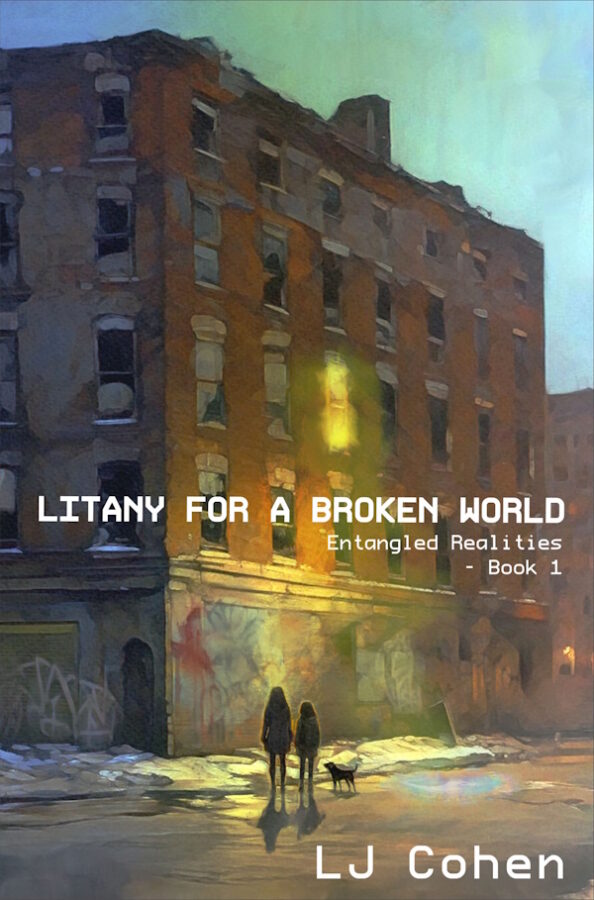
And now for LJ’s new book: Litany for a Broken World:
A young girl’s disastrous first foray through the multiverse cleaves her from her family and abandons her in a homeless encampment, adrift in a world and a body not her own.
A doctor struggling with grief volunteers for the annual Boston homeless census and is confronted by the impossible and her deeply buried childhood trauma.
A lonely, disaffected seer, rejected by those he seeks to help, is drawn from his home by a desperate call across the world walls.
When the three strangers, each broken in some way, are pulled into a conflict between those with the ability to travel the multiverse and the organization seeking to exploit them, they must risk everything that matters to heal the fractured places in themselves and throughout reality.