
Welcome to my weekly Author Spotlight. I’ve asked a bunch of my author friends to answer a set of interview questions, and to share their latest work.
Today: Michael Stephens spent a career as an innovator, building new products for startups, small businesses and large corporations. He’s now turned his creative energies to writing sci-fi comedies, “because the world needs more funny!”
- Author site: https://www.lilbluedot.com/
- Instagram: https://www.instagram.com/michael.w.stephens
- Facebook: https://www.facebook.com/MichaelStephensAuthor
Thanks so much, Michael, for joining me!
J. Scott Coatsworth: How would you describe your writing style/genre?
Michael Stephens: I write sci-fi comedies, so speculative fiction that is tech-centric and includes healthy doses of humor and satire. I think my style tends to range somewhere between silly to irreverent, though it can be thought-provoking. Sometimes.
I chose sci-fi comedies because I’ve always had a strong affinity for the sciences and love hard science fiction. That said, I also think it’s important to not take things too seriously and be able to see the lighter side of things. Especially these days when it seems like there’s plenty to fret about. That’s why I’m always saying, the world needs more funny!
JSC: Have you ever taken a trip to research a story? Tell me about it.
MWS: My last book, The Last of the Elvis Ninja Robots, starts when a signal from another galaxy is received by a giant radio telescope monitored by scientists searching for extraterrestrial life. So I dragged my wife with me through the remote mountain roads of West Virginia to visit the Green Bank Observatory, home to the world’s largest steerable radio telescope – and is actually used by the SETI (search for extraterrestrial intelligence) Institute.
The labs were about what I was expecting, but seeing the radio telescope up close really helped appreciate how genuinely massive it is. Also, I learned about the National Radio Quiet Zone that surrounds the area – and the variety of people it attracts, including: doomsday preppers, neo nazis, people with electromagnetic hypersensitivity and the NSA, who operate a Listening Station there. All of them made it into the book.
Also, did I mention my wife is a saint?
JSC: What was one of the most surprising things you’ve learned in writing your books?
MWS: I’d say how much I got into my characters’ heads, thinking about them all the time, becoming concerned with their situation. It could be at night, I’m laying in bed and I’m worried about my protagonist, wondering how is she going to get out of the jam I left her in. It was motivating. I mean, I couldn’t just leave her there, I had to write!
I seriously was not expecting that.
JSC: What was the most valuable piece of advice you’ve had from an editor?
MWS: Read your book aloud to yourself.
I had read and heard that before many times. It made sense, but I never put it into practice, thinking I had already read the thing at least a dozen times during the editing process. But reading it out loud really surprised me how it highlighted numerous instances where, maybe the voice of my character wasn’t right, or how to fix a clunky section, or finding typos (even after several rounds of editing). I was so stunned, I read the whole thing out loud again. Fortunately, there weren’t many glaring needs for improvement the second time, but it really bolstered my confidence that the book was ready to publish.
JSC: How did you choose the topic for The Last of the Elvis Ninja Robots?
MWS: It’s rather convoluted. I write ideas down as they come to me. The ideas are often scenes. One such idea I had for a scene involved a ninja gardener – which resulted from thinking about what a retired ninja might do as a second career. Anyway, pictured this ninja dude, dressed all in black, sneaking up on weeds in the yard and slicing them down with a samurai sword.
That idea merged with another I had after witnessing an Elvis pub crawl, which was a large number of adults dressed like Elvis Presley going from bar to bar. I imagined an alien mistaking their appearance as common for humans, then using them as a model for robots to use for taking over the world – which I thought would be a funny premise to a story.
Somewhere along the line, I seemed to have merged the two concepts to become Elvis, changing clones to robots. So I had this silly idea about a bunch of Elvis ninja robots.
JSC: What were your goals and intentions in this book, and how well do you feel you achieved them?
MWS: There were a few. Above all, my intention of writing the book was to entertain. Specifically, I wanted to make people laugh. If I could make someone take a break from all the doom and gloom in the world, even for just a few moments, then that was my goal. Another goal, a serious topic done in a funny way, was to highlight how digital dependence can make us, as a civilization, vulnerable to influence.
And to satisfy the geek in me, I wanted to introduce an idea about an alien takeover that would be bound by today’s technologies. That means no faster-than-light space travel, which pretty much rules out space travel in general since the distances between worlds is so mind-boggling vast (it could take millions of years to reach another galaxy).
I think I hit all my goals, so I feel good about that!
JSC: What was the weirdest thing you had to Google for your story?
MWS: Haha. I can only imagine what the Google algorithm thinks about me based upon the stuff I’ve researched!
There’re tons of examples, just thinking about my latest book. One of the characters is an AI psychotherapist who is treating an AI with multiple personality disorder. I did a lot of research on hallucinating AI’s and went down the Google rabbit hole looking up terms, diagnosis techniques, treatments, and outcomes.for dissociative identity disorder (split personalities). On top of that, I researched all the different ways an alien might replicate itself on Earth, like generate living tissue from nothing.
So I can easily picture Google putting some kind of flag by my name that says something like ‘better keep an eye on this one.’
JSC: What are some day jobs that you have held? If any of them impacted your writing, share an example.
MWS: My whole career was centered around creating things, mostly developing new products as an engineer or a product manager, but also as an entrepreneur creating new businesses. There was always a strong technical component to whatever I was doing, especially when I got into digital products and started working with machine learning and AI.
So the writing process itself is, to me, just a continuation of me being creative and the focus on science, the information technology, the AI – all of that definitely impacted my subject matter.
JSC: What’s your favorite line from any movie?
MWS: “Gentlemen, you can’t fight in here. This is the war room!” delivered by Peter Sellers in the movie Dr. Strangelove or: How I Learned to Stop Worrying and Love the Bomb.
Ask me the same question tomorrow and I’m sure I’ll have a different answer. There are just so many great lines from so many movies!
JSC: What are you working on now, and what’s coming out next? Tell us about it!
MWS: I’m working on two projects right now. One is a sequel to my most recent book, The Last of the Elvis Ninja Robots. I’m still fleshing out the storyline, but it turns out that the alien AI that was killed off in the first book is only mostly dead and embarks on its plan B to take over the planet. So Lexi, the protagonist, has to save the world. Again.
The other project is a new sci-fi comedy series for adults. It’s about a reluctant hero who lives in a far-future space colony. He’s not the brightest guy and has a knack for finding trouble, then somehow saving the day. Stay tuned, more to come on this one.
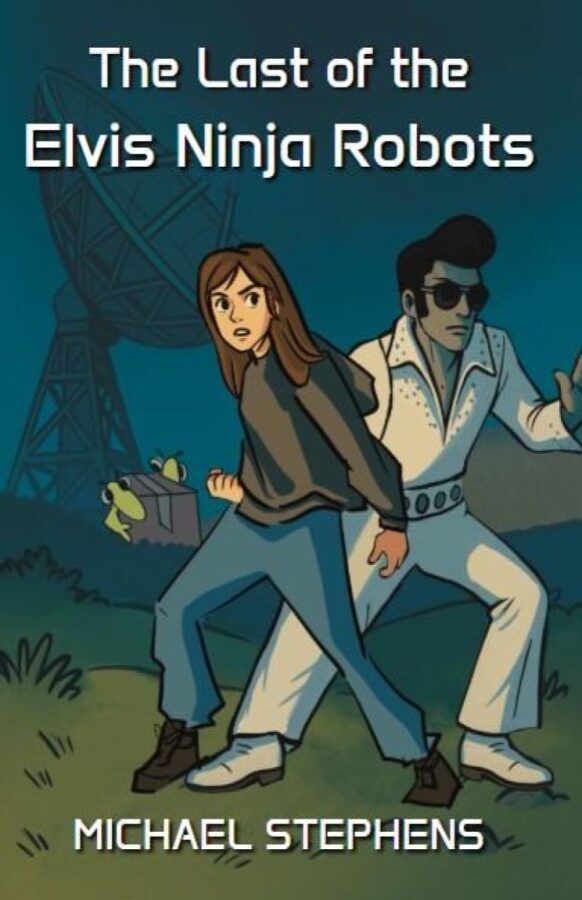
And now for Michael’s latest book: The Last of the Elvis Ninja Robots:
She wanted to prove girls can code. Unleashing an alien invasion? Not so much.
Lexi just wanted to shut up some online trolls and prove she could hack with the best of them. But when her code helps unlock a mysterious signal from deep space, it unleashes an alien AI with multiple personalities… and questionable taste in robot attire.
Now Earth is facing a full-blown invasion led by an unhinged extraterrestrial intelligence and its army of ninja-skilled bots (who all happen to look like Elvis Presley). To prevent a global takeover, Lexi must team up with an unreliable crew, including a slightly glitchy robot, the cyber bullies who used to mock her, and an alien influencer with an insatiable appetite for human attention.
It’s not exactly what Lexi signed up for. But hey, someone has to save the world!
- Bookbub: https://www.bookbub.com/books/the-last-of-the-elvis-ninja-robots-by-michael-stephens
- Goodreads: https://www.goodreads.com/book/show/239458563
- Storygraph: https://app.thestorygraph.com/books/3f06c5ff-8b27-4bcb-80a7-eeac29895f1a
Publisher | Amazon | Barnes & Noble | Bookshop.org
Excerpt
An inconvenienced population was one thing, but the US military was far less tolerable to deviations from the status quo. In a super secure, top-secret facility somewhere in the United States, Major General Terrence Newman stood before the expansive wall of monitors and announced, “Sir, everything appears to be operating normally.”
“That’s affirmative, sir,” echoed Sergeant Major Michael Lewis. “Whatever infected our systems, it’s gone. Sir!”
“There you have it, general,” said the Major General, proudly motioning to all the digital screens. “You can see, everything is normal. So, well… sir, I’m unclear on what the problem is.”
“Unclear on what the problem is,” General George Stetson repeated as he paced, eyeballing each screen. “Hmmm, what’s the problem…” He stopped and pivoted away from the monitors to face the Major General. “Well, we no longer have full control over our systems, we can’t trust any data, we can’t find our stockpiles of firearms, we can’t fly our planes, can’t fire missiles – which, you know, takes all the fun out of being in the army! And we have no idea where our subs are or what our enemies are doing.”
The General stepped into the Major General’s personal space and added, “Hell, we can’t even get a damn soda out of the drink machine without setting off a DEFCON alert! I’d say that’s a goddamn problem!”
“But sir – ”
The bulging veins in the General’s neck and face began to pulse as he boomed, “I don’t care! I don’t care about any of that gobbledygook cyberpuke – or whatever it is you think. You’re not paid to think! That Iam, Zeb, Roy, whatever. It’s still there! I am telling you.. It. Is. Still. There!” The General pounded the Sergeant Major’s desk with each of the last four words.
Then, glaring with even more intensity, the General leaned forward so that his now purple face was within a quarter inch of the Major General’s. “And I’m ordering you to find it! If you can’t, I’ll find someone who can!”
The General stomped his way out of the room as the Major General used his shirt sleeve to wipe the spittle from his face. Sergeant Major Lewis waited an uncomfortable minute before speaking, “Um, sir.”
“What?” the Major General snipped.
“Well, sir, there is someone I think might be able to help. But, it’s… uh…”
“What is it, Sergeant Major? Out with it!”
“The one who deciphered the alien code, sir. I think – ”
“Well stop thinking. You’re not paid to think. Just get him in here!”
“That’s just it, sir. It’s not a him, but um… it’s a girl. Sir.”
“What do you mean a girl? We don’t say that anymore. You mean a woman?”
“Yes, sir. I mean, no, sir. Well… she’s fifteen, sir. Alexandria Ames. She was working with the SETI team. She cracked the alien code,” he said. “It’s all in Colonel Sander’s report, sir.”
“Colonel Sanders? Like the fried chicken Colonel Sanders?”
“Oh, no, sir. Our Colonel Sanders, sir. He’s Army, sir.
The Major General processed this information, then said, “Get me this Alexandria Ames. And uh, Sergeant Major?”
“Yes, sir?”
“Get us some fried chicken. For some reason, I’m craving some fried chicken.”