
Welcome to my weekly Author Spotlight. I’ve asked a bunch of my author friends to answer a set of interview questions, and to share their latest work.
Today: Steven D. Brewer (he/him) is SFWA Secretary and, as a faculty member, both teaches scientific writing and serves as Presiding Officer of the Faculty Senate at UMass Amherst. He is the author of A Familiar Problem, Better Angels: Tour de Force, and Revin’s Heart, published by Water Dragon Publishing. Brewer identifies diverse obsessions that underlie his writing: deep interests in natural history, life science, and environmentalism; an abiding passion for languages; a fascination with Japanese culture; and a mania for information technology and the Internet. Brewer lives in Amherst, Massachusetts with his extended family.
https://wandering.shop/@stevendbrewer
https://bsky.app/profile/stevendbrewer.com
Thanks so much, Steven, for joining me!
J. Scott Coatsworth: What was your first published work? Tell me a little about it.
Steven D. Brewer: Heh. My first published work was “Observations of the gallery habits of Trypodendron retusum (Coleoptera:Scolytidae) infesting Aspen in central Michigan” published in Great Lakes Entomologist. My first literary publications were chapbooks of haiku published in Esperanto. My first speculative fiction publications were also in Esperanto. My first speculative fiction publication in English was The Third Times the Charm, the first novelette of Revin’s Heart, published by Water Dragon Publishing. Revin’s Heart is a steampunky fantasy adventure with pirates and airships and a trans protagonist.
JSC: What’s the weirdest thing you’ve ever done in the name of research?
SDB: Scientists do some pretty weird things. As an undergraduate, I spent a summer in Los Alamos, New Mexico hiking up and down the desert mesas to catch whiptail lizards (the fastest lizards in the world!) to measure their body temperature by inserting a Schultheis thermometer into their cloacae (i.e. their butts). I also spent 15 years catching mongooses in small animal traps on St. Croix to implant PIT tags (like you’d use for a pet) to study population demographics.
JSC: What secondary character would you like to explore more? Tell me about them.
SDB: In A Familiar Problem, the protagonist, Rory, has a childhood friend — Aimee — who, as it turns out, has always had a crush on him. He was too tied up in himself to ever realize her feelings. I’ve outlined a sequel for A Familiar Problem that is about her story.
In Rory’s case, he’s become the familiar of a demon who has been studying humans for thousands of years. They literally knows humans better than humans do themselves. For me, part of the charm of the story is Rory learning about being a human being from something that isn’t human at all.
In the sequel, it becomes a fad among demons to take humans as familiars. Aimee becomes the familiar of a young, inexperienced demon that doesn’t know the first thing about humans. So it falls to Aimee to have to educate him.
JSC: Who has been your favorite character to write and why?
SDB: Oh, Tseluna — hands down. Tseluna is an ancient demon that is absurdly powerful, by human standards. In this universe, demons arise spontaneously in high-magic dimensions. Demons are therefore genderless, have no parents or relations, do not reproduce, and live more-or-less forever. We rarely see demons in no-magic dimensions like ours, but Tseluna decided a few thousand years ago that humans were interesting and decided to study them. For the purpose of bonding with Rory, she chooses to present as female. And, due to her extensive study, she is capable of putting on a persuasive act as a person.
JSC: What font do you write in? Do you actually care or is that just the default setting?
SDB: I do all of my rough draft writing using a text editor. I strongly believe you should write all the words first, then format them later. Currently, I’m using Pulsar, which is a fork of the Atom editor that Microslop killed when they purchased github. I started using that one primarily because I wanted something cross platform that my students could also use. Pulsar is identical on Linux, Macs, and Windows. Its default font selections are “Menlo, Consolas, DejaVu Sans Mono, monospace”. I don’t have Menlo or Consolas installed, so it’s probably using DejaVu Sans. The DejaVu fonts are all pretty good.
When I create a manuscript for submission, unless the guidelines specify something different, I generally use Shunn Classic Manuscript Format https://www.shunn.net/format/classic/ which prescribes using Courier. I usually actually use Courier New which I like slightly better in Google Docs, which is what I’ve been using to format manuscripts. Again, I chose Google Docs because it’s what I’ve been using with my students. After I retire, I will probably switch back to using LibreOffice.
I’ve used a variety of fonts when self-publishing books. I prefer serifed fonts for blocks of text and my favorite is probably Garamond. I actually bought a copy of Garamond on floppy disks years and years and years ago. But there are a bunch of cool typefaces that I like, such as The Doves Type https://typespec.co.uk/doves-type/ which also has a fascinating story behind it.
So, yeah. Fonts. I love ’em.
JSC: If you had to write an entire story without either action or without dialogue, which would you choose and how would it go?
SDB: I’ve done both. I recently wrote a piece of flash fiction that is composed of interactions between two NeoBoxers. (Neoboxers are cybernetically enhanced, genetically engineered boxer dogs that have human-level intelligence. They feature prominently in my book Better Angels: Tour de Force.) They can’t speak, but when they bark or growl, people can understand them. Well, most people can. But there’s no dialog — at least not in the classical sense.
JSC: As a child, what did you want to be when you grew up?
SDB: I’ve been told that when I was a pre-schooler, I wanted to drive a garbage truck.
When I was in third grade, I had a teacher that encouraged my interest in reptiles and amphibians and I decided I was going to be a biology professor and do field research. And I pursued that until I became a junior in college.
At that point, I began to realize what biology professors actually did, which is to write grant applications for their students to do the actual scientific work. And there was very little funding for reptiles and amphibians — the real money was in cellular biological with medical applications, which I had no interest in.
In the end, I put off going to graduate school for several years and, when I did go back, I studied science education. Although I did ultimately become faculty member, I was a non-tenure-track faculty member and was not dependent on maintaining a funded research program.
JSC: What pets are currently on your keyboard, and what are their names? Pictures?
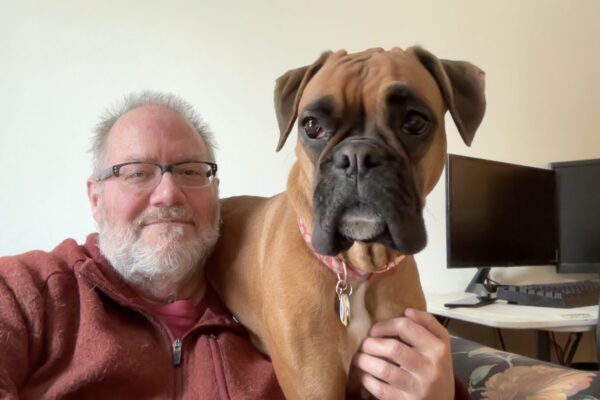
SDB: I don’t currently have a pet, but I spend a lot of time with my older son’s boxer dog. My family always had boxers when I was a kid. And when my kids were little, we had boxer dogs. And now my son has a boxer dog of his own. Her name is Tanuki, but we call her Tanuki-chan, Ta-chan, Ta-tan, Ta-taso. She wants to be lap dog — or maybe a parrot — when she’s not going ‘nuki-lar.
JSC: What’s your drink of choice?
SDB: In the morning, it’s coffee. I like my coffee with light cream. When I was in Spain, I fell in love with café-con-leche, which is what they generally call a latte in the US.
In the evening, I enjoy very hoppy beer, like an India Pale Ale (IPA). There is the wonderful Tree House brewery in Massachusetts that makes truly extraordinary Double, Triple, and Quadruple IPAs, which are a delight to the senses. They’re bit high in alcohol and calories, however, so I need to consume them in moderation.
I’ve also always been partial to rum. When I was studying mongooses in St. Croix, I fell in love with the Cruzan rum that’s distilled there. We would always visit the distillery for the tour and then get to sample the rum at the end. I can make a number of Cruzan based cocktails, like a Cruzan Blue Cosmo or Cruzan Caipirinja. Rum, of course, has even more alcohol than the strongest IPA.
JSC: Would you rather be in a room full of snakes or a room full of spiders?
SDB: Snakes. I’ve loved snakes since I was a little kid. One of my treasured memories as a child was visiting Silver Springs in Florida as a small child, where I got to hold an 8-foot indigo snake and to see a snake pit that was crawling with dozens of water moccasins and diamond-backed rattle snakes.
To be honest, I think spiders are pretty cool too. I especially like jumping spiders. My basement office frequently has cellar spiders hanging out around the lights and in the corners. I don’t mind my co-workers and enjoy taking breaks to watch them work.
Suggested Last Question:
JSC: What are you working on now, and what’s coming out next? Tell us about it!
SDB: I have three novella sequels for my Revin’s Heart series and, set in the same universe, I have a sapphic romantasy road-story, Lady Cecelia’s Journey, which I’m currently considering how to move forward with.
My next novel is The Ground Never Lies which is about a geomancer with an anger problem. She has come to believe that she is unlovable and, therefore, doesn’t trust herself to fall in love.
Her day job is using her geomancy for building lot assessments in a karst region, where people want to know what the risk is of sink holes before building. But she is also called upon to do crime-scene investigation by the constabulary.
The novel proceeds with two timelines: the present, where she gets caught up in a crime investigation that becomes personal, and the past, where we learn what dark events led her to be the way she is. They come together in the climax where the past and present intertwine.
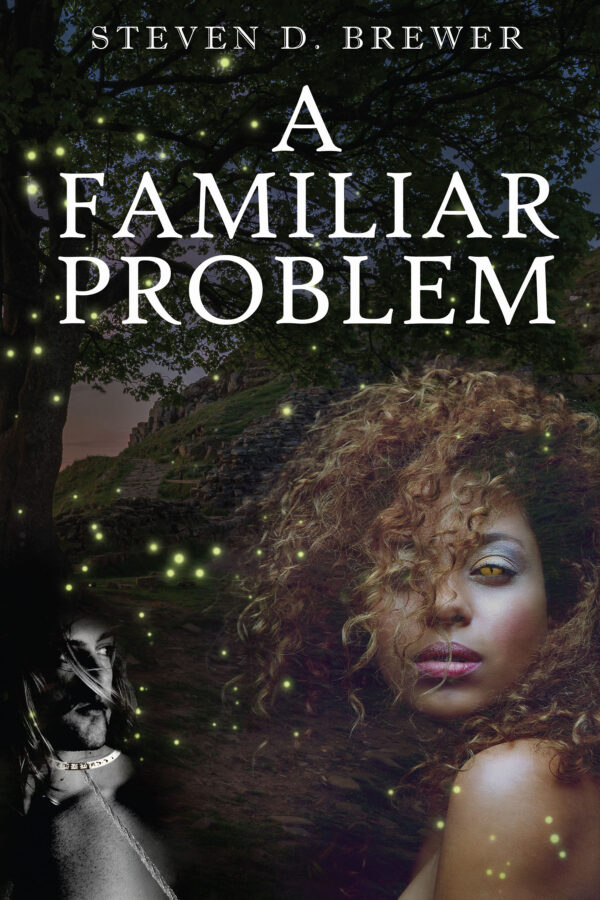
And now for Steven’s new book: A Familiar Problem:
Rory Soletsa is a 17-year-old in a low-magic dimension. A student at a magical academy, he is supposed to find a familiar. Instead, a demon captures him as her familiar to enter him in an illegal familiar-fighting tournament.
The demon secretly trains Rory. She requires him to improve his physical fitness and teaches him offensive and defensive magical techniques. The demon also introduces him to aikido…to get him to recognize that he should avoid opponents strengths and turn their strengths against them.
Rory has numerous harrowing experiences while registering and qualifying for the tournament. He is humiliated and tormented by demons while being inspected. But, after everything he’s suffered for, he finally reaches the tournament.
What will happen then?
Publisher | Amazon
Excerpt
“After our recent experience,” Tseluna said. “I think we should work on your obedience.”
“I already promised, didn’t I?” Rory said, looking down and scuffing his feet.
“You did,” she said. “But I still think we should practice. As my familiar, you should act without thinking when I give you direction.”
“That’s what I was doing when I went to save Aimee,” Rory said, sullenly.
“Yes, but you weren’t doing it because I told you to,” Tseluna chided. “I want to train you to obey me without thinking when I give you an order.”
“It doesn’t seem like a very good idea, to me,” Rory muttered.
“Hey!” Tseluna said sharply. Rory looked up. “Who is smarter? You or me?”
“You are,” Rory admitted.
“And who has more experience?”
“You do.”
“And so when I tell you to do something, what are you going to do?”
“I will obey.”
“You will obey…”
“I will obey without thinking,” he barked.
“Okay!” she said, clapping her hands. “That’s what I wanted to hear. Now, drop and give me 20 push-ups!”
“What! Why?” he said. Tseluna just looked at him reproachfully. He turned bright red, sighed, and dropped to the ground and did 20 pushups.