Genre: Science Fiction
Get It On Amazon
About The Book
He was a survivor—a wanderer who traded tales for food and shelter in the dark and savage aftermath of a devastating war.
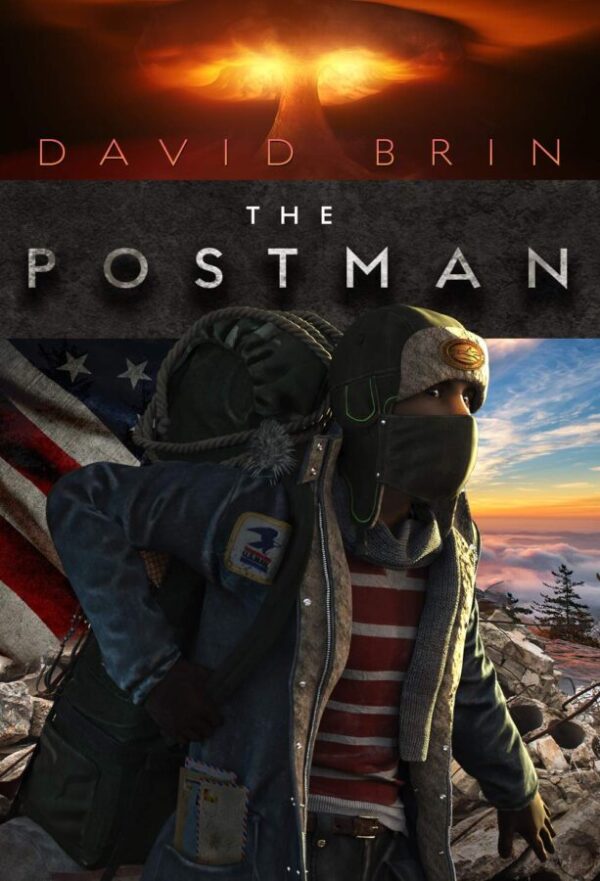
Fate touches him one chill winter’s day when he borrows the jacket of a long-dead postal worker to protect himself from the cold. The old, worn uniform still has power as a symbol of hope, and with it he begins to weave his greatest tale, of a nation on the road to recovery.
This is the story of a lie that became the most powerful kind of truth. A timeless novel as urgently compelling as War Day or Alas, Babylon, David Brin’s The Postman is the dramatically moving saga of a man who rekindled the spirit of America through the power of a dream, from a modern master of science fiction.
The Review
About a million years ago, when I was a freshman in high school, I haunted the sci-fi section in my school’s library, looking for new books to read. I picked up a thin mass market paperback called The Postman, by David Brin, and was hooked by its inspiring story and its idealism.
Flash forward 43 years, and I finally got to meet Brin at WorldCon in Seattle. I read a few of his more recent YA books, and then decided to go back and see if The Postman was everything I remembered it to be.
What I didn’t know was that the version I read was only the first third of the story. The book was republished in a much longer version a few years later, and I only read the new parts for the first time this month.
The story was made into a movie staring Kevin Costner back in 1997. I’m not sure if I ever saw it, but it got mixed reviews.
The story is told in three parts – in the first one, Gordon Krantz, a survivor of the civilization-ending war twenty years before, finally makes it across country to the Willamette Valley in Oregon. He gets waylaid by bandits who steal all his gear, and barely escapes with his life. Buried underneath the brambles, he finds a US Postal Service truck and its long-deceased postman. Thankful, he “borrows” the man’s uniform and mailbags, makes up a cover story, and sets off to find a town that will help him.
In the valley, he finds flickers of a rebounding civilization. A number of tiny villages have managed to survive, and the denizens of Pine Valley are amazed at something they thought they would never see again – a postal representative from the “Restored United States.” When he produces a bonafide letter to one of the residents, it seals their belief in his tall tale.
Gordon gets taken in, and soon falls victim to his own scheme. He sets up a post office in the town, and in the process sparks something in its citizens. But soon enough, to keep up the ruse, he must leave and take mail to the next town.
I won’t give away the rest, except to say that this tale was exactly what I needed right now – a reminder of the people we used to be here in the United States, and that we could be again if we tried. Gordon the postman becomes a channel for everything these poor folks have lost, and a beacon for what they might become again. His Big Lie helps to bring about the very thing he lied about – a restored Oregon, ready to fight off its barbarians and move into the future.
I used to look at my country in this idealistic this way. Reading The Postman was like a crash course in the things that the United States once stood for, and a reminder that we might do so once again. For a story that’s more than four decades old, it rings with a truth that’s just as relevant today as it was when Brin first penned it.
But aside from being a mirror held up to our own world, The Postman stands on its own as a well-written tale that I enjoyed just as much this time as when I first read it as a callow youth. Only this time, I can see its depths with far more clarity.
Highly recommended. Forget the film, and pick up a copy of the original – you won’t be disappointed.
The Reviewer
Scott is the founder of Queer Sci Fi, Liminal Fiction, and QueeRomance Ink, and a fantasy and sci fi writer in his own right, with more than 30 published short stories, novellas and novels to his credit, including two trilogies.