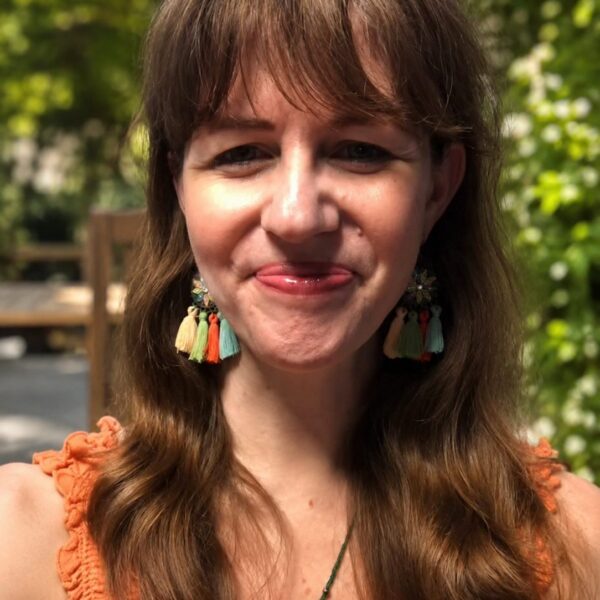
Welcome to my weekly Author Spotlight. I’ve asked a bunch of my author friends to answer a set of interview questions, and to share their latest work.
Today: K.D. Falcon is the author of the upcoming Just Go-For It, a darkly playful coming-of-age novel about Hannah Johnson, a 27-year-old woman who spends her nights holed up in her childhood bedroom with mac n’ cheese and sitcom reruns.
But all that changes when she discovers a velvet-draped tunnel behind a Rite Aid, slipping through the cracks of reality and into an underground dance party. With the help of a mysterious green drink, Hannah embarks on a mind-bending journey filled with mesmerizing strangers, uninhibited connection, and increasingly questionable decisions.
Instagram: https://www.instagram.com/k.d.falcon/
Substack: https://generatemagic.substack.com/
Thanks so much, Kate, for joining me!
J. Scott Coatsworth: When did you know you wanted to write, and when did you discover that you were good at it?
K.D. Falcon: It’s been my dream ever since I was a little kid. I was always good at writing English essays and won lots of writing awards but struggled to express myself creatively. I was a sensitive, serious kid and was crushed when my first short story didn’t get the reception I was hoping for from my peers. I thought I’d go into academia or become a critic because that felt safer.
Then one of my mentors planted the first seed when I told him I wanted to write book reviews and he said, “Why don’t you just write books?” The second seed came from Aimee Bender, who was my creative writing instructor at USC and was so wonderful, positive, and encouraging. She showed me how writing could be fun and playful and didn’t have to be such a serious endeavor (lol).
Other positive influences were Benjamin Weissman, Jilly Dreadful, and my amazing editor (and former classmate) Sorina Fant, who have shown me nothing but encouragement and unwavering belief. Eventually I learned to be my own cheerleader and not to rely so much on external validation, but these influences made a huge difference in the beginning!
JSC: How would you describe your writing style/genre?
KDF: My writing is a mishmash of genres, and I don’t adhere to genre conventions. Perhaps, then, a refusal to play by the rules is a defining trait of my fiction. Magic portals often make an appearance, as do coming-of-age themes. So perhaps “thresholds” could summarize it? Liminal spaces? How appropriate! 🙂
JSC: Do you use a pseudonym? If so, why? If not, why not?
KDF: Yes, in case it’s not obvious haha. I actually have a couple. I invented Clarice when I was teaching at a very conservative religious school and didn’t want word getting out that I was writing a deranged horror novel. And indeed, having pseudonyms allows me to write more freely and not feel the need to censor myself. But also I just think it’s fun, like having an alter ego! It really is a bit like method acting for me where I start to inhabit that character.
JSC: Do you ever base your characters on real people? If so, what are the pitfalls you’ve run into doing so?
KDF: Pretty much all of them have traits of real people. I like to mix and match so it’s not so obvious and change names to protect the innocent lol, but for those who know me really well, they would probably still be able to tell. The thing too is that I exaggerate to make it more interesting, so it often makes them seem worse than they actually are! This is yet another good reason to use a pseudonym. I don’t want to hurt people, but I also need to be able to express these things. Writing is very therapeutic for me and actually allows me to see people from my past in a more compassionate (or at least more neutral) light.
JSC: Are you a plotter or a pantser?
KDF: A little bit of both. My stories often start with a seed. For instance, my WIP was born from the line from Alice’s Adventures in Wonderland, “I can’t tell you about yesterday because I was a different person then.” Another seed for this story came from a memory: back when I was a tutor, a friend asked if I ever met any “hot dads.” Then a writing exercise where I had ten minutes to write a story using random words (three of them, I remember, were “gopher,” “frisbee,” and “bologna”). These seeds started to form a story.
But I still didn’t have a structure. And in the past, when I didn’t have a plan, I’d eventually write myself into a corner. My mentor at the time, Jill, recommended a book called The 90-Day Novel which really helped. What I learned is that the structure doesn’t have to be rigid, and there’s still a lot of room to play within the framework. In fact, I found that it actually freed me up creatively because I didn’t have to put so much energy into thinking about what happened next. I could focus on more interesting things like character and scene building!
JSC: Could you ever quit writing? Do you ever wish you could? Why or why not?
KDF: I don’t know if I ever completely quit writing fiction, but I wrote very sporadically after completing my MFA program. I no longer had the structure and support that the program provided, plus I wasn’t that motivated because I was still buying into the starving artist belief. I feared that if I really went for it, I was just setting myself up for disappointment. Then I started working as a freelance copywriter, so part of me would justify the fact I wasn’t focusing on fiction anymore by saying, “See, I’m still writing.”
Still, when people who knew me from my fiction days asked how my writing was going, I felt like a part of me was dying. When I started to experience a downturn in my copywriting business, I figured I had nothing to lose by going all in on my fiction. Everything started to feel right again, and I realized it was only inaction and knowing I wasn’t pursuing my heart’s desire that was causing the sense of unease. And as hokey as it sounds, the only way you can truly fail is if you don’t even try.
JSC: Choose a passage from your writing. Tell me about the backstory of this moment. How you came up with it, how it changed from start to end.
KDF: Below is a passage from “J.J. Fowler.” It’s a pivotal one, leading to the discovery of the secret room. The location was inspired by these blackberry patches in the alley behind my grandparent’s house that I discovered as a kid. It felt like a secret little world that only I knew about. When revising the scene, I added in more details, especially when it came to describing the door and its placement in the bushes. I realized it was clear in my head but not to the reader, which is often the case!
Sometimes I hate my mom, even though Mrs. Jensen, the school counselor, says we don’t actually hate our parents, we just think we do. After school, my mom sits me down, all serious-like, and tells me I need to be nicer to Phil, especially with his birthday coming up.
“Okay, Mom, I’ll try.”
“What do you mean, try?” She leans forward, frowning, like she’s trying to see straight into my head. I avert my eyes, focusing instead on the box of Hamburger Helper sitting on the counter. I suppose that’s what we’re having for dinner tonight. The TV mutters faintly from my mom’s bedroom, or rather, the room she shares with Phil (I can’t bring myself to call him “Dad”). Gunshots. A Western, it sounds like.
“I mean I’ll try.” I push back my chair and start walking away, eager to read my new book about crop circles.
“Just where do you think you’re going?”
“To my room. I have a lot of homework.”
“You haven’t been listening to me at all, have you?” She narrows her eyes at me. “Always thinking about yourself. You have no empathy, I swear.”
“Empathy” is a word Mrs. Jensen uses a lot, and it pisses me off every time I hear it. I make a weird face, which I do when I’m angry and trying to hold it in.
“J.J, what’s wrong with you?” my mom says, her tone softening, concern rippling through her voice.
Unable to control my face anymore, I storm out the door.
The sky is a swirl of blue and gray, speckled with torn-up pieces of cloud. I wander until the houses thin out and, without really meaning to, I end up at the blackberry bushes. Some of the riper berries have fallen to the ground, pulsating under a trail of ants. I salvage what I can from the rest.
I spot a deflated soccer ball at the base of a cottonwood tree. I kick at it lazily, seeing if I can inject some life back into it. It rolls into the bushes, making a strange thud.
I peel back the branches and come face-to-face with a door. It’s wedged into the thicket like it grew there, the wood weather-stained and half-hidden by tangles of leaves. The branches clutch the frame so tightly it’s hard to tell what kind of building it’s attached to—if it’s attached to anything at all. There’s no way anything bigger than a shed could fit in that space.
I turn the knob, and to my surprise, it opens. Inside, I grope around until I find a string. A lightbulb blinks on, weak and yellow.
The room feels small, but bigger than it has any right to be. The air smells of dust and mothballs, but in a cozy, old-person way. In the middle sits a squat plastic table surrounded by bright, stubby chairs, the kind you’d find in a kindergarten classroom. A faded painting of a castle hangs crooked on the wall.
It looks like a den, only cut off from the rest of the house. I’d always wanted a little room where I could block out all the stupid stuff going on around me, where I could be home but not home at the same time. As an added bonus, it would have snacks, beanbags, and an entertainment center, so I wouldn’t get bored like I would living in the woods (which has definitely crossed my mind).
But this is even better, because no one knows about it but me. My heart pounds, and suddenly I have all this weird energy. I do a handstand for the first time in my life.
JSC: They say to Write What You Know. Setting aside for a moment the fact that this is terrible advice…what do you Know?
KDF: Well, I’ve modified that advice a bit. Actually, it’s some of the best advice I’ve ever received: “Put something real in your writing.” For instance, in the scene above, the blackberry patch is real. In “Check Yes or No,” the scene where Sarah gets the fake love letter from her crush (as part of a class prank) is, unfortunately, based on a real experience. Packed into these experiences is the emotional texture (the heartache, the humiliation, the joy of discovery) that makes the scenes feel vivid and relatable. But to answer your question more specifically, I know what it’s like to feel misunderstood and to have very “unique and special” (lol) problems, which can be translated to the page in infinite ways!
JSC: What qualities do you and your characters share? How much are you like them, or how different are they from you?
KDF: Ooh, I was just thinking about this! Sarah as well as Hannah (from my WIP) are very much like me (although I should clarify, I’ve never had an affair with a student’s dad). Now, I’m obviously not a middle-school boy, but when writing from J.J.’s POV, I was easily able to tap into that deep sense of isolation I felt when I was his age.
Now, other characters feel very different from me, at least on the surface, but I’m still able to tap into their inner worlds. Like with Bobby, J.J.’s more popular counterpart, I’m able to access that feeling of desperately wanting to fit in, particularly as a kid. And with Sofia, another character in my WIP who’s an investment banker at the senior level and mother of two, I can relate to that feeling of achievement becoming hollow, forgetting how to have fun, being a bit jaded at times. It’s super exciting, like unveiling this rolodex that reveals more and more facets of me!
JSC: What are you working on now, and what’s coming out next? Tell us about it!
KDF: Current I’m working on a novel called Just Go-For It, which is very loosely inspired by Alice in Wonderland and the idea that life can change in an instant. Hannah Johnson is an Ivy League graduate who’s succumbed to a life of mediocrity, spending her nights holed up in her childhood bedroom eating mac n’ cheese and watching reruns of Two and a Half Men.
But all that changes when she discovers a mysterious tunnel behind a Rite Aid, slipping through the cracks of reality and into an underground dance party. With the help of a mysterious green drink, Hannah embarks on a mind-bending journey filled with mesmerizing strangers, uninhibited connection, and increasingly questionable decisions.
Then an unexpected job tutoring for a wealthy family—and her growing infatuation with the alluring Mr. Goldstein—shakes up her reality all over again. From there the book kind of morphs into a romance and tale of forbidden love, though it’s by no means a “typical” romance. Case in point, about halfway through we slip into the POV of Mrs.Goldstein (aka Sofia, our investment banker), who has an awakening of her own!
Coming-of-age is a HUGE theme in my works and my earlier writing features mostly adolescent protagonists, as we see in Step Inside and See What Happens. But as Emily Henry once said in an interview (and I’m paraphrasing here), adults can also have a coming-of-age era. After all, we’re always growing and changing!
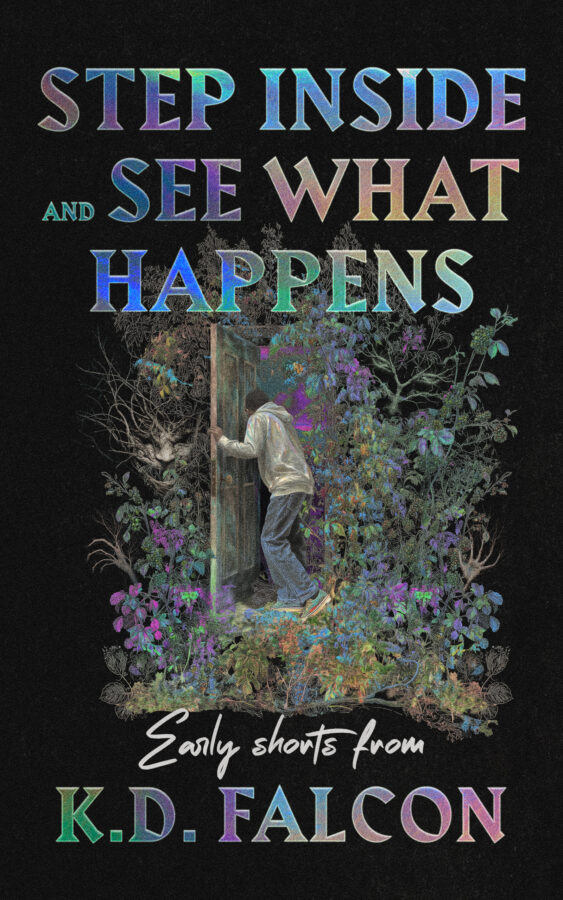
And now for AUTHORNAME new book: TITLE:
What if the only way to escape your troubled life was through a secret portal?
In “J.J. Fowler,” a middle school outcast stumbles upon a door hidden in the blackberry bushes. On the other side is a room that shouldn’t exist—one that shifts and reshapes each time he enters. It could be his refuge, his escape, or even his home… if it doesn’t consume him first.
In “Check Yes or No,” a 14-year-old girl discovers an image of her adult self, pulling her into a strange game of self-discovery. Each time she slips into that world, the boundaries of past, present, and future blur, leaving her unsure of who she really is.
Think Stand by Me meets Eternal Sunshine of the Spotless Mind, with a dash of Twin Peaks—two uncanny journeys into the spaces that shape us and the memories that won’t let go.
Story Origin
Excerpt
“Check it out,” Tommy says to Sarah and Amanda.
Amanda is Tommy’s on-and-off girlfriend. Sarah thinks of her as an all-access pass. Every time she goes to Amanda’s house, Amanda says, “I have a lot of movies, you know.”
“I know,” Sarah always answers. Then they go to Tommy’s.
Tommy lives in a condo. Sarah used to think that would be cool because you get to swim without sneaking past security guards, but his condo is kind of crappy. Off-white buildings cluster together like hermit crab shells. Tiny satellite dishes tilt from balconies, keeping watch on whoever comes and goes.
Whenever the wind picks up, the dumpster lid flips open, sending beer cans and fast-food bags skittering across the asphalt like urban tumbleweeds. Women who could pass as bartenders at places named Whiskey Pete’s or Slick Willie’s pace the perimeter, hand-in-hand with men who look like they’ve been awake for three days straight.
Tommy ushers them into his parents’ bedroom. Amazingly, they’re never home. The air swelters with Lysol layered over cigarette smoke. Clothes sprawl across the floor. Sheets and blankets mound on the bed like a frumpy updo.
Tommy pulls a deck of cards from beneath the bed and fans them across the carpet with a magician’s flourish. Every card features weapons and women: legs shimmying up to swords, pistols tucked like bouquets against bare shoulders, elegant fingers tracing the edge of razor blades.
“Pretty fucked up, huh?” Tommy says.
Amanda rolls her eyes.
“Your parents are cool,” Sarah says. If her parents were once cool, she never witnessed it for herself. All her mom ever talks about are diets and what so-and-so in the Sewing Society is up to, and her dad sometimes wears a fanny pack. Tommy’s parents smoke weed and listen to Green Day.
Sarah notices a shimmer peeking from the deck.
“What’s that?” she asks.
“Nothing,” Tommy says, sliding the cards back together.
***
Amanda and Tommy sit on the edge of the bathtub. Sarah leans against the sink, picking at her nails. Amanda runs a woman’s razor up and down Tommy’s lathered leg. He whispers something; they giggle.
“What’s so funny?” Sarah asks.
“Believe me, you don’t want to know,” Tommy says.
Amanda’s eyes apologize to her.
“Sure I do.”
“You wouldn’t get it anyway.”
“I’m not as innocent as you think.”
Both Tommy and Amanda laugh at this. Sarah feels like a deflated pouch of Capri-Sun.
“Don’t you have homework?” Tommy says.
Sarah drifts back to the parents’ bedroom and drops to the floor, stabbing at the carpet with her nail file until sandpapery specks scatter across her knees. The floral pattern on the fan blades gapes at her like googly eyes. She imagines Tommy’s hand on Amanda’s leg now, creeping higher.
In the stand-up mirror, her reflection stares back. Her hair looks like a bird’s nest drizzled in semen—her version of the “tousled beach babe” look from Seventeen, achieved with vinegar and baby powder. Around her neck hangs a quarter-machine ruby ring on a string. Really, girlfriend? Vanessa would say.
The giggling grows louder through the wall. Sarah rifles through the deck of cards again, hunting for that shimmer she saw earlier.
One card feels different. Cold, silky, framed in silver like a celluloid screen. The image reveals a sepia-toned woman seated at an oval glass table, chandelier twinkling overhead. The whole thing looks elegant, like a Victorian tea party.
The woman, wearing a pastel pink gown with puffed sleeves, is easily her mom’s age. Yet as Sarah studies the image, a truth settles into her, hard as concrete: the woman is her.