Welcome to my weekly Author Spotlight. I’ve asked a bunch of my author friends to answer a set of interview questions, and to share their latest work.
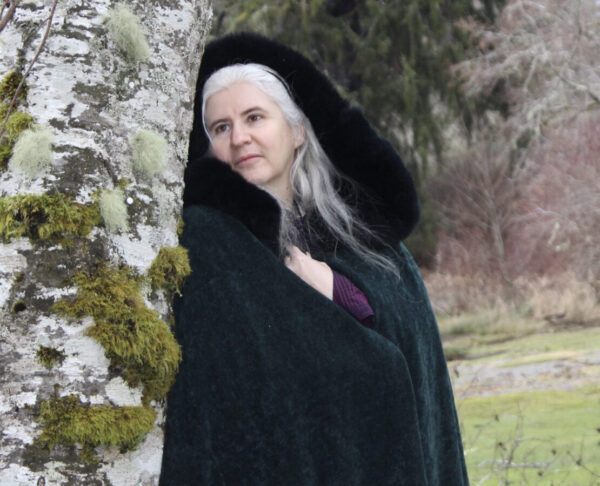
Today: Alma Alexander’s life so far has prepared her very well for her chosen career. She was born in a country which no longer exists on the maps, has lived and worked in seven countries on four continents (and in cyberspace!), has climbed mountains, dived in coral reefs, flown small planes, swum with dolphins, touched two-thousand-year-old tiles in a gate out of Babylon. She is a novelist, anthologist and short story writer who currently shares her life between the Pacific Northwest of the USA (where she lives with two obligatory writer’s
cats) and the wonderful fantasy worlds of her own imagination. You can find out more about Alma and her books on her website
(www.AlmaAlexander.org), at her Amazon author page (https://amzn.to/2N6xE9u), on Bluesky (@almaalexander.bsky.social), at her Facebook page (https://www.facebook.com/AuthorAlmaAlexander/), or at her Patreon page (https://www.patreon.com/AlmaAlexander)
Thanks so much, Alma, for joining me!
J. Scott Coatsworth: When did you know you wanted to write, and when did you discover that you were good at it? How long have you been writing?
Alma Alexander: I did not suddenly “know that I wanted to write”. I just… started writing. Other people saw themselves growing up to “be” things, I just “was” one. I was a writer forever. I taught myself to read at age 4; started putting down my own words on paper as soon as I could hold a pencil in my pudgy little hand. I wrote my first poem aged 5. My first (badly derivative) novel at 11; thankfully, it does not survive. My first GOOD novel at 14 (that one does survive. SOme day I might do something with it). In the years since I have produced dozens of novels, hundreds of stories, heaps of poetry, lots and lots of non-fic. As to discovering whether or not I was good at it… I have awards that prove it, the first of which I won when I was 12 years old, and twice in my writing career my GENRE books were finalists for the Washington State Book Awards. Also, generous readers have been giving me their responses for nearly six decades now. I’ll take their word for it.
JSC: Do you ever base your characters on real people? If so, what are the pitfalls you’ve run into doing so?
AA: I wrote Nikola Tesla into the matrix of my Worldweavers series, and I did a fair amount of research for that at the time (including being in New York, and staying in the New Yorker Hotel, where he died, in the very room that he once lived in. No, I was not haunted. I was kind of annoyed at that. I was HOPING for it.) The man was a genius but he was also certifiable in so many ways and the tightrope there was creating a character who was crazy, likeable, and worthy of respect all at the same time. That is not as easy as it sounds (oh, it doesn’t sound easy in the first place…? sorry…) But I had an enromous amount of fun doing that. His character was an utter gift. In another novel, I (re)created a character who was pretty clearly based on a historical character of, shall we say, ill repute. Turning HIM into a real person (who does all the wrong things for what seem to him to be all the right reasons), as well as an unexpected romantic foil for my protagonist, was a real challenge. Read “Embers of Heaven” for more. In general, reinventing real people as fictional characters can be… an interesting task. But in a really weird way, because they are already semi-established, as it were, in a known reality and a real-life persona, they can be much less feral than characters you invent whole-cloth. The latter, at least in my work, tend to take the bit between theiri teetn and run with it in a way that a “real” character, constrained by their “real” history, simply cannot.
JSC: How long do you write each day? How long on average does it take you to write a book?
I may not even WRITE “each day”. Sometimes I don’t physically write, as in putting words on a page, for weeks. But stuff is percolating in teh back of my brain at those times, waiting for a shape and form in which it can emerge – so it counts as “writing” in a way. I also dream stuff that finds its way into my writing so you might say I am “writing” 24/7, as it were. As to how long it takes to write a book, all I can ask in return is “which book?” – some take mere months, at white heat, and some can take literal years, occasionally in stops and starts. Still others basically practice guerilla wordwarfare and come careening out of ambushes to take over the writing brain and derail it out of any current writing endeavour and demand that they, themselves, have absolute priority and need attention FIRST.
I write. I do not question the process. My muse is not a gentle wafty nymph whispering sweet nothings into my ears, it’s more like a loud sergeant major wielding a sledgehammer of discipline – and sometimes it is absent altogether leaving me to fend for myself (which never ends well). But I write like I breathe. It is just part of who and what I am.
JSC: Who did your cover for The Wind’s Four Quarters, and what was the design process like?
AA: The cover was designed and produced by Maya Kaathryn Bohnhoff, who is brilliant at this, but the twist in this particular cover is that I wanted a Compass Rose on the cover and the images that I found that I liked for it were often iffy in terms of I wasn’t sure if they were royaltied and if so who needed to be approached for permissions and how much it would all cost. So I decided to take matters into my own hands, as it were. I found a couple of suitable images, I transferred them onto fabric, and I EMBROIDERED THEM IN SILK AND GOLD. Maya did the rest, with the images I provided of those works. But the cover of this book… is quite literally something I created myself. And it was fun; it had been a while since I had done any fine needlework like this. The unexpected result of this, though, is that I now find myself in a position of having signed up to actually teach a class on silk and gold embroidery at a local craft store and needlework class emporium. Strange are the ways of the universe.
JSC: Let’s talk to your characters for a minute – what’s it like to work for such a demanding writer? Are you happy with where your writer left you at the end? (don’t give us any spoilers).
AA: [characters]: LOOK. Don’t even get us started. She finds creative ways to torture us even when there are no such ways in obvious sight – she is gifted that way. She tries to offer closure but boy howdy do we have to pay through the nose for that. She’d better not come alone into a dark alley at night because she would probably get mugged… oh, who are we kidding… we probably have a feast waiting for her.
JSC: Were you a voracious reader as a child?
AA: As I said before, I taught myself to read at 4 because mother wouldn’t read me a favourite book again as soon as she was finished reading it to me for the first time (and yes, it was “Heidi”, it was a Real Book and not See Spot Run. I just skipped over that stage of “reading” completely and leaned into WORDS.) In the aftermath of that, I read like a true bookworm, just devouring anything put in front of me. By age 7 I had blown through the entire collection (the books that interested me, at least) of our local children’s library, and my father got me an adult card, much to the consternation of the librarian. But I was reading Sigrid Undsett and Henryk Sienkiewicz and Pearl Buck (all Nobel Lit Prize winners) before I was ten, and the full unabridged Forsyte Saga by John Galsworthy (another Nobel laureate) in a completely different second language by the time I was 13. I currently live in a house WITH A ROOM THAT IS A LITERAL LIBRARY, wall-to-wall and floor-to-ceiling bookshelves stuffed and overstuffed with books (for a full tour, may I recommend my recent book “Alchemy of the Word”) To summarize. I have never known, nor do I wish to imagine, a world in which READING was not a foundation. I am and always have been a child of the word, and I glory in that.
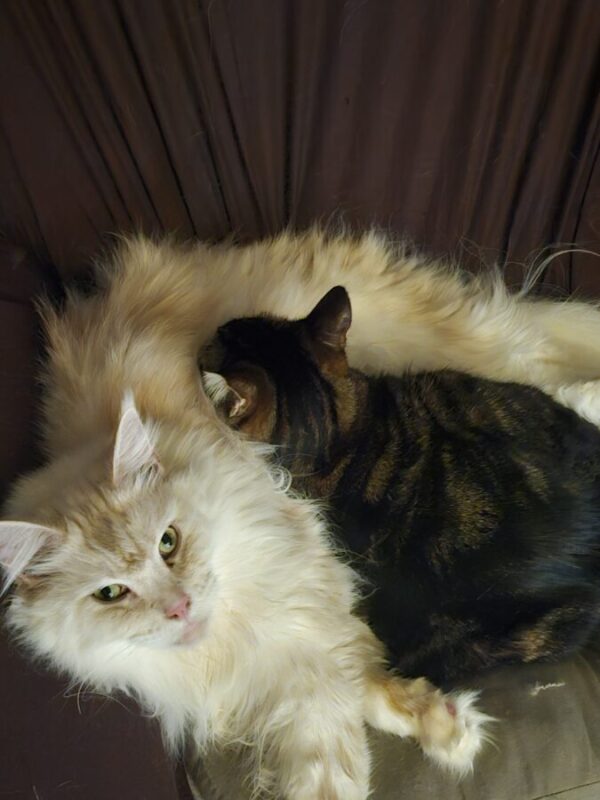
JSC: What pets are currently on your keyboard, and what are their names? Pictures?
AA: Current feline overlords are the princess and the pauper – the first being Avalanche (otherwise known as Creampuff, the WHite Lady, and often “AvaNO!” when she creates mayhem), a pedigreed ex-grand champion Maine Coon who came to rule my roost as her retirement package, and the second being a shelter rescue ex-street-feral and congenitally half-blind moggy lovebug variously known as Blackjack, Muffinface, and “QUIT-it”. They love each other. And I adore them both.
JSC: What other artistic pursuits (it any) do you indulge in apart from writing?
AA: well, as I mentioned, there is the embroidery and needlework – I also do wool tapestry and I have several of my efforts in my house, framed on the walls (one looks just like a painting until you look closely and see all the stitches…) or hung on a rail like medieval tapestries covering an entire wall, or made into cushion covers for display cushions. I also dabble in photography – I have, in fact, actually had a show once of my photos. People came in and looked at them. I even sold some. I really like black-and-white work, which relies on vision and texture and context far more than color photos do. I am told I have a good eye.

JSC: If you could choose three authors to invite for a dinner party, who would they be, and why?
AA: Living: Alix Harrow, Joanne Harris, and Guy Gavriel Kay – because for all three of those people the guiding principle would be that I am utterly in love with their words and their worlds and the idea that I could have them all around my table AND TALK TURKEY ALL NIGHT is intoxicating. My only problem would be to stop being a giggly fangirl and actually make some sort of contribution to the conversation as opposed to just sitting there and grinning like a loon and listening to them talk.
If I am having a seance and inviting the ones who have already left us, then J R R Tolkien, Ursula Le Guin, and Roger Zelazny. The first because he was the writer who showed me *what was possible*. The other two because I respect and admire them. I have often told people in other interviews that i wanted to be Ursula Le Guin when I grew up; when someone compared my work to hers once in a review I think I grew several inches that day just by holding my head that much higher with pride and joy. As for Zelazny, I had the utter privilege of having met him literally months before he died – and the thing he told me about my writing on that occasion has been my guiding light for decades. I would really love a chance to thank him for that.
JSC: What is the most heartfelt thing a reader has said to you?
AA: “We were under a tornado evacuation warning and my daughter chose five things to take with her into potential exile – her favourite bear, and your Worldweavers books…”
JSC: What are your least favorite parts of publishing?
AA: *Marketing*. If I could sell things I would have sold things and been considerably better off than a random creative. For me, the thing is to write the book, to create the story. I wish someone else would take over the SELLING of said books to potential readers. I am terminally lousy at that.
JSC: If you were stuck on a desert island all alone with only three things, what would they be?
AA: Tolkien’s “Lord of the Rings”, Guy Gavriel Kay’s “Tigana”, and Alix Harrow’s “Ten Thousand Doors of January”. And don’t even bother looking for me, if I have those.
JSC: What action would your name be if it were a verb?
AA: Procrastination
JSC: What book is currently on your bedside table?
AA: I Contain Multitudes by Ed Yang (non-fic)
JSC: What’s your drink of choice?
AA: Coffee. I am an ADDICT. I tell people I have just enough blood in my coffeestream to qualify as a human being…
JSC: What are you working on now, and what’s coming out next? Tell us about it!
I spent the last five years of my life mired in grief and caregiving, losing my beloved husband (my first reader, my first editor, my one-man cheering section and my best friend), a 19-year-old cat (I SO wanted her to reach 20. I would have thrown her a party.) and my mother (whose slow slide into physical frailty and dementia frayed me and my faculties to a quiet near oblivion of my own), in that order. It’s been YEARS since I have done any real writing because there was no space in my life for it at all. But the well is refilling, slowly. There have been a couple of short story sales in this last year. There’s the ambush book of “The Wind’s Four Quarters”, which arrived uncalled for and demanded that it be written. And then I went back to a book I started six years ago and then abandoned in the fallow fields of grief in the intervening time between then and now. It had some 20 000 words in it. I looked those over, found them worthy, and decided to continue. But then I found out that my beginning was not where I began this story, and so I went back a bit to where the true beginning was and started again. And realised that my book was TWO books. So I think for the next year or so my writing goals are set. Not sure if I will offer up book 1 when it’s done while I am working on #2, or just wait until I am done with both and put a duology out there from the get go, but that is a question to be answered down the line. For the time being… I am WRITING AGAIN, and I am grateful for that.
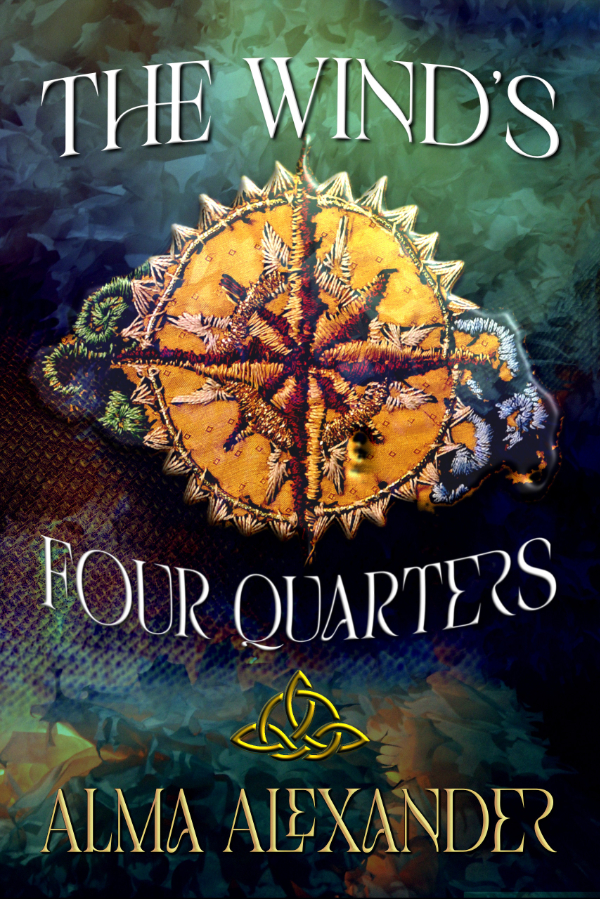
And now for Alma’s latest book: The Wind’s Four Quarters:
Many things come to you when the wind blows.
The wind brings the scents of spring flowers, of the sea’s salt air, of the landfill or the charnel house or the tanning works, of petrichor, of the first hint of frost in an autumn morning.
The wind blows around the red and gold fallen leaves, or dust, or tumbling rubbish in deserted city streets at night.
The wind can bring a waft of freshly baked bread or donuts, and make you hungry. Or a hint of perfume once worn by someone you loved and lost, and make you sad.
The wind blows in grief and joy. Love and loss. Life and death.
Amazon | Universal Buy Links | eBook From Author | Signed Paperback
Excerpt
South Wind
What can you say about the South Wind? She is barely a wind. She is a zephyr, a breeze, a warm breath stirring the leaves and women’s hair, picking up scents from flowers and bringing them to unexpected places where they arrive like dreams and people close their eyes and take a deep breath and inhale and instantly believe…
…in lies.
Because the South Wind is tender-hearted. It isn’t that she is blind, or indifferent to pain – it’s just that she doesn’t like to speak about it or call it by name. It could make grief deeper, or joy too much to bear. So, she lies. She tells tender little lies with every sweet scent she carries – she whispers that everything will be all right, every little thing will be all right, the air will always smell like summer and summer will never end, one day after another filled with sunshine and beauty and dreams fulfilled.
Those who live in the real world, though, can find themselves becalmed in a place where the South Wind does not blow, and in that moment of empty silence bereft of beguiling scents of hope and joy someone could open their eyes instinctively, or take a breath of that empty air, and the world around them changes, and all that South Wind light and colour turns to grey, and dim; to ashes.
Because no joy is forever and every dream ends – and the South Wind cannot deal with that reality. She tries to blow again, to carry scent again, to tangle loose hair on lovers’ heads as they lean into one another sitting on the sunlit sands of beaches lapped by sparkling waters, to bring the sound of birdsong, or a somnolent hum of happy bees going about their business. It’s all about Sunday ice cream or playing hooky on a boring weekday, while the South Wind is blowing and the promise of romance is in the air like blowing rose petals.
But she lies. All the stories she tells are not real; she creates them out of light and bird trills and the smell of summer roses. The light of day always sinks into night. The birds fly away for the winter. Roses wither and die on the stem when the first frost sets in. It was all wonderful. It was all beautiful. It was all a lie. The South Wind cannot tell you the truth – she cannot bear it. It is too harsh for her soul, and therefore she cannot inflict it on yours.
Love her. Reach out and embrace her – but close your eyes, and do not look at that thing that’s just out of your sight; because if you do then you will let the truth in, and when you let the truth in the South Wind will withdraw into silence and into pain. Love her, always. Never, ever, trust her.