
Welcome to my weekly Author Spotlight. I’ve asked a bunch of my author friends to answer a set of interview questions, and to share their latest work.
Today: James is an author and video game developer based out of North Carolina, USA, specializing in fantasy more broadly. He runs a storefront selling old collectibles (particularly TCG cards, like Pokémon and Magic: The Gathering) on top of his writing and game development.
Born in Hawaii to a military family, James spent much of his childhood moving around to various military bases, spending a large chunk of his childhood in Europe. With a background in hard science and philosophy, he likes to bring in those roots into his writing, along with inspiration spun from a lifetime of reading anything he could get his hands on, plenty of travel as a child and as an adult, and a debatably unhealthy amount of video games (especially classic RPGs and SRPGs, like Golden Sun, Fire Emblem, and Dragon Quest).
In addition to writing, game development, and store management, James enjoys gaming, listening to heavy metal (and is known to sing along with death metal), gardening, and baking. He has a geriatric parakeet and three rambunctious cats, the latter of whom all yearn for the top-shelf kibble that has been promised to them.
Substack: https://acktar.substack.com/
Bluesky: https://bsky.app/profile/acktar.bsky.social
Itch.io: https://acktar.itch.io/
Instagram: https://www.instagram.com/im_trogdor/
Thanks so much, James, for joining me!
J. Scott Coatsworth: What was your first published work? Tell me a little about it.
James E. Honaker: There are three different answers to this. The technically correct, and least-interesting, one is that I was a co-author on a scientific paper published in 2015, for research involving liquid crystals and being able to evaluate surface properties with how they deformed in a solution. That’s probably not too relevant here, but it’s technically correct.
The more “proper” answer depends on if you want to count my video games, another thing I do on the side, in the equation. If you do, then my first published work was in October 2023, a little indie strategy RPG I made in the vein of Fire Emblem. It’s called Chronicles of Dramarith I: The King of Light and His Dark Heir, and it’s been out for 2.5 years now (and gets updates to improve it as I have time and resources to sharpen it up).
As for novels and what not, my first published one came in August 2024, when I put out Beyond Good & Evil: The Horizon’s Edge. It was a fantasy story I’d started working on over a decade ago, a synthesis of video game settings (most notably Baten Kaitos: Eternal Wings and the Lost Ocean and The Legend of Zelda: Skyward Sword), mixed in with fantasy adventure and a bit of pointed religious critique. It’s gone through many rewrites and restructurings over the years, so while the original version dates back to 2011, the story I published only has a couple of common characters and the overarching setting as the constants.
So, my first published work is either a scientific paper in 2015, a video game in 2023, or my first novel in 2024.
JSC: Do you ever base your characters on real people? If so, what are the pitfalls you’ve run into doing so?
JEH: Very much so! Early on, I had several friends who I used as bases for characters in my stories, though I always made sure to not just copy-and-paste them with no changes. It’s about making them the most “exciting” version of themselves, drawing out particular threads and character traits that I think would make for fun interactions and reactions when placed with everyone else.
In general, I tend to prefer to make those real-life “inspirations” less antagonistic, but there are exceptions, and I’ve based two antagonists off of people I know (or know of, at least). It turns out that “bisexual vegetarian pagan vampire” is already insane enough that I can take it and work some magic on it to make it even more absurd and over-the-top.
I think there’s always a fine line to walk. You can’t just put someone you know into your stories without alteration, because that often is neither interesting nor prudent from a legal perspective. But I’ve definitely drawn inspiration, both positive and negative, from the people in my life, and they can make for interesting foundations to structure things off of.
JSC: If you had a grant to write any book you wanted as a freebie without worrying about sales, what kind of story would you like to tell?
JEH: If there were no constraints, I’d love to try and capture something epic in scope, about a sprawling conflict with moral ambiguity and different perspectives. The story I come back to a bit is Fire Emblem: Three Houses, a video game where there are four factions with different, yet convergent, histories and wildly different motivations. It’s not just a blanket “good versus evil” story, but more asking what matters and if there is a moral absolute.
I’d love to write something that captures the feeling of playing that game. Deep lore that can get really deep (but still makes sense on a more surface reading), and a sense that the story isn’t exactly what it seems. Maybe it could be multiple stories, each told from a different side of the conflict and with no “right” side. Admittedly, something like that would be an undertaking, and it would take a lot of work to bring it together like I would want.
JSC: What inspired you to write The Sordid Tale of Sir Ginger? What were the challenges in bringing it to life?
JEH: Back in college, I wound up watching a bit of anime as a consequence of a group of friends I had, and there were a surprising number of “monster of the week” set-ups. I thought that it could be fun to capture a bit of that with an overarching narrative, a perversion of the “chaste damsel gets saved by the heroic prince” story. Those subversive stories, like The Princess Bride, always interested me more than just playing it “straight”.
One of my friends was a tall, red-haired man who spent time in Japan and was sometimes referred to as “Orenjii”, and so I originally wrote a tale set in a variant of feudal Japan. That didn’t last, though, and I later rewrote it with more of a medieval European backdrop (which I know far better). The ginger samurai became a ginger knight, and the rest flowed from there.
I originally wrote it as a novella, but I was feeling badly burned out over Christmas, and I thought rewriting it could be rewarding. So I took the skeleton and fleshed it out, cleaning it up and using my improved writing skills to make it a better story.
In sum, it was a subversion of a princess fairy tale. I think the only challenge was in making it feel like a novel and not just a tapestry of vignettes.
JSC: Who has been your favorite character to write and why?
JEH: For this work, the story’s principal antagonist, an interplanetary pimp dragon calling himself “Imperial Muthafuckin’ Trogdor”, was far and away my favorite character to write. I love being able to let loose at times with an unashamed and unabashed villainous force…no nuance, no tragic backstory to make them sympathetic, and no subtlety.
Sometimes a story demands a nuanced antagonist, deep motivations underpinning their actions, and moral ambiguity. This was not one of them; Trogdor is a disgusting dragon who wants loads of money and a stable of women, and he sees the princess at the story’s heart as a perfect addition. Finding ways to make the pimp-dragon more absurd and overwrought, while still being an actual legitimate menace, was fun; I like writing villains that are fun, yet still actually a threat to the protagonists.
JSC: If you had to write an entire story without either action or without dialogue, which would you choose and how would it go?
JEH: I think I could do a story without dialogue far easier than I could do a story without action, if I had to assess my abilities. I do think it would honestly go better than it might seem at first; while you lose a lot of interiority without dialogue, there are still plenty of ways to express and get feelings across. Relying on dialogue might be a fun exercise, but I also think that there’s apt to be a lack of “grounding” if you go that way, where you’re leaving your reader trying to figure out where the neutral perspective is.
I like to have a sort of centering point, that neutral perspective that you can build off of. Relying exclusively on dialogue makes it hard to have that, and it’s always felt harder to make sense of a story where you don’t have a point you can go back to in order to process it.
JSC: What other artistic pursuits (it any) do you indulge in apart from writing?
jEH: I think making video games counts in that regard, right? It’s maybe not the most typical artistic, but there’s definitely a good amount of artistry that goes into it. To that end, I’ve done pixel art and assets for my games, and I’ve been steadily trying to expand my artistic capabilities in terms of what I can do. Ideally, I would get to the point where I can do music, graphics, and everything else in games with comfort and competence, and that’s my long-term objective.
I also like baking and cooking, which also might not be conventional, but it’s fun to construct things that are both pretty and delicious. It also lets me stretch some of my chemistry knowledge, which is fun from time to time.
JSC: Were you a voracious reader as a child?
JEH: I had a knack for getting in trouble reading when I was supposed to be doing classwork, so I would say that I was definitely a voracious reader as a kid. I loved to read whatever I could get my hands on, and my combination of reading quickly and reading lots of different things certainly left a mark.
I spent a large swath of my childhood on a military base in Germany, and there was a healthy amount of instability and flux around me. I suppose the books were always there, a sort of anchor that remained when my friends would leave as a result of repeated moves. So I read a lot (and played video games), a world that would be there even if things kept moving.
JSC: Describe yourself using a place.
JEH: I think Bavaria, where I grew up, describes me pretty well. It’s an interesting mix of old and new; a lot of what we associate with Germany as stereotypes (lederhosen, pretzels, sauerkraut, Oktoberfest) has some roots in Bavaria, which is the largest of the German states and the most populous. It’s akin to the Texas of Germany, if that makes sense.
Bavaria is an interesting mix of old and new. It’s been one of the hearts of the German economic engine, and it’s very modern and progressive…but they also tend to be very close to nature and embrace a lot of the natural world, and some of the most iconic sights in Germany are found in Bavaria (like Neuschwanstein Castle, the mountaintop castle that inspired the castles in Disneyland parks).
I’m not wildly dialed in to the modern world, but I’m also not ignorant of it. Where it makes sense to, I embrace new technology and new methodologies, but I think it’s always good to know why we got to how we got there, and there’s a lot of value and charm to be found in embracing the things that have survived and the things that just continue to work.
A bit stubborn, a bit traditional, but also willing to embrace what needs to be embraced to move forward…that sums me up, I would say.
JSC: What are you working on now, and what’s coming out next? Tell us about it!
JEH: I have a couple of projects up in the air right now, some bigger and smaller.
I have a third video game (another strategy RPG, like the other two) I’ve been working on since the end of 2024, and it’s been going a lot slower than I might have liked for various reasons. It’s still coming along, though, and I think that it should be in a releasable state by year’s end. Right now, I’m shooting for a Christmas release for the game, and I’ve also been doing a couple of smaller updates for my two extant games.
In terms of novels, I have two active projects and a third one that’s very much in the planning stages. One novel is more of an erotic, bodice-ripper-style project with vampires and lots of sex, and that’s looking to be a shorter work that I might have out sometime in July or August. That one is one I do plan to release under a pen name, though, since that’s a very different beast from my more “standard” fantasy fare.
I also have a longer work-in-progress that I finished drafting some time ago, involving humans and dragons going to war, and I’m still trying to figure things out. I’m optimistic I’ll figure it out by the end of the year, so hopefully we’ll have something to report on there.
I’ve always got other ideas I’m fiddling around with here and there, seeing what sticks and what feels interesting to pursue!
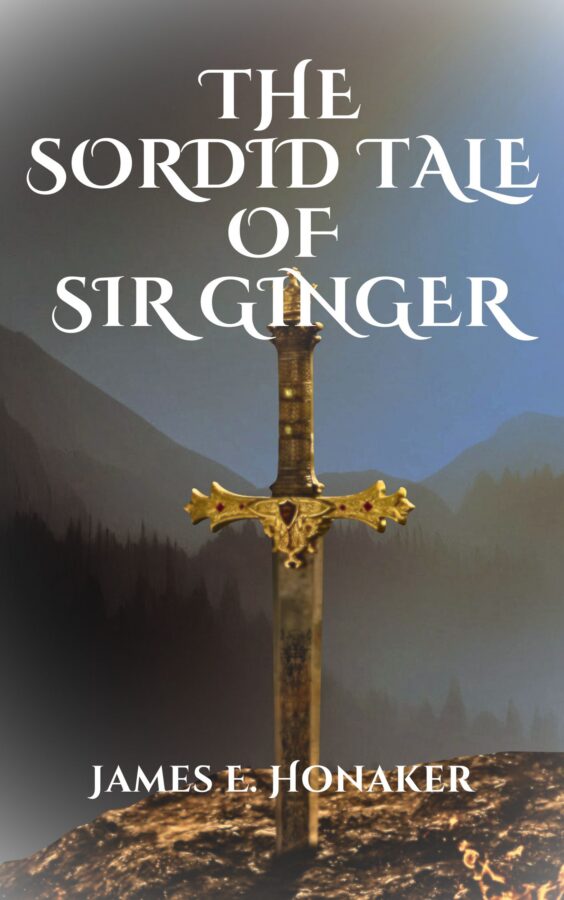
And now for James’ new book: The Sordid Tale of Sir Ginger:
A knight embarks on a journey to rescue a princess from the clutches of a dragon that absconded with her. Only…the knight is cowardly, the princess is thoroughly unpleasant, and the dragon is a pimp.
Sir Ginger is hardly the picture of knightly distinction in Volo, his valor nonexistent and the songs written about him all insulting and pejorative. Nor is he the only knight who alights to rescue the princess after her kidnapping at the hands of a dragon. And yet it is he who gets embroiled in a maelstrom of cultists, fluorescent hydras, and horrors that lurk only in the deepest, darkest nightmares of men. A roguish crew assembles and tags along, interested in what adventure follows the intrepid knight.
The princess Sir Ginger aims to rescue, though, is hardly the demure and mindful kind. And the dragon who absconded with her calls itself a pimp and has nefarious plans for her…
Amazon
Excerpt
It turned out that eastward was, indeed, the destination the princess had been ferried towards. Her captors had wound their way across a diverse landscape before winding up in a rocky, treacherous area known only as “Ore Chasm”. Said chasm was a long, suggestively-carved impression in the rock sheet, and situated in the chasm was a large, multi-tiered building that rose tall and narrow, with a flared base and fairly narrow apex.
Inside the garish and grandiose building, a retinue of goons, clad entirely in dark colors and with obscuring masks, had custody of a gold-plated metal cage, a cage that housed none other than the princess of Volo, currently making quite the commotion protesting against the injustices she was presently being subjected to.
She was not an impressive figure at all, a fairly frumpy and plain-looking maiden with flat, matte brown hair, hazel eyes, and a perpetually disgruntled look that read as incredibly disagreeable and quarrelsome. Her attire was also strikingly plain, with her royal dress a surprisingly modest and neutral garment. The only things that suggested she might even be royalty were a glittering tiara that sat atop her head, a silver ornament set with a number of diamonds, and a simple silver necklace in the shape of the ensign of Volo.
“What is the meaning of this all?” she thundered, looking around in the dimly-lit room and trying to figure out where she was. “This is an affront to me and to my dignity, and I will have all of you executed now if you don’t let me out of this awful thing!”
She did get a response, but it was hardly one she (or anyone else in her position) would have expected. She heard some rustling in the darkness on the other end of the room, and she thought she could make out a large shadow of some kind.
“Aw, hell to tha yeah, bitches!” a voice shrieked. “Y’all done brought me a princess!”
The lights cut on, momentarily blinding the princess, and she shielded her eyes to better adjust to the change. The room revealed itself to be a lavishly-decorated hall with all sorts of red, gold, and silver accents to make as much of an impression of wealth as mere decoration could convey. Opposite her in the hall was a chaise, and a dragon sat upon it.
Said dragon was what appeared to be a gray lung, a long and serpentine dragon with four legs, pronounced whiskers and ridges along its back, a pair of red horns shaped like antlers, a white mane of fur and a matching goatee at the end of its snout, and a long and swishy tail that swished back and forth vigorously. More interesting than the dragon’s physical appearance was what the dragon wore, consisting of a luxurious-looking purple fur cape that draped down its entire back, an inordinate number of chains and necklaces dangling around its neck, and a lot of sparkling and gleaming rings on its various claws.
“Who are you, and who do you think you are, speaking like that in my presence?” she demanded. She wasn’t scared, but instead incredibly annoyed and aggrieved.
“An’ who do you think you is, running yo’ whore mouth at me like that?” the dragon replied. Its voice was easily the most annoying she had ever heard, a high drawling tone with a tendency to draw some sounds out in a particularly torturous way. Coupled with the dragon’s somewhat slurred diction and its fast cadence, she was immediately left with a terrible first impression.
“How dare you! I am the princess of Volo, Clithymenestra, and I…”
“Aw, hold up just a second there, baby! I ain’t calling you by that long-ass name, nuh-uhhhhhh! I’mma call you Clitty instead!”
“Wait…what?” She was horrified, appalled, and taken aback. “That is not my name, and you will not call me that! I am the princess Clithymenestra, and I will not stand for this injustice and affront, being referred to by such a demeaningand disgusting name from a vile creature such as yourself!”
“Man, you’s still thinking you’re back in yo’ crib, ain’t cha, girlie?” the dragon continued. “Thinkin’ that you’s in charge and can just order stuff to happen? Think again, Clitty! You’s as wrong as they get! You’s up in tha Interplanetary Pagoda of Perpetual Pleasure, the most rockin’ and bitchin’ establishment this side of the cosmos, and I is its proprietor, the interplanetary pimp known far and wide as I.M. Trogdor! Yeeeeeeeeah!”
“I.M. Trogdor?” she repeated, confused.
“That’s right, baby, and don’t cha forget it! Imperial Muthafuckin’ Trogdor is gonna be tha pimp to teach yo’ ass! Trust and believe, okcurrrrrrrrrrrr!” He added a tongue pop for emphasis, and the dragon’s tail swished in a way meant to drive this particular point home.
“What are you going on about? Where am I? Where are my servants? Where are my maids? And what’s a pimp?” The princess’s sanctimony had started to give way to legitimate distress, the severity of the situation dawning on her.
“A’ight, boys, get her outta here fo’ now! I’mma need to do some high-quality ruminating up in here! I is a draco-genius, after all, but my genius can’t be rushed! We need to figure out what we gonna do with this primo princess we done got, aw hell yeah!”
The black-clad men wheeled the princess Clithymenestra, still reeling from this appalling exchange with the vile fiend, out from whence she came, and the self-proclaimed pimp dragon continued to swish its tail animatedly and show signs of excitement. She didn’t like what was happening, and she was left hoping that all of this was some terrible nightmare she’d soon awaken from.