
Welcome to my weekly Author Spotlight. I’ve asked a bunch of my author friends to answer a set of interview questions, and to share their latest work.
Today: K.G. Anderson is a technology writer, a frustrated guitarist, and a collector of easy recipes and difficult cats. She lives in Seattle in a house haunted by the bad remodeling decisions of the previous owners. She has reported on politics for metropolitan dailies, reviewed crime fiction for January Magazine, and written about Americana and roots music for the iTunes Music Store. Her short fiction appears in magazines and anthologies including Welcome to Dystopia, Quaranzine, and Alternative Liberties, as well as on podcasts such as The Overcast. Her short fiction collection, Patti 209: Fifteen Tales of the Very Near Future, was published in 2025. For links to more of her work, visit http://writerway.com/fiction
Thanks so much, K.G., for joining me!
J. Scott Coatsworth: When did you know you wanted to write, and when did you discover that you were good at it?
K.G. Anderson: I started out writing consumer complaint letters on behalf of my mother. I think the first one demanded a refund after her vacuum cleaner exploded. Eureka replaced the vacuum cleaner immediately, and thus I was on my road to a writing career.
JSC: What was your first published work? Tell me a little about it.
KGA: Of fiction? I was a journalist for many years, used to writing fast and meeting deadlines. In some ways this helped me when I began to write fiction, but in other ways it held me back. The editor Deborah Doyle worked with me at the Viable Paradise program to break me of telling stories in a flat, journalistic style. She told me to “take off your corset.” Two days later I wrote a story about a human grief therapist called in to help an alien ambassador to Earth after his partner dies. “Grief” appeared in the anthology Second Contacts, which won Canada’s Aurora Award. It was my first published story.
JSC: What do you do if you get a brilliant idea at a bad time?
KGA: I race to my computer and write a few pages, plus a possible ending—enough so that I capture the pace of the story and—especially—the protagonist’s voice. Tom Whitmore, my partner, talks about the time that I got off the phone from an interview with Harlan Ellison for Locus. I waved Tom away, turned to my computer, and wrote the first several pages of “Where the Train Goes.” That story became my first pro sale (to Mike Resnick, for Galaxy’s Edge).
JSC: Are there underrepresented groups or ideas featured in Patty 209? If so, discuss them.
KGA: My new book, Patti 209, is primarily about the underrepresented. Main characters in the stories include a trans politician, an elderly woman trapped in a nursing home, a teenager whose immigrant parents are pressuring her to ignore her ethnic identity so she can “get ahead,” a political prisoner on Death Row, and a woman working two jobs to pay for her husband’s cancer treatments.
JSC: What is the most heartfelt thing a reader has said to you?
KGA: An online reviewer said that he’d never read a story in which someone like him (a cross-dresser) was the hero instead of the victim or villain. He was referring to my story “His Last Victim,” published in The Mammoth Book of Jack the Ripper Stories, about a cross-dressing cop who uncovered the identity of the Ripper.
JSC: What are some day jobs that you have held? If any of them impacted your writing, share an example.
KGA: I’ve been a library assistant, bakery employee, grocery store clerk, coffee shop waitress, nude art model, pop music critic, ghost writer, newspaper reporter, technical editor, desktop publisher, magazine editor, grant writer, greeting card designer, social media consultant, conference organizer, and humor columnist. I was part of the team that redesigned the King County buses and I wrote content for Apple’s iTunes Music Store. Most recently, I wrote about home design for the Seattle Times and cats and cat products for Rover.com. The jobs that most inspired my writing were waitress and journalist—both are jobs in which you learn a great deal about other people, and get to discover a lot of secrets.
JSC: We know what you like to write, but what do you like to read in your free time, and why?
KGA: I read mysteries, primarily the works of Georges Simenon, Arthur Upfield, and K.C. Constantine. In the speculative fiction field, I read Ben Aronovich, Jo Walton, and David Gerrold.
JSC: What qualities do you and your characters share? How much are you like them, or how different are they from you?
KGA: My characters are problem solvers and keen observers (or at least, they think they are—what they fail to notice, or fail to fix, is often the flaw that drives the plot). In that way, they are very much like me. Where we differ is that my problems and challenges are pretty mundane, while theirs are usually life-threatening. My characters’ lives are far more interesting than mine!
JSC: What fantasy realm would you choose to live in and why?
KGA: Discworld. I’d like to work at the Ankh-Morpork Opera House—or as a reporter for the Ankh-Morpork Times.
JSC: What are you working on now, and what’s coming out next? Tell us about it!
KGA: I’m writing a novel about a powerful witch who’s trying to choose the right successor to inherit her library, her secrets, and her magical cat. This turns out to be far more difficult than she’d imagined because the world of magic itself is under attack by evil forces she’s neglected to confront. If this plot sounds political, it is.
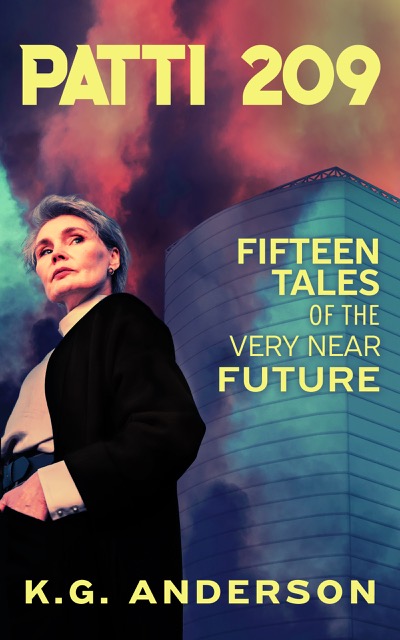
And now for K.G.’s latest book: Patti 209:
Patti 209: Fifteen Tales of the Very Near Future
The 15 short stories in this new collection by K.G. Anderson tackle the classic science fiction query: “What if this goes on?” Her answers span magic realism, humor, science fiction, horror, and fantasy. Each story is firmly rooted in the familiar present and moves seamlessly into a very near political future—chilling in most cases, but darkly humorous in others. They illuminate the many possibilities for resistance.
Amazon
Excerpt
Excerpt from “The Right Man for the Job,”
in Patti 209: Fifteen Tales of the Very Near Future
The chief of staff for a U.S. senator paused in the kitchen doorway, a bottle of chilled Sauterne in each hand. “I can’t believe we’ve come to this,” he said.
His wife, a political advisor to the 2016 Clinton campaign, pulled trays of desserts out of the stainless steel refrigerator. “You mean Trump?”
“No!” With a jerk of his head, he indicated the formal dining room down the hall of their Silver Spring home. “I mean a séance. Really?”
His wife, her features drawn with stress and exhaustion, shrugged. “Why the hell not?” she asked. “People keep saying ‘If only Molly Ivins were here! If only Walter Cronkite could see this!’ So I figured, why not? We’ll call them back to help us!”
“But…a séance?” her husband said.
“You have a better idea?”
He shrugged. Together they entered the dimly lit dining room and joined the ten high-ranking Democrats seated around the damask-draped oval table. Conversation stopped when a middle-aged woman in an evening gown, shawl, and black silk turban appeared in the opposite doorway. She took the chair at the head of the table and extended her be-ringed hands to the guests on either side of her.
“Turn off ze lights,” she said. “And ve shall begin.”
The host, seated at the foot of the table, leaned over and whispered to his wife. “Nice touch, the Eastern European accent. I hope she’s not a friend of—.”
“Shut up, dear,” his wife hissed. She clasped his hand, somewhat more tightly than necessary, and the séance began.