Welcome to my weekly Author Spotlight. I’ve asked a bunch of my author friends to answer a set of interview questions, and to share their latest work.
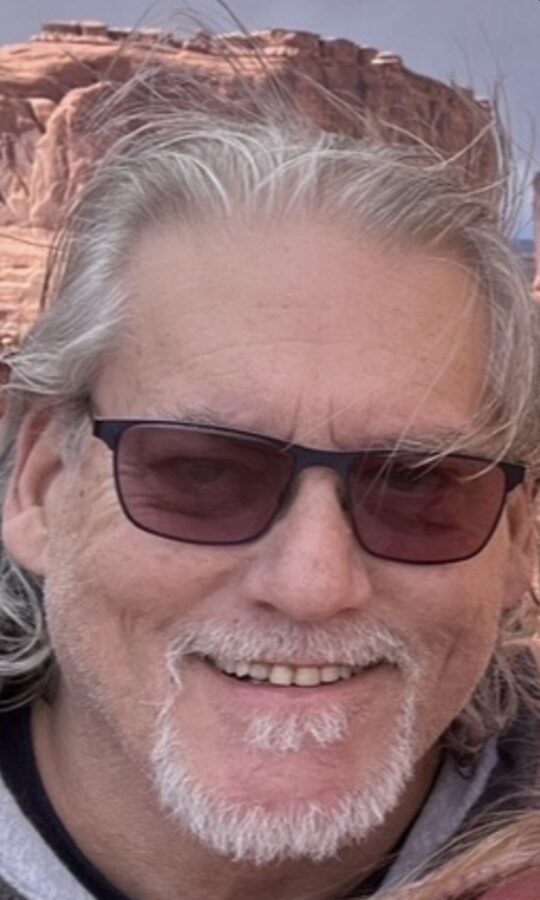
Today: Samuel Freedman is a writer of both fiction and non-fiction. His latest science fiction novel “Revision: The Dawn of Awareness,” released in July 2025, explores questions about humanity’s place in the universe, our purpose, and what actually makes us human. Focusing on new discoveries in the fields of genetics and astrophysics, this mind-blowing story is set in the present day. It will have you rethinking everything you thought you knew about mankind’s past, present, and future.
His epic four-book series, “Venerable,” a work of social science fiction, explores alternative social and political structures. The series brings us into a future utopian society, which inevitably still presents its citizens and leaders with challenges, which are amplified when a dark secret is exposed. Will they survive this revelation, or will it ultimately destroy them? This thought-provoking tale is presented in a fast-paced action and adventure narrative that entertains and informs the reader, both intellectually and emotionally.
Freedman’s work explores cutting-edge hard science, sociology, political systems, philosophy, spirituality, and the continuing evolution of mankind. His first book, “See It My Way,” tells the story of his blind daughter’s childhood from her perspective.
When he is not writing his next novel, Sam also enjoys painting, spending time with his family, traveling the world, and riding rollercoasters.
https://www.facebook.com/VenerableSeries
https://www.instagram.com/samuelfreedman_author
https://www.linkedin.com/in/samuel-freedman-3086639
Thanks so much, Samuel, for joining me!
J. Scott Coatsworth: Do you ever base your characters on real people? If so, what are the pitfalls you’ve run into doing so?
SF: Almost all of my characters are based on aspects of different real people. That’s the only way I know to make them feel authentic. The only pitfall is making sure I convey everything necessary for the reader, since I know the real people I may have blind spots.
JSC: How long do you write each day?
SF: I try to write at least six hours a day. It is now my full time job. But it doesn’t feel like work.
JSC: Do you read your book reviews? How do you deal with bad or good ones?
SF: Yes, and fortunately most of them are good. I have only one really bad review and it was also the longest one, paragraph after paragraph about how the story made no sense. It made me laugh. I use the good ones in my marketing.
JSC: Why did you choose to write in your particular field or genre? If you write more than one, how do you balance them?
SF: I grew up in the sixties and early seventies and was captivated by science fiction at a very early age. I vividly remember reading Michael Crichton’s first novel, “Andromeda Strain” at the age of 12 in 1969. And this was just a few months after the first moon landing. I read it straight through. Didn’t come out of my room for two days. I have also written a couple of non-fiction books in the past, but Sci-Fi has always been my primary genre.
JSC: What inspired you to write this particular story? What were the challenges in bringing it to life?
SF: I have always been fascinated by the evolution of the human mind and had an idea of what may have played a hand in it. It required hours of research in biology, genetics, and chemistry to make the story authentic and believable. I prefer hard science fiction, both to read and write. That’s why Michael Crichton had such an impact on me.
JSC: If you had to write an entire story without either action or without dialogue, which would you choose and how would it go?
SF: Without action. As explained below, I am now adapting the novel into a screenplay, which requires that dialogue carries the entire story.
JSG: What other artistic pursuits (if any) do you indulge in apart from writing?
SF: I enjoy painting. I mostly dabble in acrylic on canvas with some multi-media to create unique abstract paintings.
JSC: What are some day jobs that you have held? If any of them impacted your writing, share an example.
SF: I retired from a career in sales, marketing, advertising and magazine publishing in 2021. I wrote ad copy, newsletters, press releases, etc. Wouldn’t even know where to start for an example. I was a journalism major in college, as well.
JSC: Star Trek or Star Wars? Why?
SF: Both, because they are both epic. It’s like, would I rather have lobster or filet mignon. Can’t I have both?
JSC: If you could choose three authors to invite for a dinner party, who would they be, and why?
SF: Michael Crichton, Kurt Vonnegut, Philip K. Dick. If I could have one more it would be Dean Koontz. These are my favorite authors and I would just enjoy picking their brains.
JSC: What are you working on now, and what’s coming out next? Tell us about it!
SF: I am currently adapting my latest novel “Revision: The Dawn of Awareness” to a screenplay for a feature film.
My next novel is entitled “Port Ascension: The Isolation of Ganymede.” A mining colony on Jupiter’s largest moon is cut off from the rest of civilization as the result of a cataclysmic event. It will be published in 2027.
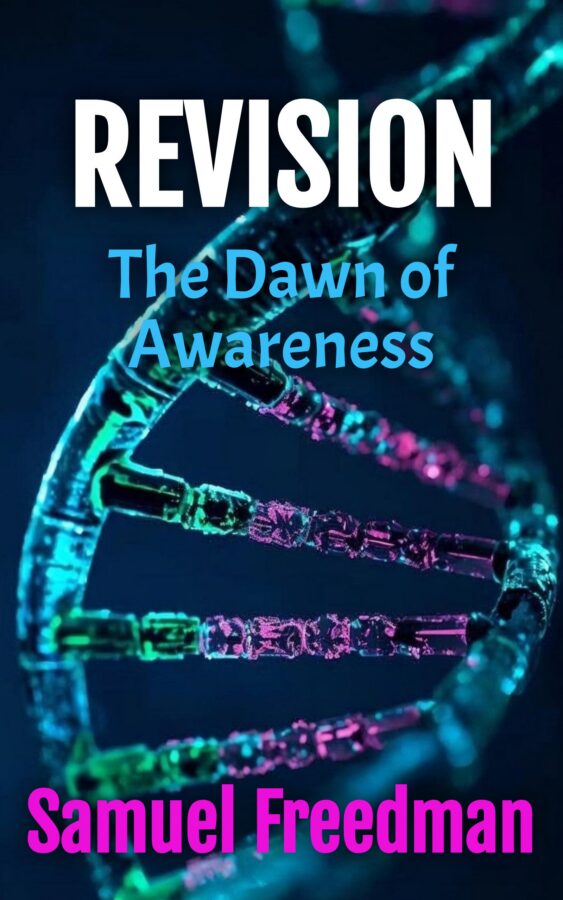
And now for Samuel’s latest book: Revision: The Dawn of Awareness:
What if everything we believe about humanity is wrong?
When scientists discover an alien object orbiting Venus that is possibly related to a shocking new discovery about human DNA, they race to explain and understand the connection, which threatens everything we think we know about what it means to be human, before the chilling information is leaked to the public, creating worldwide panic.
Discoveries that could rewrite human history…
These shocking discoveries may answer age-old questions about human consciousness and mankind’s place in the universe. What makes us human? Why are we here? Are we alone?
Amazon
Excerpt
The rest of the lab faded away around her, Leonid and Elena vanished into their own task-oriented worlds, and Anna settled into what she called the “zone,” where she felt at one with the digital world she was connected to, at ease with her role of simply being another, though more intelligent, input and output “device” with a specific function.
The upper monitors contained static images from the previous day’s scans, which Anna could advance to the next image in the sequence when she completed analyzing each one. To the untrained eye each image on the left monitor appeared to be of a long blue-gray silvery worm. This worm had numerous dark ridges coiling along its length, resembling black pinstripes on a very tall barber pole. These worms were chromosomes, each dark ridge a coil of DNA.
The monitor on the right contained an image that was magnified another magnitude of one thousand, the screen filled completely by the width of one dark ridge, which now resolved into the familiar lumpy ladder-like DNA molecule. At this level of magnification, each gene along the strand was too large to fit on the screen. In fact, for the first time, individual pairs of nucleotides, or base pairs, could be distinguished as shimmering lumpy nodes making up the steps on the twisting ladder. The fuzzy Guanine/Cytosine pairs appeared a deep green color, the Adenine/Thymine pairs seemed smoother and appeared a lighter blue. The visual characteristics were computer enhanced and colorized for better interpretation by the human eye, and the effect was spectacular.
The axon Anna was analyzing was connected to a neuron collected from the most primitive region of the human cerebral neocortex. The sudden rapid growth of this area of the brain is what ultimately resulted in the higher species-specific brain functions of homo sapiens, separating them from other primates. It was estimated that this much more rapid development began in the homo lineage approximately 2.5 million years ago. To date there was no clear understanding of exactly when or how this unique change was initiated, or precisely what environmental factors affecting the natural selection process accounted for it. Finding the answer to this mystery was her life’s quest.
She read, processed, and recorded the data incredibly rapidly, moving the data and accompanying images across the screens every one or two minutes. After about an hour she was ready for a short break, her eyes beginning to fight against her, the lids getting heavy. But then some intriguing data appeared on the screen. The general pattern had changed, and new combinations she was not familiar with appeared. She backed up to the previous screen and went through the section again.
The anomalous region contained unfamiliar nucleotide codes. According to the data, the pairs were not made up of Guanine and Cytosine, or Adenine and Thymine, but something else.
Her eyes were drawn to the image on the upper right monitor. These molecules appeared out of focus in the image, as if the software were struggling to interpret them. Instead of appearing a greenish or bluish hue, the area was represented with various shades of red, from pink to scarlet and dark maroon, undulating along the strand.
Her sudden cry echoed throughout the lab. “Leonid!”