Welcome to my weekly Author Spotlight. I’ve asked a bunch of my author friends to answer a set of interview questions, and to share their latest work.
Today: T. C. Weber has pursued writing since childhood, and learned filmmaking and screenwriting in college, along with physics and ecology. His published novels include Sleep State Interrupt (the first book of the near-future War for Realitycyberpunk trilogy), The Wrath of Leviathan (the second book of the trilogy), Zero-Day Rising (the trilogy finale), Born in Salt (a character-oriented alternate history novel), The Survivors (a post-apocalyptic cli-fi horror novella), and The Council (a satire of local government and politics). His latest novel is The Others, an undersea science fiction action-adventure set off the Florida Keys.
Mr. Weber is a member of Poets & Writers, the Science Fiction & Fantasy Writers Association, the Horror Writers Association, and the Maryland Writers Association. By day, Mr. Weber works as an ecologist, and has had numerous scientific papers published. He lives in Annapolis, Maryland with his wife Karen. He enjoys traveling, hiking, and diving, and has visited all seven continents.
For book samples, short stories, and more, visit https://www.tcweber.com/
Website: https://www.tcweber.com/
GoodReads: https://www.goodreads.com/author/show/15548787.T_C_Weber
YouTube: https://www.youtube.com/channel/UCN5yA42ewy7OMleBIL9pMsg
Facebook: https://www.facebook.com/TheFreedomThorn
Instagram: t_warbler
Thanks so much, T. C., for joining me!
J. Scott Coatsworth: How would you describe your writing style/genre?
T. C. Weber: I write in a lot of different genres, but mostly in speculative fiction; specifically, science fiction, alternate history, and horror.
JSC: What was your first published work? Tell me a little about it.
TCW: My first published novel was Sleep State Interrupt, a near-future cyberpunk thriller that was the first installment of a trilogy. In Sleep State Interrupt, a giant media corporation has taken over the Internet, created an addictive virtual reality called BetterWorld, and controls nearly all information. Politicians do their bidding and a brainwashed humanity serves a privileged few. Waylee Freid, an unemployed Baltimore journalist with ever-worsening bipolar disorder, is the only hope for a brighter future. She and her countercultural friends bust a notorious teenage hacker out of jail and sneak into a closed presidential fundraiser at the Smithsonian castle, where they hope to record incriminating admissions that will wake up the world. Hunted by Homeland Security, Waylee and her friends must reach a sufficient audience by broadcasting their video during the Super Bowl. But to do so, they’ll have to break into one of the most secure facilities ever built. This novel was a 2017 Compton Crook Finalist for best debut science fiction novel.
JSC: What’s the weirdest thing you’ve ever done in the name of research?
TCW: I wouldn’t call them weird things, but for many real-life settings, like the Smithsonian Castle, DC City Hall, a county council building, etc., I go inside, explore them, and take photos, including in off-limits areas. The key to wandering around someplace is to act like you belong there. I also use a more legit approach, to find a contact and say I need to do research for a book.
JSC: Do you use a pseudonym? If so, why? If not, why not?
TCW: It’s not a pseudonym, but I use my initials (T. C. Weber) because there was already a Ted Weber on Amazon. If I shared the name of a mega-millions author like Stephen King or J. K. Rowling, that would be a different story 😀
JSC: Do you ever base your characters on real people? If so, what are the pitfalls you’ve run into doing so?
TCW: I never base my fictional characters off real people. Instead, I create characters whose desires, goals, background, and personality will drive the plot forward. That said, all fiction derives from the experiences and knowledge of the author, even if subliminally, and character traits and history are informed by the author’s own past and those they know or have observed.
JSC: How long on average does it take you to write a book?
TCW: Novels take me about two years from start to finish. Most of that is editing, which can be a painstaking process, and awaiting feedback from critique partners. I also write short stories, which can be finished in one or two sittings.
JSC: How did you choose the topic for The Others?
TCW: I had recently written a post-apocalyptic horror story and wanted to write something more hopeful. I didn’t set out to convey a message, but the characters and events of the book conveyed messages during the writing process. We depend on the Earth for survival and prosperity, and abuse it at our peril. And humans are neither all bad nor all good, but have the capacity for both, and also have the capacity to overcome past mistakes.
JSC: What inspired you to write this particular story? What were the challenges in bringing it to life?
I hadn’t yet written any stories set in South Florida, where I grew up, and decided to combine my love of cyberpunk with my love of the ocean and scuba diving to create what I call “seapunk.” To bring the story to life, I researched mammalian aquatic adaptations; technical details of U.S. Navy ships, aircraft, and tactics; intricacies of the global financial system; and ways that cyberattacks can affect physical infrastructure. And I spent some time in the specific setting to refresh my memory.
JSC: Who has been your favorite character to write and why?
TCW: I like both of the main characters of The Others, Will and Andreia. Will must overcome the tragic death of his wife and his loss of hope for the future in order to save humanity and the ocean. Andreia must reconcile her subservience to her clan’s leaders and her streak of independence to solve the mystery of her brother’s death and save her people. Their evolving relationship brings out the best of each. Neither Will nor Andreia fully fit into the world they were born in, but together, they can create a world of their own.
JSC: They say to Write What You Know. Setting aside for a moment the fact that this is terrible advice…what do you Know?
TCW: That is indeed terrible advice. Just imagine if fantasy authors had to follow that! One thing all writers know—setting aside LLM’s (“AI”)—is what it’s like to be human. Love, hate, triumph, despair… all the emotions, thoughts, and conditions we share. That is, by the way, why AI stories will always be hollow garbage. As far as specific knowledge, I am a professional ecologist and long-time scuba diver, much like Will Myers in The Others. I’m familiar with the setting also, having dived and fished in the Keys since childhood.
JSC: What are you working on now, and what’s coming out next? Tell us about it!
TCW: I am revising two previously unreleased books and have a sequel to The Others planned, but a techno-horror story about imprisoned immigrants, body part harvesting, and brain chips came to me and is practically writing itself. Stay tuned at https://www.tcweber.com/ !
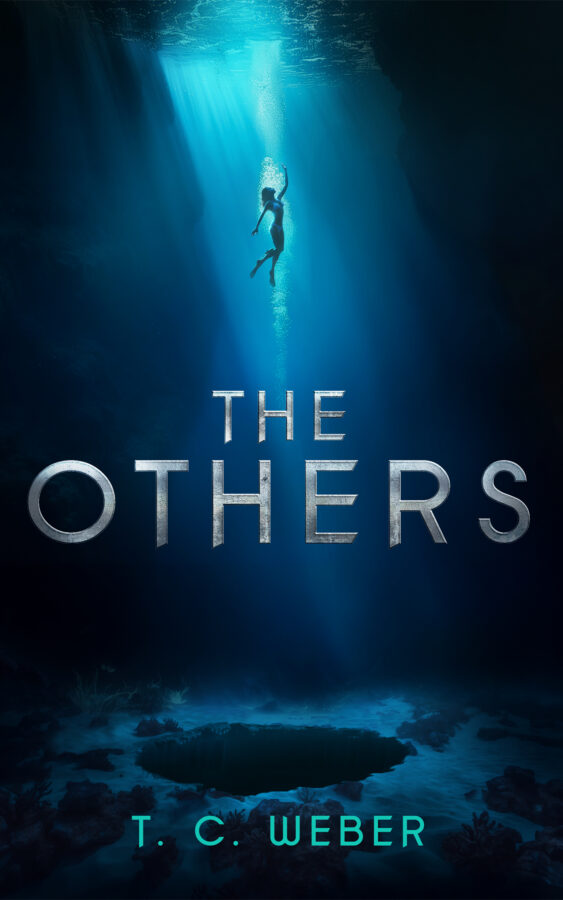
And now for T. C.’s latest book: The Others:
When a corpse with webbed feet and other aquatic adaptations washes ashore during a hurricane, the county medical examiner calls in marine biologist Will Myers for assistance. The deceased’s mysterious sister, Andreia, claims the body and asks Will to help figure out how her brother died. Will and Andreia bond over shared tragedies and a yearning to heal a dying ocean as they seek to learn how her brother spent his final days.
Andreia brings Will to her undersea home, part of a hidden civilization inhabited by smugglers, hackers, treasure hunters, and traders—all members of a different species, driven to the edge of extinction by human diseases and climate change. As feelings between the two grow, the investigation into her brother’s death leads to a sinister plot by a fanatical cabal. Together, Will and Andreia must find a way to save both humanity and the ocean without imperiling the existence of her species.
Amazon | Barnes & Noble | Bookshop.org | Universal Buy Link
Excerpt
The Monroe County Medical Examiner’s Office was on Grassy Key. With the slow traffic, it took Will nearly half an hour to get there.
He’d never been to Eloise’s office before. Two single-story, green-roofed buildings sat connected by a breezeway and surrounded by battered scrub. The hurricane had toppled the electric and floodlight poles, which had been bulldozed out of the way, along with piles of plant debris. The rumbling of a diesel generator sounded from the far side of the buildings.
Will met Eloise in the lobby. She was older than him—about forty—with dark brown skin and close-cropped curly hair, and wore a white lab coat with huge pockets.
“Thanks for coming,” she said.
She led him down a hallway and opened a door with a keycard. They entered a tiled room with stainless-steel cabinets, sinks, and equipment trays. Frigid air blew from ceiling ducts, raising goosebumps on Will’s forearms. The room reeked of formaldehyde and alcohol.
On the metal autopsy table in the center lay the body of a teenage boy, clad only in swimming trunks. Will recoiled at the sight. He forced himself into scientist mode, and noted no visible damage—at least at first glance.
“I took photos and fluid samples,” Eloise said, “but I haven’t opened him up. We’re hoping to find next of kin, but he didn’t have an ID.”
The boy had an oval face, large almond-shaped eyes, a slightly broad nose, shoulder-length dark hair, and smooth, golden-bronze skin. He had a thick chest and muscular legs, like an athlete. But his most distinguishing features were large feet, elongated toes, and thin webbing between the fingers and toes.
Real or fake? Will stepped closer to look.
“Gloves on.” Eloise passed him a pair of latex gloves. “You might want to take the ring off.”
Will twisted off his wedding band, feeling naked and alone without it. He secured it in his pocket, then slipped on the gloves and approached the body.
The feet were wide, especially in front. The toes were at least twice as long as normal—almost like fingers. Bad for endurance running, but advantageous for swimming. The webbing looked and felt like real skin, like that between his own fingers, only reaching all the way to the top joints.
“Take a look at this.” Eloise shone a penlight into the boy’s nostrils.
Inside the hairless interior, the flesh bulged noticeably. Will poked it. It was pretty solid. “Strong-looking nasal musculature. I bet he can—could—close his nostrils easily.”
Eloise handed him an otoscope. “Check out the ear.”
The lobe was a little smaller than normal, with an enlarged tragus—the flap people pressed to block loud noises. The ear canal was short and wide. Through the magnifying lens of the otoscope, the tympanic membrane—the eardrum—was also big. It was undamaged—no signs of rapid pressure change.
“Have you ever seen ears like this?” Will asked.
“Never.”
The eyes were closed, but seemed a little on the large side. “Do you mind if I lift the eyelids?” he asked Eloise.
She pushed them up herself. The pupils were fully dilated, pools of black staring unseeingly at the ceiling. And there was something strange about the iris.
“Do you have a magnifying glass?” he asked.
She pushed over a hefty magnifying glass mounted on a swing arm, and flipped on its ring light, illuminating the boy’s face. Seen close-up, the iris muscles bulged upward, forming a raised berm around the wide pupils.
“It looks like his iris muscles are thicker,” he said.
She peered through the magnifying glass. “Agree. Why would that be?”
Will wasn’t exactly sure. “Maybe some adaptation to see underwater? I’d have to look into it.” He pulled out his cell phone. “Mind if I take some pictures?”
“Go ahead, but you can’t share them anywhere.”
“I know.”
As Will took photos, Eloise asked, “So what do you think?”
He stared at the oversized webbed feet again, one of the most bizarre things he’d ever seen. “He’s evolved flippers, either by chance or genetic tinkering.”
“At least he doesn’t have gills.”
“Gills can’t provide enough oxygen for warm-blooded animals. You’d need 50 gallons of sea water per minute passing through the gills to keep a human alive.” He’d calculated this while an undergrad. “The gills would have to be bigger than the body. That’s why dolphins and whales breathe air.”
Eloise picked up a data pad and started typing, her fingers a blur.
“What’s the cause of death?” Will asked.
“Don’t know yet. Drowning, perhaps. No froth around the mouth or nose, but I’m going to check for water in the lungs. Only marks I found on the outside were postmortem, probably from when he washed ashore.”
“Did you estimate a time of death?”
“Around the time of the hurricane. The body’s past the rigor mortis stage, so it’s been more than 24 hours. Sheriff’s deputy found him against a house on Sunset Drive. He hadn’t been exposed to air long, but the decay rate in salt water is considerably slower. It’s hard to tell how long he was in the water until I run some tests. But decomposition’s minimal, and nothing’s fed on the body, so he died either during the hurricane or shortly before. My guess is, he’s a hurricane victim.”
“Could have come from Cuba,” Will mused. Although that’s 90 miles away. “Or a boat.”
“That’s what I was thinking too. The hurricane passed between Florida and Cuba.”
“Does Cuba have genetic engineering labs?”
Eloise shrugged. “Not my area of expertise. I’m going to open him up now.” She looked at Will. “You don’t have to stay, but it might be helpful.”
Seeing the dead body hadn’t been as bad as he’d feared. It was almost like examining a dead marine animal, which he’d done a thousand times. “I’m fine,” he said. So far.
Eloise donned a surgical mask and hair net, and instructed Will to do the same. She switched on an overhead video camera and narrated, “Resuming examination of unknown male teenager,” and added the current date, time, and other official details.
With a long-handled scalpel, she cut a deep ‘Y’ incision from the front of each shoulder down to the pelvis. Eloise peeled back the skin, pulling the top flap over the face.
Will felt stirrings of revulsion. He told himself, it’s no different from dissecting a sea turtle. He noted the subcutaneous fat layer was thick for someone in such good shape.
Eloise switched instruments and snipped the ribs in half. She set aside the severed sternal plate, revealing the internal organs. With scissors, she cut out the body organs individually and placed them in enamel kidney-shaped pans by the sink at the foot of the long table, narrating her findings as she went.
Next, she sawed open the skull and removed the brain. Will had never seen a human brain before, only props. The bulging folds were yellowish and coated with thick, congealed blood. His stomach turned queasy and he found himself backing away.
Eloise glanced at him. “There’s some Vicks over on my desk. It can help mask the odor.”
Will flushed with embarrassment. “That’s okay.” He forced himself to approach the table again.
Eloise proceeded to weigh the organs and narrate the readings. “They’re all within the normal range for someone his height and weight,” she told Will afterward, “except the lungs, which are slightly larger, and the spleen, which is twice the normal size.” She looked at him as if waiting for feedback.
“The lungs are obvious,” he said, “to store more air.” He tried to remember what he’d been taught in biology classes about spleens. It filters blood… Holds white blood cells for fighting infections… “I’ll have to get back to you about the spleen,” he said.
Eloise resumed her examination, removing and fixing small fragments of each organ for later testing. “There’s water in the stomach, but no food material,” she spoke to the camera. “Intestines empty.”
“So he hadn’t eaten for more than a day before he died?”
“Correct. Bodies typically release stool from the rectum after death, but without muscles pushing it along, whatever’s in the intestines remains.”
She dissected the lungs next. “There’s water in the lungs. Quite a bit.”
“So he drowned?” Will asked.
“Apparently.”
“Isn’t that strange for someone with so many… um, swimming adaptations?”
She met his eyes. “If he was caught in the hurricane, it wouldn’t matter.”
Plausible explanation, but… “Why would he swim in hurricane conditions? It couldn’t have been by choice. Even dolphins and sharks leave the area when hurricanes approach.”
Eloise shrugged. “That’s a question that can’t be answered in the lab.”
“So what happens next?”
“I write a report and send a copy to the sheriff’s office. The remains stay here until claimed by next of kin. If no one claims it, it’s delivered to the anatomical board, and I predict a big fight over who gets to use it for research.”